
Removal and installation
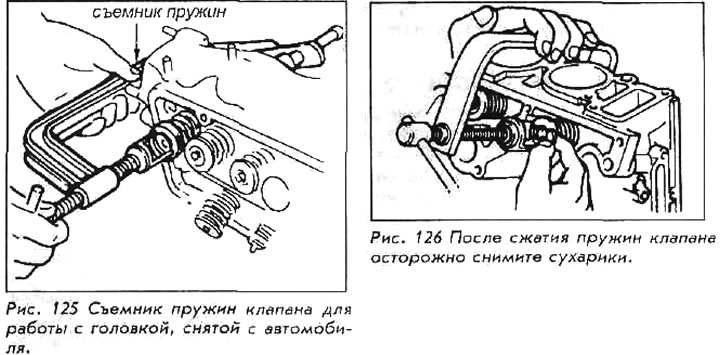
A special puller is needed to remove the valves and springs. A small magnet can be very useful for extracting the spring crackers and support washers.
Place the cylinder head on its side on a stand. Position the spring compressor so that the thrust side of the tool is flat against the valve head in the combustion chamber and the screw side is against the spring plate. Slowly turn the screw toward the plate, compressing the spring. Once the spring is compressed, crackers will appear; collect them with a magnet, as they easily slip out of your hands and get lost. Once the crackers are removed, put the puller screw back and remove the plates and springs. Remove the puller and take out the valves from the other side of the head. Remove the valve stem seals by hand and remove the valve spring support washers with a magnet.
Since it is important that each valve (its spring, retainer, spring seat, and keepers) be reassembled from the same kit, you must keep these parts from getting mixed up. The best way to do this is to make a retainer - cut holes in a piece of hard cardboard. Label each hole with the cylinder number and the valve name Vp. or Vyp. corresponding to the position of each cylinder and valve in the head. As you remove each valve, insert it into the retainer and assemble the washers, springs, keepers, and retainers on the valve stem on the marked side of the retainer. In this way, each valve and its parts are kept together and can be put back into the head in the correct position.
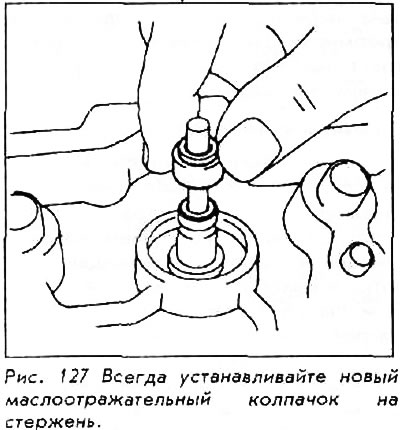
After each valve has been lapped in its seat (see Lapping the Valve), the valve stem is lubricated and each valve is installed in the head in the reverse order of removal, so that all parts except the keepers are assembled on the stem. Always use new valve stem seals.
Install the spring compressor, compress the retainer and spring until the keyway on the valve stem is fully exposed. Fill the groove with grease and install both keys with the wide end facing up. Slowly turn the screw back on the compressor until the spring retainer covers the keys. Remove the tool. Lightly tap the end of each valve stem with a rubber mallet to ensure that the retainers and keys are seated properly.
Inspection
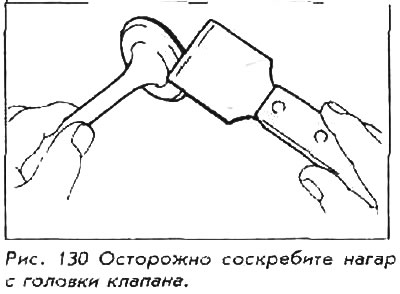
Before the valves are checked, the stem, the lower end of the stem, and the entire surface of the valve and head should be cleaned. Old valves are good for scraping carbon off the valve head, and a wire brush or scraper can be used to clean the valve face and the area between the face and the bottom of the stem. Do not scratch the valve face while cleaning. Clean the entire stem with a rag soaked in carbon remover.
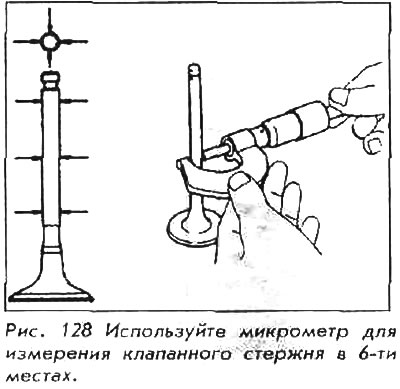
A complete inspection of the valves requires the use of a micrometer and a dial gauge to measure the inside diameter of the valve guides. If these tools are not available, the valves and head can be taken to a shop. Refer to the table VALVE SPECIFICATION to check the valve stems and guides. If the above tools are available, measure the diameter of each valve stem at the top, middle, and bottom. Measure in two directions (looking down on the stem). That's six measurements per valve; record these measurements from top to bottom in order for each valve.
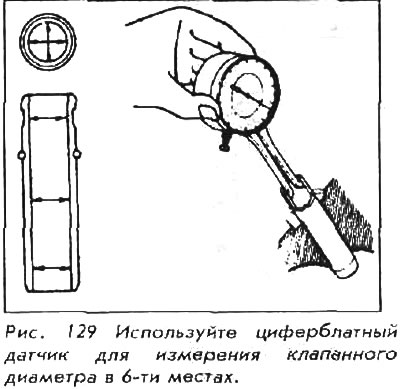
Using a dial gauge, measure the inside diameter of the valve guides at their base, top, and midpoint, again in two directions. Six measurements for each guide; also write down these measurements.
Subtract the measured valve stem size from the measured guide inside diameter; if clearances exceed the specification for rod-guide clearance, replace the valve(s). Rod-guide clearance can also be checked by a machine shop with a dial gauge.
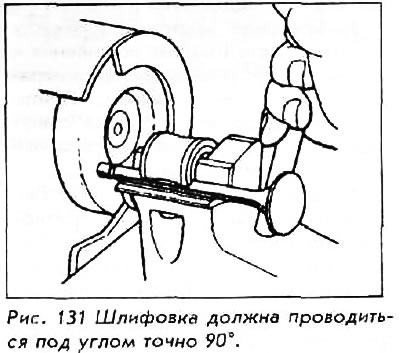
Check the top of each valve stem for pitting, bending, and abnormal wear due to improper rocker arm adjustment. The tip of the stem may be flattened due to wear. If more than a little grinding is required to make the tip flat and smooth, the valve must be replaced. When grinding, be sure to clamp the valve securely in a jig designed for this purpose so that the tip contacts the grinding wheel at exactly 90° perpendicularly. Most machine shops that work on cars are equipped to do this job.
Regrinding
Valve resurfacing should only be performed by a reputable mechanical workshop, as the experience and equipment required for this work are not available to the average car owner/mechanic. When working on valves, resurfacing is necessary when simply grinding the valves into their seats does not correct the wear of the seats and ends. Valve seats can also be trimmed, but this also requires specialized equipment and experience.
Valve grinding
Valves must be lapped into their seats after regrinding to ensure a reliable seal. Even if the valves have not been regrinded, they must be lapped into the head before reassembly. Lapping is nothing more than a very fine polishing of the metal to produce a precise fit between the two contacting surfaces.
Mount the cylinder head on a work stand, combustion chamber side up. Support the head on wooden blocks at each end so that there is 5-8 cm between the tops of the valve guides and the stand.
1. Lightly lubricate the valve stem with clean machine oil. Cover the valve seat completely with valve lapping compound. Use ONLY enough compound to cover the entire seat surface.
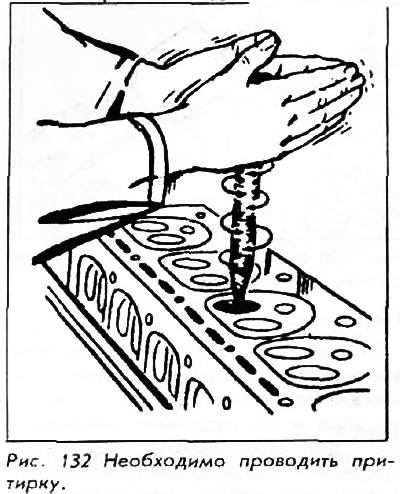
2. Place the valve in its natural position in the head. Attach the end of the valve lapping tool with the suction cup to the valve head. A small amount of saliva in the suction cup will usually help it attach to the valve.
3. Rotate the tool between your palms, changing position and lifting the tool frequently to prevent grooves from forming. Lapping the valve until the valve seat and end are smooth and evenly polished.
4. Remove the valve from the head. Wipe off all traces of lapping compound from the valve face and seat. Wipe the bore with a solvent soaked rag and coat the valve guide with a piece of solvent soaked rag to ensure there are no traces of lapping compound particles inside the guide. This cleaning is important because if the compound is not removed, it will lap parts inside the engine as it runs.
5. Lapper the remaining valves one at a time. Make sure the valve faces, seats, cylinder bores and valve guides are clean before reassembling the valve train.
Valve springs
Inspection
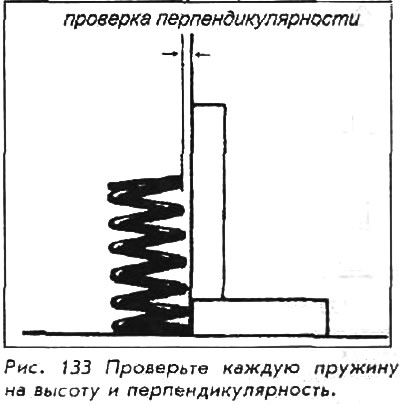
The valve spring perpendicularity, length and extension should be checked during disassembly of the valve train. Place each valve spring on a flat surface next to a steel square. Measure the length of the spring, and rotate it near the edge of the square to measure the curvature. If the length of the spring differs (when compared) by more than 1.0 mm or if the curvature exceeds 1.0 mm, replace the spring.
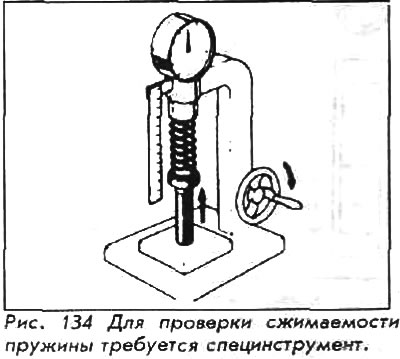
Spring tension should be checked with a spring tester. The springs used on most Honda engines should be within ½ kg of each other when tested at specially set heights.
Article source on the website HONDABOOK