
Contents: Removal ⇊ To install: ⇊
WARNING: These operations involve removal and installation of the timing belt. DO NOT attempt to remove the water pump unless you are familiar with the proper timing belt installation procedures.
Removal
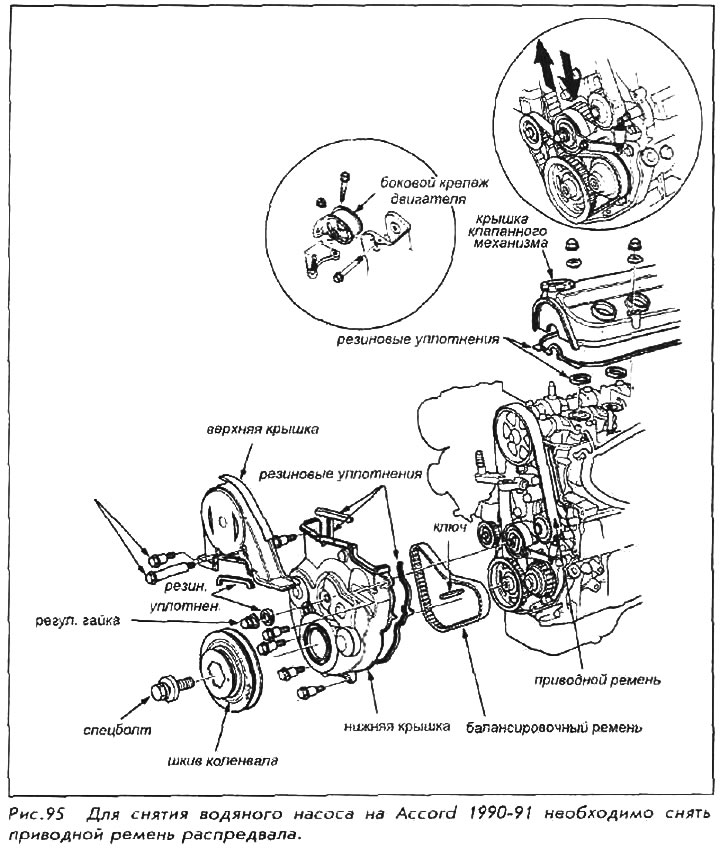
1. Disconnect the cable from the negative battery terminal.
2. Turn the crankshaft pulley so that the piston of cylinder number one takes the TDC position on the compression stroke, check the alignment of the marks on the drive pulleys and the cylinder block. In this position, turning the crankshaft or camshaft is prohibited.
3. Remove the splash guard from below the engine.
4. Drain the coolant from the radiator into a dry, clean container. Seal the container and dry up any spills thoroughly.
5. Disconnect the electrical connector from the cruise control drive and, without disconnecting the cable from the drive, move the cruise control drive out of the working area.
6. Remove the belt from the power steering pump. Remove the pump mounting bolts. Without disconnecting the hoses, move the pump out of the work area.
7. Disconnect the wiring from the generator terminals and remove the wiring harnesses from the valve cover.
8. Remove the adjusting and mounting bolts of the generator and/or compressor, remove the drive belts.
9. Remove the valve cover.
10. Remove the side engine mount bracket, if equipped.
11. Remove the upper camshaft drive belt cover.
12. Support the engine with a jack below the center of the center beam. Make sure that the jack only supports, but does not lift, the beam.
13. Remove the through bolt from the side engine mount and remove the mount.
14. Remove the oil level gauge and its pipe.
15. Remove the adjusting nut.
16. Remove the crankshaft pulley bolt and the crankshaft pulley itself.
This bolt is one of the tightest bolts on the entire vehicle. The pulley can be held in place by the old belt while you loosen the bolt, but you should not support the pulley with the belt you are going to reinstall on the vehicle. This will stretch or tear the belt.
17. Remove the two rear bolts from the center beam. Slowly lower the jack and engine until the lower timing belt cover can be removed.
18. Remove the lower camshaft drive belt cover.
19. There are two belts here: one goes to the camshaft pulley - this is the camshaft drive belt, the other, shorter one, which drives the balance shaft, is called the balance belt, or timing belt. Move the belt tensioner to the side so as to loosen the belts. Holding the tensioner, install the adjusting nut and tighten it so that the tensioner remains in this position.
20. Carefully remove the balance belt and camshaft drive belt without twisting or bending them. Do not allow oil or coolant to come into contact with them. Slide the belts off the pulleys.
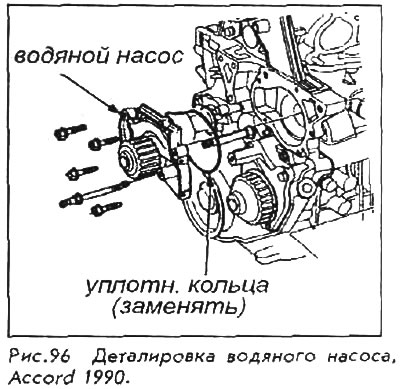
21. Remove the water pump mounting bolts. Note the position of the long bolt.
22. Remove the water pump and sealing ring..
To install:
23. Install a new sealing ring and ensure it is seated correctly. Install the water pump and retaining bolts, tightening them to 12 Nm.
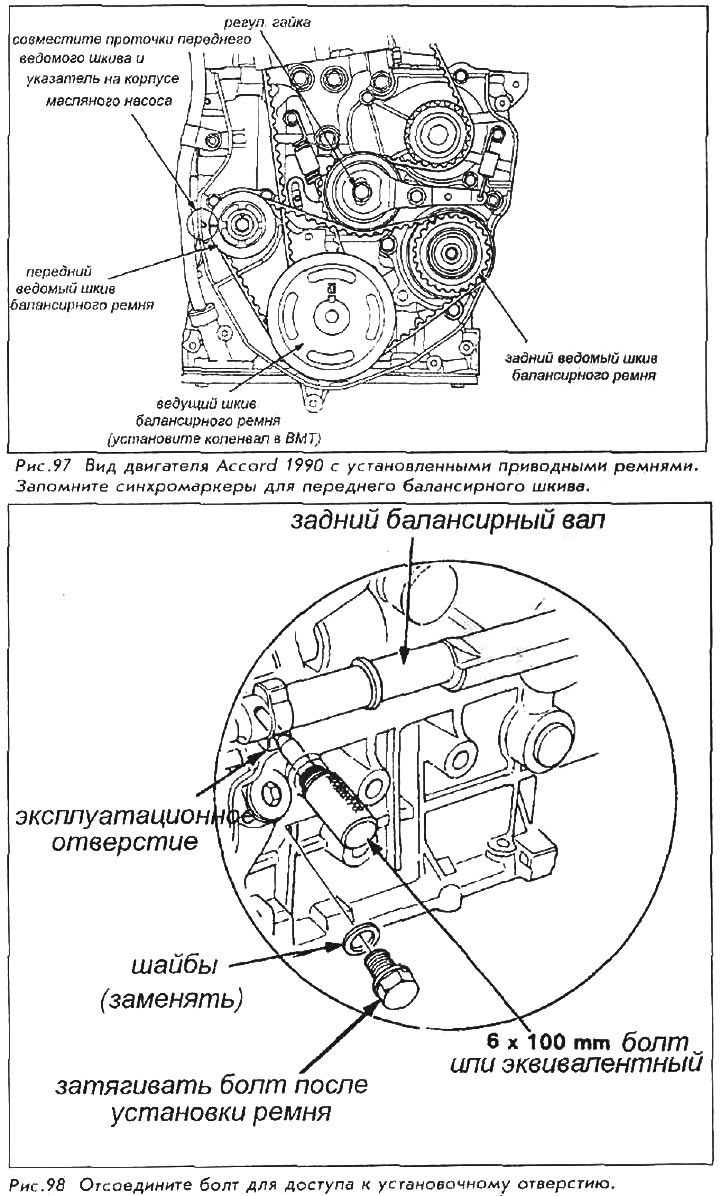
24. Check the crankshaft position: the pointer on the back of the cylinder block should be aligned exactly with the white mark on the flywheel or drive plate (for an automatic transmission). The camshaft pulley should be oriented so that the word "UP" is on top of the pulley and the marks on the edge of the pulley are aligned with the surface of the cylinder head. In addition, the front surface of the front balancer pulley has a mark that should match the mark on the oil pump. This pulley is installed with the mark at "10 o'clock" from the crankshaft pulley, as viewed from the center of the crankshaft pulley.
25. To install the balance shaft correctly, align the mark on the rear balance pulley at 2 o'clock from the crankshaft pulley. To do this, you will need a 6x100 mm rod or bolt with a 74 mm mark on it from the end. Remove the bolt from the service hole and insert the rod into it. Make sure the rod is immersed to the 74 mm mark. This rod will hold the axle during installation.
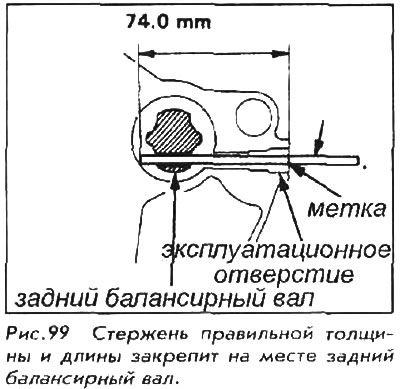
26. Place the camshaft drive belt over the pulley and tensioners. Install the balance belt. Once the belts are in place, double check that all the timing marks have remained the same. If the marks have moved, remove the belts, set the marks, and reinstall the belts. Once the belts are installed, slowly loosen and remove the adjusting nut, allowing the tensioner to move against the belts. Remove the rod from the service hole and install the bolt and washer.
27. Install the bottom cover, making sure the rubber gaskets are in place and correctly oriented. Tighten the retaining bolts to 12 Nm.
28. Lift the lower beam and engine into position. Install the lower beam rear bolts, tightening them to 39Nm.
29. Install the key on the crankshaft and install the crankshaft pulley. Lubricate the bolt threads with oil and tighten to 230 Nm.
30. Adjust the camshaft drive belt tension. Turn the crankshaft counterclockwise so that the camshaft pulley rotates by 3 sectors (teeth). This will increase the camshaft drive belt tension. Tighten the adjusting nut to 45 Nm.
31. Install the oil level dipstick with its pipe.
32. Install the side engine mount fasteners. Tighten the mounting bolt, nut and through bolt to 55 Nm. Remove the jack from under the center (lower) beam.
33. Install the upper belt cover.
34. Install the side engine mount bracket.
35. Install the valve cover.
36. Install the compressor and/or generator drive belt, adjust its tension.
37. Distribute the wiring harness on the valve cover and connect the wires to the generator.
38. Install the power steering pump, tighten the bolt to 45 Nm and install the belt.
39. Install the cruise control drive, connect the vacuum hose and electrical contacts.
40. Double check that all components are installed correctly, paying particular attention to possible loose hoses, loose wires, loose nuts, hose and wire connections that are too tight or too loose, and tools left at the job site.
41. Fill the cooling system.
42. Install the splash guard underneath the engine.
43. Connect the cable to the negative battery terminal.
44. Run the engine at idle speed, checking for possible leaks or the sound of beating belts or any connections.