
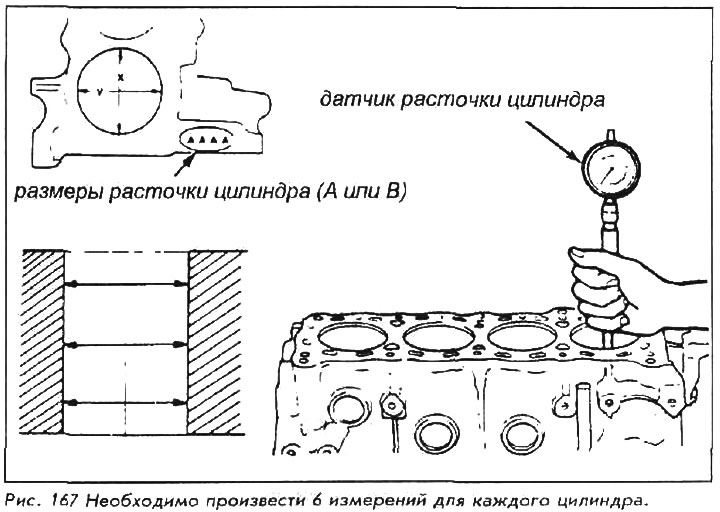
2. If the cylinder bore taper and ovality are within specification and there are no nicks or scratches on the walls, then no boring is required. If this is not the case, then the cylinder will need to be bored to a larger size to eliminate the taper and ovality. In this case, the block should be taken to a workshop for precision machining by a qualified mechanic using specialized equipment.
If you are reboring a cylinder, then be sure to install larger pistons and rings. Since all pistons must be the same size, all cylinders must be rebored, even if only one is outside the table.
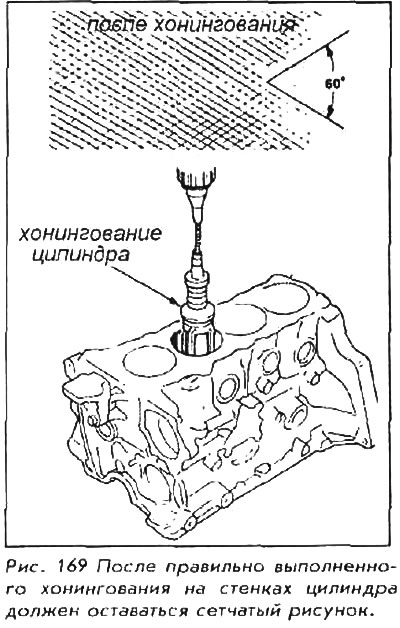
3. Even if the cylinders do not require boring, they should still be honed. A polishing attachment for a regular drill can be used to remove the gloss on the cylinder walls.
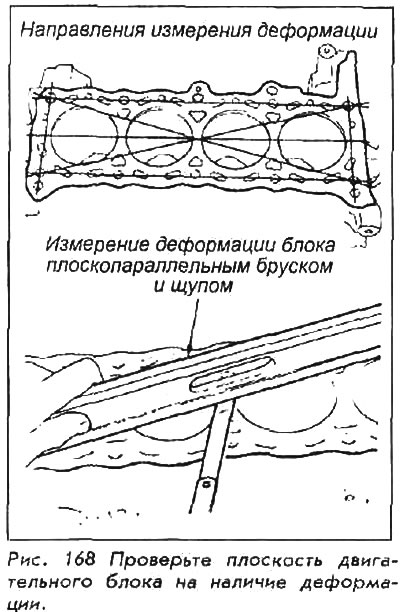
4. The top of the cylinder head (the surface where the gasket is placed) should be inspected for warpage. Run a straight edge along all four faces of the block, diagonally through the center. If you can pass a 0.1 mm feeler gauge under the straight edge, the top surface of the block should be machined or straightened.
5. Remove the rings from the piston using a piston ring remover. Keep all the rings together and the piston from which they were removed. The rings and the grooves in the piston must be completely cleaned with a brush and solvent, as deposits will prevent proper ring wear measurements.
6. Before taking any measurements, inspect the piston (a magnifying glass will come in handy) for any signs of cracks, especially in the skirt area. Anything more serious than light surface scratches means the piston is no longer fit for use. The metal will heat unevenly and the piston may break, especially when the engine is running. If there is a very loud noise, do not risk it, as this can lead to very expensive repairs.
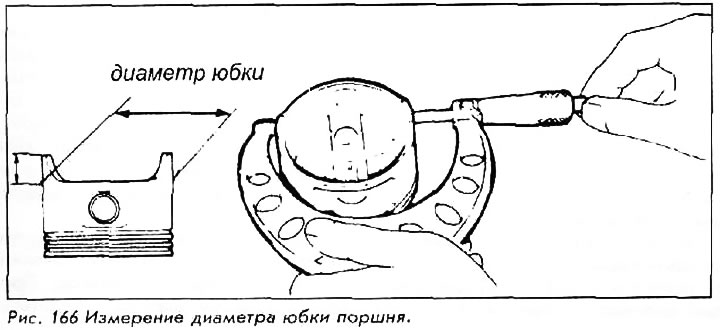
7. The piston diameter is measured on the piston skirt, at right angles to the piston pin.
Compare the measurement with the diameter specified in the table or subtract the piston diameter from the cylinder bore size to obtain the clearance value. If the clearance is above the norm, the piston must be replaced. If the clearance is still not within the table data when installing a new piston, select a larger piston and bore the cylinders accordingly.
8. The side clearance of the compression rings is measured after the cleaned rings have been placed back in their original positions on the piston using a piston ring puller. Measure the clearance by trying to slide a template (with a thickness within the table specification) between the ring and the edge of the ring groove. If the template does not fit into the groove, the ring can be used, although it is always recommended to use new rings. If this template fits, but a template with a greater thickness equal to the wear limit does not, then the piston can still be used, but new rings must be installed.
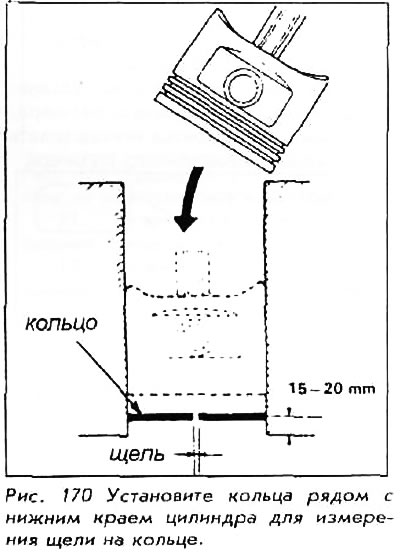
9. Measure the ring gaps for all three rings by placing the piston with the rings in its cylinder, but upside down (top to bottom). The rings should be at least 1520 mm from the base of the cylinder. Use a template to measure the ring gaps and compare the measurements with the table. If the gap is too large, the ring should be checked with a template with a thickness equal to the wear limit. If the cylinder liner wear is small, you can use new rings to bring the ring gaps up to specification without boring the cylinder itself. Measure the gaps by placing the ring near the base of the cylinder, but not near the top, where the wear is greatest.
10. The connecting rods should not be worn, split or bent. Inspect them, especially at the top and bottom. Look for any sign of deformation of the metal or wear. The piston pin should fit cleanly and firmly. When inserted through the upper end of the connecting rod, it should not wobble or roll. The lower end of the connecting rod should also be in the form of an exact semicircle without deformation.