
1. Remember that if you install larger pistons, you will also need to use new rings of the correct size.
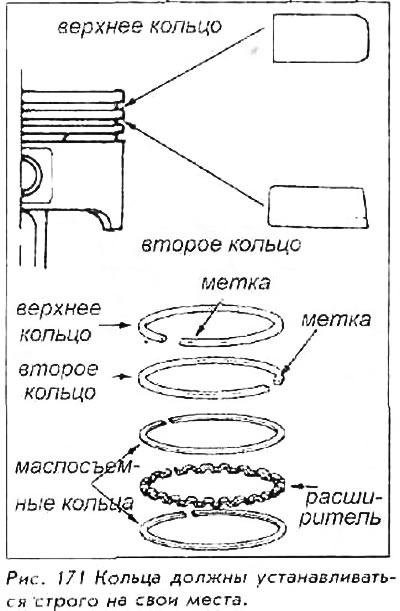
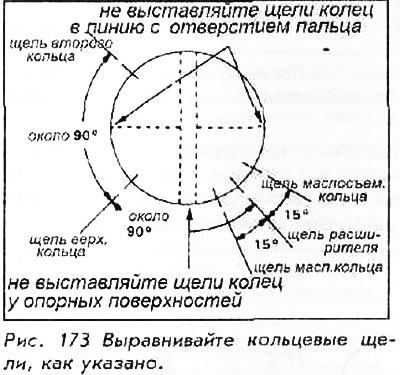
2. Install the rings on the piston, the lowest one first. Usually the oil control ring is installed carefully by hand. Other rings require the use of a piston ring puller. There is a risk of ring breakage or piston damage if a puller is not used. Correct mutual arrangement of the ring gaps is critical to ensure oil scraping. No two gaps should be aligned; they should be evenly distributed around the piston.
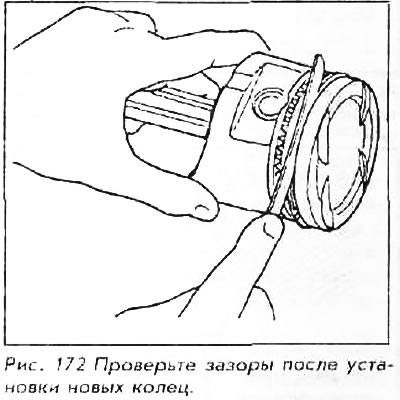
3. Using a piston ring puller, install the number two compression ring and then the top compression ring. Note that these rings are the same thickness but have different profiles; they must be installed exactly in their places. Make sure that all markings are facing upwards and that all ring gaps are correctly spaced. These gaps must also not be located in line with the pin or piston support elements.
4. All pistons, connecting rods and caps must be installed in their cylinders. Make sure all tags and stamped numbers are present and match. Double check that piston rings and connecting rod bearings are installed correctly. Reinstall the pieces of rubber hose on the connecting rod bolts.
5. Generously coat the cylinder walls and crankshaft journals with clean, fresh machine oil. Also lubricate the bearing surfaces on the connecting rod and cap.
6. Locate the FRONT marker on each piston and connecting rod. Place the piston and connecting rod assembly into each cylinder with the markers facing the timing belt. Make sure the number stamped on each piston matches the cylinder number.
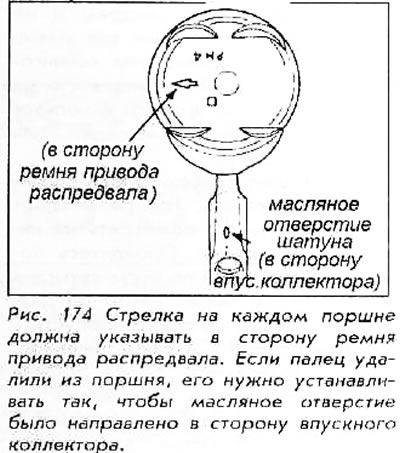
WARNING: Failure to properly position the marker pointing to the front of the engine can result in sudden and catastrophic engine failure.
7. Place the ring compressor around one piston and gently tighten it until the rings are almost completely compressed.
8. Gently press the top of the piston with the handle of a wooden mallet, pushing the piston into the cylinder liner. Once all three rings are in the liner, the piston will begin to move almost freely.
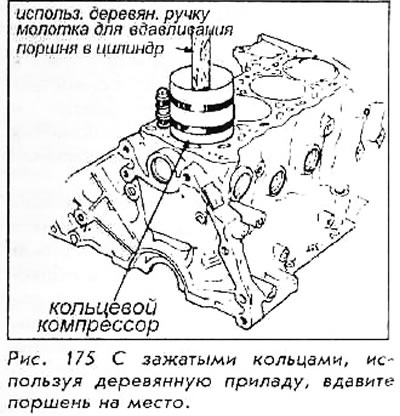
WARNING: If any resistance or binding occurs during installation - DO NOT force. Tighten or adjust the ring compressor and/or reinstall the piston. Brute force will destroy the ring(s) or damage the piston.
9. From below, install the connecting rod in its place on the crankshaft. Remove the rubber hoses from the bolts. Check the connecting rod cap, make sure the bearings are in place and correctly installed, then install the cap (observing the correct number and position) and nuts. Leave the nuts lightly tightened - this will make it easier to install the other pistons.
10. Assemble the remaining pistons in the same manner, repeating steps 7, 8 and 9.
11. After installing all the pistons and lightly tightening all the nuts on the covers, proceed to the final tightening of the nuts. Check the tightening torque with the table provided in this Chapter. Tighten each pair of nuts in 3 steps, alternating the nuts between each other. Each tightening pass should be approximately one third of the final tightening torque; for example, if the final tightening torque is 48 Nm, then the breakdown by steps will be 16, 32 and then 48 Nm. The idea is to install each cover on the crankshaft without distortions and with uniform pressure.
12. Turn the crankshaft a few revolutions, make sure that everything moves smoothly and without catching. When connecting the piston and connecting rod, the crank may be difficult to turn. Try to continuously rotate it evenly so as to eliminate the difficult turning of the crankshaft.
13. Install the oil pan. Even if the engine must remain out of the car for other repairs, install the oil pan to protect the bottom edge. Install all oil pan bolts and tighten them properly.
14. If no further work is required, continue assembly by installing the head, timing belt, etc.
15. When you start the engine after assembly, the exhaust will be very smoky for some time - this is the oil burning inside the cylinders. This is normal; the smoke will quickly disappear as it warms up. Depending on the condition of the spark plugs, they should be checked for oil contamination after the engine is turned off.
16. Reminder: After you assemble the engine, remember that you have an unbroken, essentially new engine - follow the rules for operating unbroken engines.
(The article is based on information from the website «www.HondaBook.ru»)