
The ends of the bearing shells should never be filed flush with the mating surface of the connecting rod and cap.
If the connecting rod starts making noise or is so worn that its clearance on the crankshaft is increased, select and install a new bearing of the correct size. In this case, there is no other way to solve this problem. Under no circumstances should the end of the connecting rod or cover be ground down to compensate for wear.
Inspect the connecting rod bearings at the same time as removing the connecting rods. If the bearings are scratched or peeling, they must be replaced. ANY nicks or burrs on the crankshaft mean it must be replaced.
Bearings can only be replaced according to their standard dimensions, usually marked on the liners or on the connecting rod cap. Do not confuse the mark on the bearing cap with the cylinder number. It is quite possible that the connecting rod of piston #3 contains the number 1, which indicates the code for the size of the hole for the connecting rod bearing. The connecting rod cap may also have the number "1" stamped on it.
Measuring the clearance between the connecting rod bearing and the crankshaft (oil clearance) is done using a plastic measuring tool such as a Plasti-gage or similar product.
1. Remove the connecting rod cap and bearing. Clean the cap, bearings and journal on the crankshaft thoroughly. Blow off any oil from the oil hole on the crank. The plastic tool is oil soluble and will begin to fall apart if the area is not completely clear of oil.
2. Place the measuring strip along the center of the base of the lower liner. Install the cover, liner and tighten the bolts in three passes to the correct torque.
Do not turn the crankshaft after installing the measuring strip.
3. Remove the bearing cap with the shell. The flattened plastic gauge will stick to the shell or to the crankshaft journal. But DO NOT remove it yet.
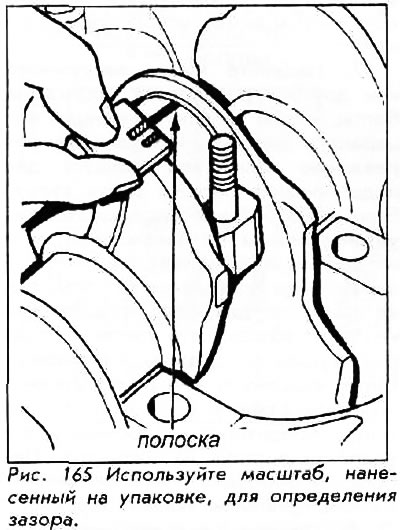
4. Use the scale printed on the gauge package to measure the width of the flattened gauge strip at its widest point. The closest number within the scale to the width being measured will indicate the gap in thousandths of an inch.
5. Check the clearance specification table in the middle of this chapter. If any measurement approaches the maximum allowable value, replace the bearing.
6. If the bearing is OK, remove the gauge, lubricate the entire working surfaces of the bearing and install it in the cap. Install the other half of the bearing at the end of the connecting rod and attach the cap to the connecting rod. Tighten the nuts evenly in three passes to the required torque.
7. If the bearing is installed correctly and the nuts are tightened properly, you can move the connecting rod back and slightly forward along the crankshaft axis. If the connecting rod does not move, this means that the bearing is too small or the connecting rod is overtightened.