
Contents: Evaporative Emission (EVAP) Canister ⇊ Fuel Vapor Absorber Tank Purge Valve…⇊ Control system ⇊
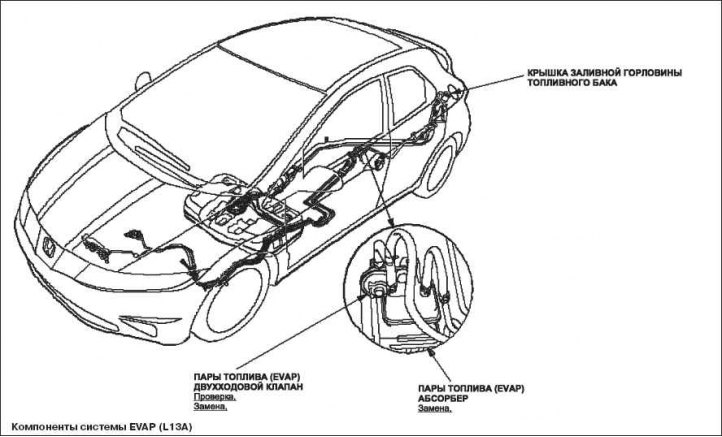
Evaporative Emission (EVAP) Canister
The EVAP canister temporarily stores fuel vapor from the fuel tank until it can be purged from the EVAP canister into the engine and burned.
Fuel Vapor Absorber Tank Purge Valve (EVAP)
When the coolant temperature is below 60°C, the ECM deactivates the EVAP canister purge valve, which shuts off the vacuum supply to the EVAP canister.
Control system
The EVAP canister control minimizes the amount of fuel vapor released into the atmosphere. Vapors from the fuel tank are temporarily stored in the EVAP canister until they can be directed from the canister to the engine cylinders and burned.
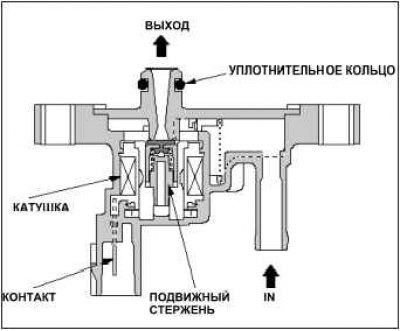
The EVAP canister is purged by introducing fresh air into it, which is then directed into the intake manifold.
The vacuum required for purging is controlled by the EVAP canister purge valve, which is open when the coolant temperature is above 60°C.
When the vapor pressure in the fuel tank is higher than the EVAP two-way valve set point, the valve opens and regulates the flow of fuel vapor into the canister.
The EGR system reduces nitrogen oxides (NOx) in the exhaust gases by bypassing a portion of the exhaust gases through the EGR valve and the intake manifold into the combustion chamber. The ECM memory contains ideal EGR valve position values for various operating conditions.
The EGR valve position sensor detects the amount of lift of the EGR valve and sends this information to the ECM. The ECM then compares this value with the optimum lift value stored in its memory (based on signals received from other sensors). If there is a difference between these two signals, the ECM interrupts the power supply to the EGR valve.
(The original can be found on the resource «HONDABOOK.ru»)