
Examination
1. Remove the ignition coil cover.
2. Label and disconnect the connectors from all 6 coils.
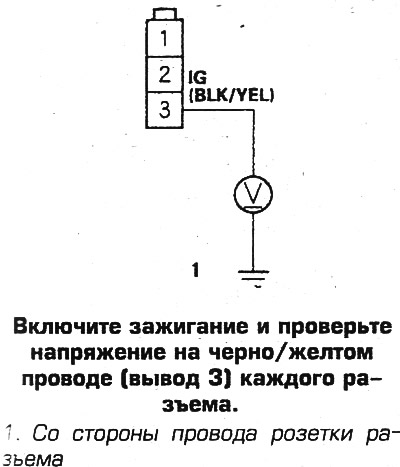
3. Turn on the ignition and check the voltage at the black/yellow wire of each connector. If there is no voltage, check and repair the circuit between the coil and fuse N11, which is located on the left side of the mounting block under the instrument panel.
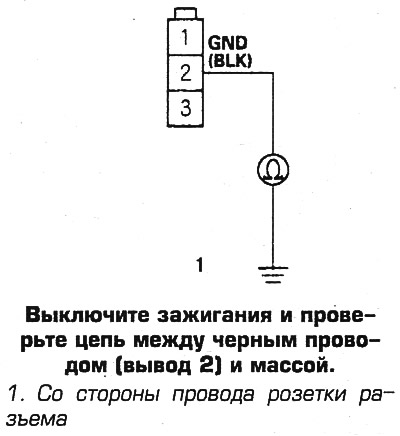
4. Turn off the ignition and check the circuit between the black wire and ground. If there is no circuit, repair the circuit between the coil and ground.
5. If there is a ground circuit, disconnect the 31-pin connector from the processor unit and check the ground circuit at the following connector terminals:
- pin 3, blue wire
- pin 4 yellow/green wire
- pin 12 red/black wire
- pin 13 yellow wire
- pin 4 red wire
- pin 23 white/blue wire
It should be taken into account that the terminals 1-11 of the connector are located in the upper row of the connector (when viewed from the side being connected, the connector key should be facing up, counting from right to left), terminals 12-22 are in the second row, terminals 23-31 are in the third row, the connector sockets for terminals 11 and 24 are empty.
If there is a circuit to ground, then eliminate the short circuit of the corresponding wire to ground.
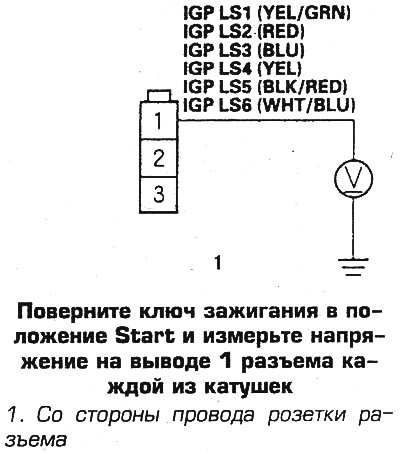
6. If there is no ground circuit, then connect the connector, turn the ignition key to the Start position and measure the voltage at the following terminals of the connectors of each of the coils: blue, yellow/green, black/red, yellow, red and white/blue.
If the voltage is 0.5 V, replace the coil. If there is no voltage, then repair the circuit between the processor unit and the coil.
Removal and installation
1. Remove the clamping coil cover.
2. Label and disconnect the connectors from all 6 coils.
3. Loosen the bolts and remove the coil.
4. Installation is carried out in reverse order.
Electronic ignition module
The ignition module is built into the coil and is replaced together with the coil.