
Rear differential of the car Honda CR-V 2
.

Description of the system
Basic Provisions On models with Real-Time 4WD-Dual Pump System (4 wheel drive with two pumps) the rear differential includes a hydraulic clutch and differential mechanism. Under normal conditions, the vehicle is driven...
Basic Provisions On models with Real-Time 4WD-Dual Pump System (4 wheel drive with two pumps) the rear differential includes a hydraulic clutch and differential mechanism. Under normal conditions, the vehicle is driven...


Hydraulic control system
Starting and accelerating in forward gear (4WD) When starting off or accelerating in forward gear, the dual-pump system can engage all-wheel drive. If the front wheels spin faster than the rear wheels, the front oil...
Starting and accelerating in forward gear (4WD) When starting off or accelerating in forward gear, the dual-pump system can engage all-wheel drive. If the front wheels spin faster than the rear wheels, the front oil...

Testing the REAL-TIME 4WD-DUAL PUMP SYSTEM (4WD with two pumps)
Automatic transmission When starting off or accelerating in forward gears (4WD mode) 1. Raise the vehicle on all four wheels. 2. Place a mark (A) on either propeller shaft #1 or propeller shaft #2 (B). 3. Start the...
Automatic transmission When starting off or accelerating in forward gears (4WD mode) 1. Raise the vehicle on all four wheels. 2. Place a mark (A) on either propeller shaft #1 or propeller shaft #2 (B). 3. Start the...
Table of signs of malfunction
Most faults in a mechanism are diagnosed by analyzing noise in gears or bearings. When performing diagnostics, do not confuse differential noise with noise in other chassis components. Sign of malfunction Probable cause...
Most faults in a mechanism are diagnosed by analyzing noise in gears or bearings. When performing diagnostics, do not confuse differential noise with noise in other chassis components. Sign of malfunction Probable cause...

Checking and replacing differential fluid
1. Stop the vehicle on a level surface and check the differential fluid with the engine off. 2. Remove the plug (A) from the filler hole and remove the sealing washer, then check the condition and level (C) of the...
1. Stop the vehicle on a level surface and check the differential fluid with the engine off. 2. Remove the plug (A) from the filler hole and remove the sealing washer, then check the condition and level (C) of the...

Removal the rear differential
1. Drain the fluid from the rear differential. 2. Mark the propeller shaft (A) and the rear differential coupling flange assembly (B) so that they can be installed in their original positions (C). 3. Separate the...
1. Drain the fluid from the rear differential. 2. Mark the propeller shaft (A) and the rear differential coupling flange assembly (B) so that they can be installed in their original positions (C). 3. Separate the...

Removal and installation the differential housing
1. Loosen the six mounting bolts in a crisscross pattern in several passes, then remove the differential housing assembly (A) and seals (B). 2. Remove any dirt or oil from the sealing surfaces. Apply sealant...
1. Loosen the six mounting bolts in a crisscross pattern in several passes, then remove the differential housing assembly (A) and seals (B). 2. Remove any dirt or oil from the sealing surfaces. Apply sealant...

Replacing seals
1. Remove the oil seals (A) from the differential housing. Note: Be careful not to damage the differential cup when removing the seals. 2. Press in the seals (A) without tilting using a special tool. Do not damage the...
1. Remove the oil seals (A) from the differential housing. Note: Be careful not to damage the differential cup when removing the seals. 2. Press in the seals (A) without tilting using a special tool. Do not damage the...

Disassembling the differential
1. Remove the drain plug (A) and filler plug (B) and remove the sealing washers (C). 2. Bend the lock nut tongue (A) out of the groove of the guide sleeve. To avoid damaging the guide sleeve, make sure the tongue is...
1. Remove the drain plug (A) and filler plug (B) and remove the sealing washers (C). 2. Bend the lock nut tongue (A) out of the groove of the guide sleeve. To avoid damaging the guide sleeve, make sure the tongue is...
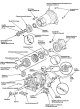
Differential assembly
Rear differential assembly 1. Apply DPSF fluid to the ATF strainer rubber (A), then install the ATF strainer, magnet (B), oil pump pin (C) and seal (D) to the differential cup assembly. 2. Align the tabs (A) of the seal...
Rear differential assembly 1. Apply DPSF fluid to the ATF strainer rubber (A), then install the ATF strainer, magnet (B), oil pump pin (C) and seal (D) to the differential cup assembly. 2. Align the tabs (A) of the seal...

Installing the rear differential
1. Install the rear differential support assembly (A) to the rear differential assembly (B). 2. Place the rear differential on a jack and raise it to the required height for assembly. 3. Install new snap rings (A) onto...
1. Install the rear differential support assembly (A) to the rear differential assembly (B). 2. Place the rear differential on a jack and raise it to the required height for assembly. 3. Install new snap rings (A) onto...

This section is available on: russian, bulgarian, belarusian, ukrainian, serbian, croatian, romanian, polish, slovak, hungarian
Link in different formats to this section
TEXTHTMLBB Code
- General information
- User manual
- Technical data
- Maintenance
- Power unit
- Engine repair
- Lubrication system
- Cooling system
- Exhaust system
- Fuel system
- Engine management
- Engine electrical equipment
- Transmission
- Clutch
- Manual gearbox
- Automatic gearbox
- Rear differential
- Drive shafts
- Chassis and running gear
- Steering
- Front suspension
- Rear suspension
- Brake system
- Body and interior
- Exterior (external elements)
- Interior (internal elements)
- Doors, locks and windows
- General information
- Maintenance
- Tips for car owner
- Power unit
- Engine repair
- Engine overhaul
- Cooling and lubrication system
- Engine electrical equipment
- Control system
- Fuel system
- Transmission
- Clutch and drive shafts
- Car gearbox
- Chassis and running gear
- Front suspension
- Rear suspension
- Steering
- Brake system
- Body and interior
- Body service
- Exterior (external elements)
- Interior (internal elements)
- Electrical equipment
- Equipment and devices
- Electrical circuits