
 |
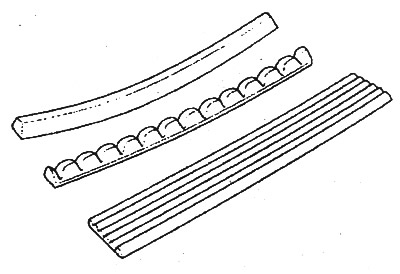
3 types of belts used in cars: 1. V-shaped wedge; 2. Toothed-wedge |
A belt with a corrugated V-shaped profile used on the vehicles in question. The same belt, rotating several units with the inner and back sides, is sometimes called a "serpentine" belt.
Checking the status
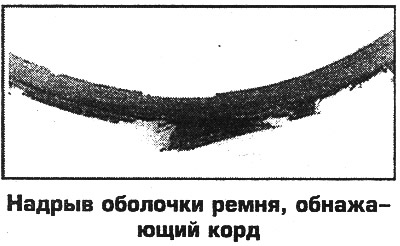
Check belt tension every 24,000 km or 12 months. Check the condition of the belts, the presence of gloss, cracks, peeling of the base and other defects. If the slightest defect is detected, replace the belt. A belt in which tears are observed on at least 2 profile ribs, the length of which exceeds 13 mm, should be replaced.
 |
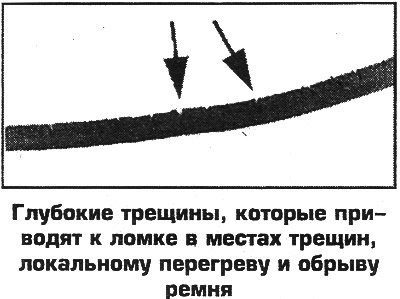 |
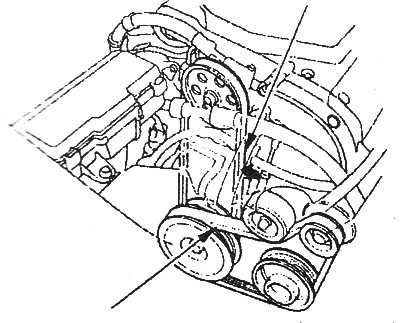
If 1-2 rare cracks are found across the profile ribs (not along!), then further use of the belt is permitted. To check the condition of the belt, there is an indicator on the tensioner lever, which should point to a rectangular mark on the tensioner bracket (photo). If the indicator goes beyond the mark, the belt is stretched to the limit and must be replaced.
Checking belt tension
Corrugated belts
The tension of these belts is checked by deflection when a force of 10 kgf is applied in the middle between the pulleys, on the longest section of the belt. Before checking, disconnect the battery from ground. The belt deflection when the specified force is applied should be as follows.
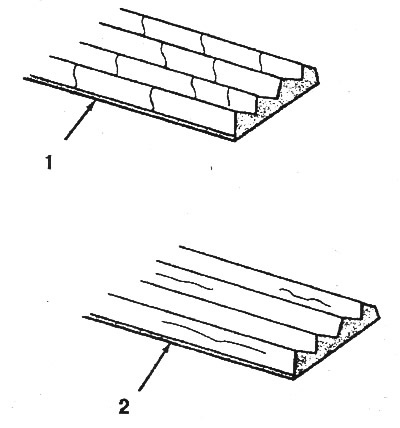
Typical damage to the corrugated belt: 1. Acceptable; 2. Inadmissible |
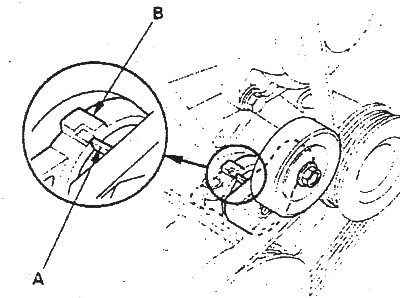
If the indicator A has moved beyond the wear indicator B, the corrugated belt should be replaced (Odyssey 3.5 l) |
CR-V Models
Belts with corrugated wedge-shaped profile
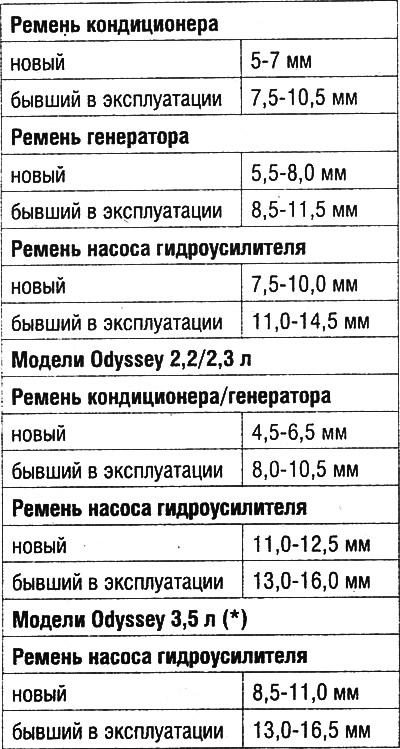
(*) This model is equipped with automatic tensioning of the alternator and air conditioning belts. These belts are serpentine (i.e. they set additional pulleys in rotation by touching it with their back side).
Serpentine belts
The tension of these belts is adjusted automatically by means of a spring-loaded roller.
The tensioner roller is also a wear indicator. When tensioned correctly, the pointer on the tensioner arm is located within a small rectangular area on the tensioner body. If the arrow extends beyond this area, either the wrong type of belt is installed, or the belt is stretched. In this case, the belt should be replaced immediately. If the indicator on the tensioner lever noticeably shifts when the engine is running, you should check the condition of the belt or the elasticity of the tensioner spring. To do this, follow these steps:.
1. Remove the belt.
2. Loosen the bolts and remove the tensioner.
3. Insert M6 bolts into the tensioner mounting holes, clamp them in a vice, and check the tensioner turning resistance moment, which should be at least 23 Nm. Otherwise, replace the tensioner.
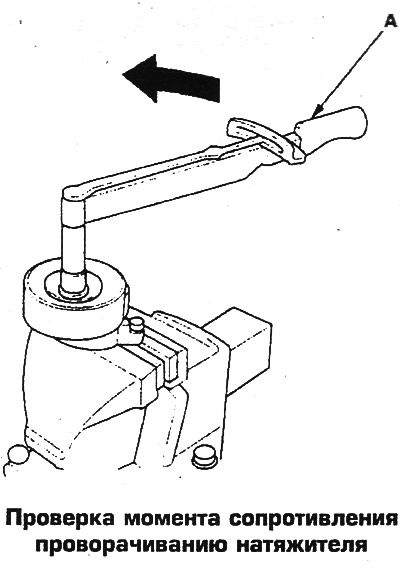
Tension adjustment
Model CR-V
These models use 3 separate belts to drive the generator, compressor and power steering pump.
Air conditioning compressor belt
The belt tension is adjusted by moving the intermediate roller bracket in the slot. The roller bracket is attached to the engine with a bolt and nut.
1. Loosen the roller bracket axle bolt and bracket adjustment groove nut.
2. Turn the adjusting bolt to set the required belt tension.
3. Tighten the roller bracket axle bolt, then tighten the nut.
4. Check the tension, repeat the adjustment if necessary.
Generator belt
1. The tension of this belt is adjusted by turning the generator relative to the axis with the nuts of the axle bolt and the stud for fastening to the bracket loosened. The pin moves in the groove of the bracket.
2. After adjustment, tighten the upper stud nut first, then the axle nut. Check the tension and readjust if necessary.
Power steering pump belt
The pump is attached to the bracket with two bolts and nuts. The upper bolt is axial, and the lower one moves in the groove of the bracket.
1. Loosen the pump mounting nuts (first the top, then the bottom).
2. Turn the pump with a 1/2 inch wrench (approximately 13 mm), inserted into the 4-sided hole in the pump body near the top bolt.
3. After adjustment, tighten the upper axle nut first, then the lower nut. Check the tension and readjust if necessary.
Odyssey Models with 4-Cylinder Engine
The 2.2/2.3L Odyssey models feature a belt with a corrugated profile, one of which is used to drive the generator and compressor, and the other is used to drive the power steering pump.
Alternator/Compressor Belt
The tension of this belt is adjusted by moving the generator in the bracket slot with the nuts/bolts loosened. The upper bolt is axial, and the lower one moves in the bracket slot. The generator moves by turning the adjusting bolt on the lower bracket. Loosen the top nut first, then the bottom one. After adjustment, tighten the top nut first, then the bottom nut. Check the belt tension and readjust if necessary.
Power steering pump belt
The pump is attached to the bracket with two bolts and nuts. The upper bolt is axial, and the lower one moves in the groove of the bracket.
1. Loosen the pump mounting nuts (first the top, then the bottom).
2. Adjust the belt tension by moving the pump by turning the adjusting bolt on the upper bracket. When the bolt is turned clockwise, the belt is tightened and vice versa.
3. After adjustment, tighten the upper axle nut first, then the lower one. Check the tension and readjust if necessary.
Odyssey V6 Models
On these models, one belt is used to drive both the generator and compressor. The tension of this belt is adjusted automatically by a spring-loaded roller. A separate corrugated belt is used to drive the power steering pump. The tension is adjusted as follows.
1. Loosen the right pump mounting nut, then the left one (axle bolt nut).
2. Turn the adjusting bolt to adjust the tension. When the bolt is turned clockwise, the belt is tightened and vice versa.
3. After adjustment, tighten the right nut first, then the left one. Check the tension and readjust if necessary.
Belts - replacement
When replacing the belt, you need to loosen the bolts/nuts securing the unit, loosen and remove the belt. The new belt should be installed so that it fits exactly onto the pulley profile. Clean the pulleys thoroughly beforehand.
Model CR-V
The belts are removed in the following sequence: power steering pump belt - compressor belt - generator belt.
Generator belt
1. Remove the power steering pump and compressor belts
2. Loosen the top nut, then the axle nut.
3. Move the generator towards the engine and remove the belt.
4. Installation is carried out in reverse order. First place the new belt on the pulley with the largest diameter. Adjust the belt tension.
Air conditioning compressor belt
1. Remove the power steering pump belt.
2. Loosen the roller bracket axle bolt and the adjusting bolt nut. Loosen the adjusting bolt counterclockwise until maximum slack is achieved.
3. Remove the belt.
4. Install the new belt in reverse order, first putting it on the pulley with the largest diameter. Adjust the belt tension (including power steering pump belt)..
Power steering pump belt
1. Loosen the pump mounting nuts (first the top, then the bottom).
2. Turn the pump with a 1/2 inch wrench (approximately 13 mm), inserted into the 4-sided hole in the pump body near the top bolt.
3. Remove the belt.
4. Install the new belt in reverse order, first putting it on the pulley with the largest diameter. Adjust the belt tension.
Odyssey Models with 4-Cylinder Engine
Alternator/Compressor Belt
1. Remove the power steering pump belt.
2. Loosen the nuts first, then the lower one.
3. Turn the generator adjusting bolt on the lower bracket counterclockwise to loosen the belt and remove.
4. Install the new belt in reverse order, first putting it on the pulley with the largest diameter. Adjust the belt tension.
5. Install the new belt in reverse order, first putting it on the pulley with the largest diameter. Adjust the belt tension.
Power steering pump belt
1. Loosen the power steering pump mounting nuts (first the top, then the bottom).
2. Turn the generator adjusting bolt on the upper bracket counterclockwise to loosen the belt and remove.
3. Install the new belt in reverse order, first putting it on the pulley with the largest diameter. Tighten the upper pump mounting nut first, then the lower one (axle bolt nut). Adjust the belt tension.
Odyssey V6 Models
Power steering pump belt
1. Loosen the right pump mounting nut, then the left axle bolt nut.
2. By turning the adjusting bolt, which is located on the right side of the pump, loosen the belt tension and remove the belt from the pulleys.
3. Install the new belt in reverse order, first putting it on the pulley with the largest diameter. Tighten the right pump mounting nut first, then the left one. Adjust the belt tension.
Alternator/Compressor Belt
1. To remove the alternator/compressor belt, first remove the power steering pump belt.
2. Loosen the tensioner roller bracket bolt, move the roller away and remove the belt. To move the tensioner roller, you should put a socket head with an extension on the roller axle bolt. First, remove the belt from under the roller, then, holding the roller, remove the belt from the adjacent pulley.
3. After removing the belt from the pulley, carefully return the roller to its original position, avoiding a sharp return under the action of the spring (since in this case the regulator mechanism may be damaged)..
4. When installing a new belt, pay special attention to ensure that the belt profile exactly matches the ribbed profile of the pulleys (photo). Before removing the belt, it is recommended to mark its route to facilitate installation. Adjust the power steering pump belt. When finished, warm up the engine. Make sure the pointer on the tensioner is in the range corresponding to normal tension.
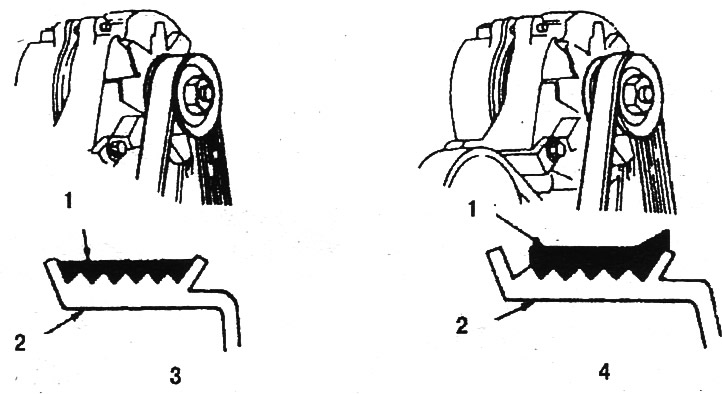
Correct positioning of the belt on the pulley: 1. Belt; 2. Pulley; 3. Correct; 4. Incorrect