
Contents: Tire rotation ⇊ Tire design ⇊ Winter tires ⇊ Tire storage ⇊ Tire pressure and tread depth ⇊ Maintenance of specially designed…⇊
Common sense and good driving skills will help you maximize the life of your tires. Rapid starts, sudden stops, and sharp turns will shorten their life. Always make sure you are not overloading your vehicle and that your tire pressure is correct before any trip, otherwise you will increase the wear of your treads.
Inspect your tires frequently. Pay particular attention to the treads and sidewalls for bulges and deep cuts. Replace tires that have bulges or very deep cuts that reach the cord. Any cut in the sidewall of a radial tire makes it unsafe. Look for uneven tread wear, which will indicate unevenness of the front edge and unbalanced tires.
Tire rotation
Tires must be rotated periodically to ensure even wear, which varies with the position of the tire on the vehicle. Tires also wear unevenly as the front suspension system tilts toward the desired alignment.
Rotation ensures maximum life for the entire set of tires at the same time, since you will not have to replace a single tire if its tread wears out. This is especially important for front-wheel drive vehicles. Since on them, the front tires have to handle everything: traction, cornering, and heavy loads when stopping; they will wear out noticeably faster than the rear ones. Therefore, to even out the wear, a uniform, coordinated alternation is required.
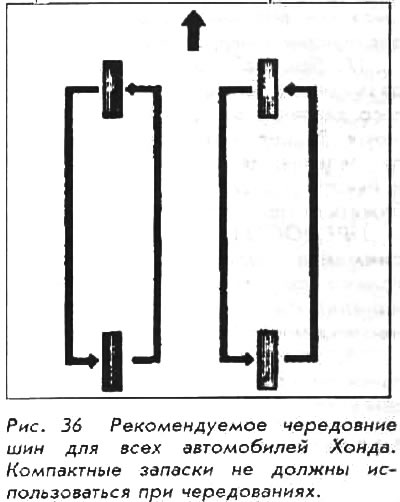
Follow the general rule for radial tires - they should always rotate in the same direction. This means that tires used on the left side of the car should not be interchanged with right-hand ones and vice versa. If a tire or tires are removed from the car for a while due to a puncture, seasonal change, etc., remember which side it (they) is removed from so as not to mix it up when re-mounting. Some wheels have a stylized symbol for this purpose.
The compact spare tire is strictly intended for use in critical situations. It should not be installed for everyday use.
Tire design
The optimal solution is to use a set of four tires. Avoid mixing different types. All Accords and Preludes are equipped with quality radial tires. Always choose this type for replacement.
When using radial tires, they should be selected based on tire size and wheel diameter, based on the need to provide adequate ground clearance and tire loading capacity equal to the specified parameters of the original. Radial tires should always be used in sets of four.
CAUTION: Never use radial tires on the front axle only.
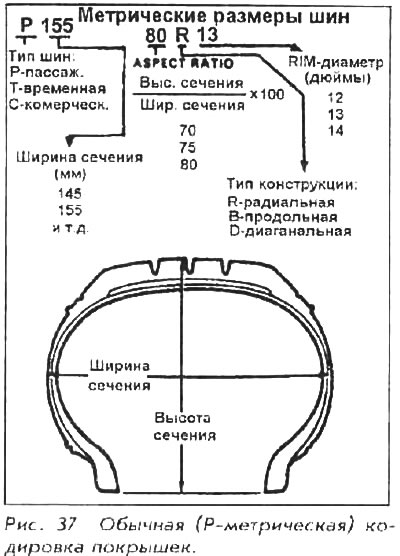
When selecting tires, pay attention to the size indicated on them. Tires on Honda vehicles use an industry size code, sometimes referred to as P-METRIC. This allows the tire specification to be accurately identified, regardless of the manufacturer. When selecting tires of different sizes or brands, remember to inspect newly installed tires for any signs of contact with the body or suspension when the vehicle is stopped, under sharp turns, or under heavy load.
Winter tires
Good radial tires, together with front-wheel drive, give Hondas a big advantage in slippery conditions, but in snow they do not have enough tread width to provide reliable traction and control. Small grooves in the tread quickly fill with snow, and the tire behaves like a billiard ball on a marble field. The more open, large-tread width of the spears of snow tires will self-clean when turning, providing good stability on snowy sections of the road.
Winter tires used on Honda vehicles must be radial construction. Most of these tires are further disguised by either "M+S" symbols printed on the sidewall or the designation "All Season". Generally, no size modification is required when purchasing winter tires. Since the Accord and Prelude are front wheel drive vehicles, the first two winter tires must be installed on the front, although Honda recommends using 4 tires at a time for greater stability. If these tires are installed only on the front, the rear of the vehicle may become very unstable when braking or turning on slippery surfaces. This instability can lead to unpleasant consequences if the driver is unable to counteract the slide in time. Prelude vehicles with 4 wheel drive REQUIRE the installation of 4 of these tires at a time.
Tire storage
All tires should be stored in a cool, dry place. Store tires at the correct pressure if they are mounted on wheels. If they are stored in a garage, do not place them on a cement floor; place them on boards, a mat or a large stack of newspapers. Keeping them away from direct moisture is of utmost importance. Do not store them upright.
Tire pressure and tread depth
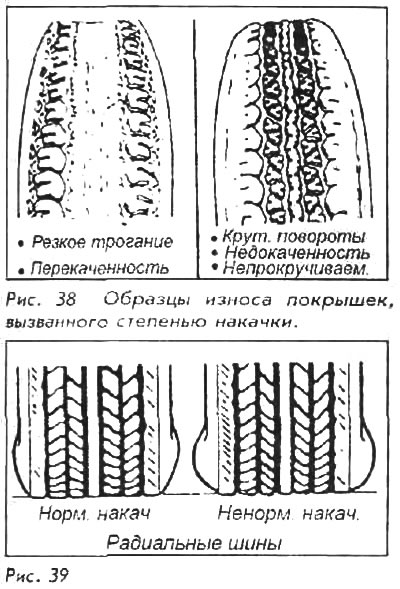
Correctly adjusted tire pressure is an important parameter that affects the operation of your car. The air in the tire is part of the structure. For this reason, incorrect pressure significantly reduces the ability of the tires to perform their intended purpose. Tires lose some air every day; therefore, the need for periodic inflation is not necessarily a sign of a flat tire.
Two items should be kept in the glove compartment at all times: an accurate tire pressure gauge and a tread depth gauge. Check the tire pressure regularly (including the spare) with a pocket pressure gauge. Always check the pressure when the tires are cold, as pressure increases with temperature. If you need to transport the car to check the pressure, do not do it more than one kilometer.
CAUTION: Never exceed the maximum tire pressure stated on the tires! This is the pressure to be used when fully loaded, not for everyday driving. Consult your owner's manual or the tire pressure label (located on the door) for proper tire inflation.
If you have been maintaining the correct tire pressure for a few weeks, you will have become familiar with the individual handling and braking characteristics of your car. Small pressure adjustments will help to optimally adjust the characteristics of the car, but never change the specified cold pressure by more than 13.79 kPa (or 100 mm Hg). A small under-pressure will provide a softer ride, but will also increase fuel economy. More elastic tires will crunch on dry roads, but may slip in wet areas. If you do not have a full "feel" for the car, stick to the recommended air pressures.
All tires made since 1968 have built-in wear indicators that appear when 1.5 mm of tread remains, in the form of 13 mm wide smooth stripes located across the tire. The appearance of this indicator means that the tire needs to be replaced. Many states have laws prohibiting the use of tires with a tread depth of less than 1.5 mm.
You can check the tread depth of your tire with an inexpensive gauge or by using a coin. The same goes for checking snow tires.
Maintenance of specially designed wheels
Whether you have purchased aluminum alloy, magnesium, or just performance wheels, take special precautions to ensure that your investment is not wasted and that your special wheels will last the life of your vehicle.
Specialty wheels are easily damaged and/or scratched. Check the rims occasionally for cracks and collision damage. If you find any, replace the wheel. To prevent this type of damage and costly replacement of a specialty wheel, take the following precautions:
- Pay special attention not to damage the wheels during removal, installation, balancing, etc. After removing the wheels from the car, place them on a mat or other protective surface. If they are to be stored for a long period of time, store them on boards. Never store tires and wheels in an upright position - bedsores may form in the tread.
- Be careful when driving; it doesn't take much to split a tire.
- When washing, use mild soap or detergent. Avoid cleaners with abrasives or using hard brushes. There are many detergents and polishes for special wheels. Use them.
- If possible, remove your wheels for the winter. Salt and sand used to remove snow can severely damage the wheel finish.
- Tighten the lug nuts to the recommended torque, never exceed it or you may split the wheel. Never use snow chains on special wheels; otherwise serious scratches will appear.