


WARNING: Never disconnect the battery with the engine running or the ignition on. This could cause serious and expensive damage to the trip computer. With the ignition off and the key removed for safety, disconnect the negative (-) battery terminal first and reconnect it last.
When the battery is disconnected, various semiconductor devices in the car may lose data in their memory. Be prepared to reprogram your radio and clock.
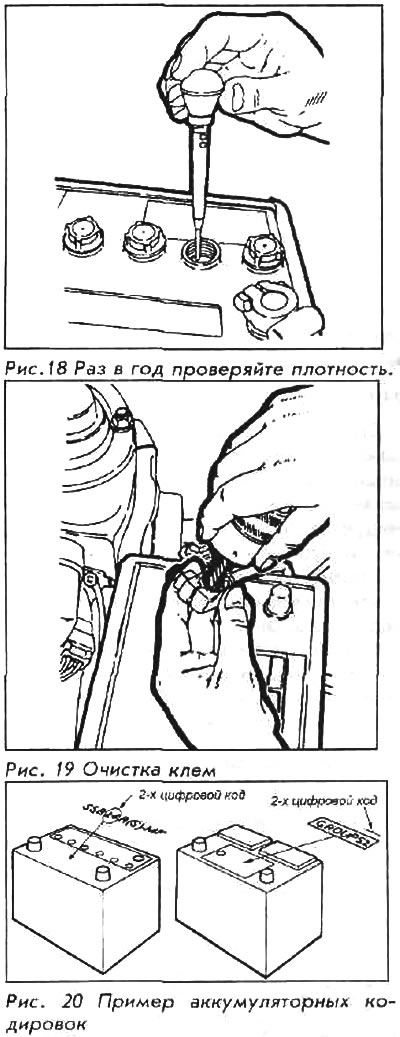
Check the battery cables for fraying or wear, and replace any that are damaged. The cables are easy to clean: accumulated white powder and corrosion can be scraped off the top of the battery with an old toothbrush and a solution of baking soda and water.
Make sure the vent holes in each cap are not clogged with grease or dirt. These holes allow hydrogen gas, which is formed as a result of the chemical reaction in the battery, to escape.
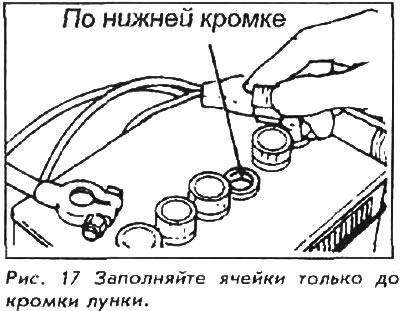
Check the battery electrolyte level at least once a month, or more often in hot weather or during periods of heavy vehicle use. The level should be maintained between the upper and lower marks on the battery case or at the bottom edge of the round opening in each cell. If the level is lower, top up the battery with distilled water. Avoid using tap water; the mineral salts it contains will shorten the life of the battery by reacting with the metal plates inside the battery. Each battery cell is completely independent of the others, so take this into account when pouring in the distillate. To avoid splashing the electrolyte when pouring, it is convenient to use a bulb.
Vehicles that are regularly driven at high speeds and over long distances require more frequent battery maintenance because constant charging causes water to evaporate.
At least once a year, check the condition of the electrolyte. To do this, you will need a hydrometer. The result it shows at room temperature should be between 1.22 and 1.28 g / cm³. If it shows 1.00 g / cm³ or slightly higher, this means that the electrical process has stopped, i.e. there is only water in the battery. In such cases, you need to buy a new battery. You can not simply add acid to the old battery. If water is added in cold weather, you will need to drive several kilometers so that the water mixes with the electrolyte and does not freeze.
If electrolyte splashes out of the battery when adding water, a mixture of baking soda and water can neutralize the acid. Traces of electrolyte should be washed off with cold water after you have made sure that the cell caps are screwed on. Battery fluid is especially dangerous for painted surfaces, so be careful when working to avoid drips on the guard and other painted parts.
If recharging is required and the battery is in the car, disconnect the terminals, especially the negative one. If you have removed the battery from the car, make sure that it is not on bare ground or concrete while charging. A wooden block or a small stack of newspapers will prevent the battery from overcooling during the charging process.
When replacing a battery, the new one must have output parameters equal to or even greater than those of the one being replaced. Do not confuse physical dimensions with electrical capacity. A more powerful battery (capable of delivering more power) does not necessarily have to be larger in size than the original. The size and capacity of batteries is indicated by a two-digit code on the plate or case.
CAUTION: Keep the battery away from sparks or flames as it produces explosive hydrogen gas. Battery electrolyte contains sulfuric acid and if it accidentally comes into contact with your skin or eyes, rinse the affected area thoroughly with clean water.
Most Accords and Preludes come with low-maintenance batteries. But that doesn't mean the battery doesn't need to be inspected and cleaned periodically.
The liquid level on such batteries can be observed through a plastic window built into the side wall of the case. The case has UPPER and LOWER markers pressed into the plastic; the liquid should be between the pines. If there is not enough liquid, you can drink it up. Moreover, some batteries have a peephole or a built-in hydrometer. By visual observation through the peephole, you can judge the battery's condition. If the peephole is green, the battery has some charge, but it is not necessarily full (it may need recharging). When the battery is discharged, it has a black peephole, and in this case the battery needs to be charged.
CAUTION: If the eye is yellow or cloudy yellow-white, do not attempt to recharge the battery. Replace it with a new one.
(The original is located on the website «www.hondabook.ru»)