
HondaBook.ru
Auto companies Volkswagen Auto companies Ford Auto companies Lada Auto companies Skoda Auto companies BMW Auto companies Mazda Auto companies Peugeot
English Русский
Български
Беларускі
Український
Српски
Hrvatski
Română
Polski
Slovenský
Magyar
Bookmark Contacts Sitemap   


Accord Civic Fit / Jazz CR-V HR-V Others Articles
CR-V 1 (1995-2001, petrol) CR-V 2 (2002-2006, petrol)

Control valve (Honda CR-V 2)

  • Main
  • Honda CR-V
  • 2 (2002-2006, petrol)
  • Transmission
  • Automatic gearbox
  • Control valve
0
Contents: Servo valve body ⇊ Hydroaccumulators ⇊
The control valve maintains constant hydraulic pressure supplied from the ATF pump to the hydraulic control system and also supplies fluid to the lubrication system and torque converter. The fluid from the ATF pump passes through channels B and B'. The fluid supplied from channel B flows through the valve opening into cavity A. The pressure in cavity A pushes the control valve to the right, as a result of which the channel to the torque converter and the pressure reducing valve opens. The fluid flows into the torque converter and the pressure reducing valve, and the control valve moves to the left. Depending on the level of hydraulic pressure through channel B, the position of the control valve changes, as does the amount of fluid flowing from channel B' through the torque converter. This process is continuous, maintaining pressure in the line.
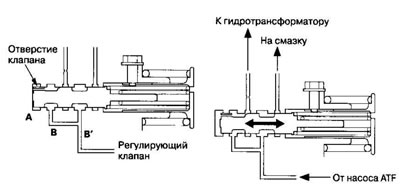
The control valve maintains constant hydraulic…


Note: "Left" or "right" indicates the direction in the drawing.

Note: «Left» or «right» indicates the direction…


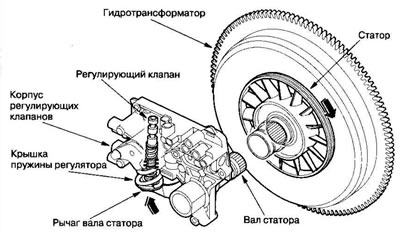
The increase in hydraulic pressure depending on the torque is produced by the control valve due to the reactive torque of the stator. The stator shaft is mounted on the stator splines in the torque converter and the end of its lever touches the governor spring cover. When the vehicle accelerates or moves uphill (torque converter range), the stator reactive torque acts on the stator shaft, and the stator lever pushes the governor spring cover in the direction of the arrow in proportion to the reactive torque. The stator reaction spring is compressed and moves the control valve, which increases the pressure in the line. The line pressure is maximum when the stator reactive torque reaches its maximum value.


Servo valve body


The servo valve housing contains the servo valve, the clutch pressure reserve valve (CPV), the 2nd, 3rd and 4th gear accumulators and the gear shift solenoid valves for valves A, B, C and E.
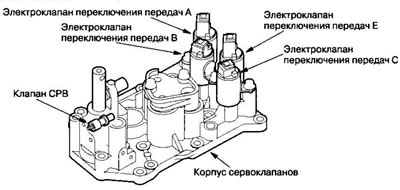
The servo valve housing contains the servo valve,…


Hydroaccumulators


The hydraulic accumulators are located in the control valve housing and the servo valve housing. The 1st gear hydraulic accumulator is installed in the control valve housing, and the 2nd, 3rd and 4th gear hydraulic accumulators are installed in the servo valve housing.
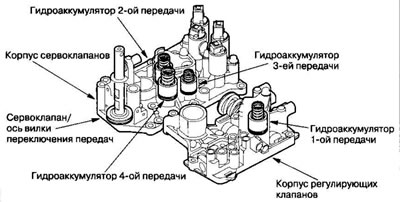
The hydraulic accumulators are located in the…
This article is available at: russian, bulgarian, belarusian, ukrainian, serbian, croatian, romanian, polish, slovak, hungarian
This information has been verified: Mikhail Kopasov
Share with friends:
◀ Previous
CR-V 2: Automatic gearbox
Next ▶

Control valve body
Main valve body
Hydraulic drive control
PCM Input and Output Signals
Electrical diagram of the PCM unit (automatic transmission control system)
Road tests of automatic transmission
Checking engine speed on a stationary vehicle
Checking the automatic transmission pressure
Testing the gear shift solenoid valves
Replacing the gear shift solenoid valves
See also other articles from Honda manuals:
Check No. 2 of the electromagnetic control valve of the idle speed Honda Accord 3 (1985-1989)
Intake Air Temperature Control Valve Control Honda Civic 3 and 4 (1983-1991)
Windscreen wiper and washer control Honda Fit 1 (2001-2008)
Manual control valve body Honda HR-V 1 (1998-2006, petrol)
Diagnostics of malfunctions of the VTEC system (electronic control of… Honda Avancier 1 (1999-2003, petrol)
Link in different formats to this article
Comments and feedback from visitors
No comments yet


How much will 46 + 30 ?


CR-V 2 (2002-2006, petrol) 
  • General information
  • User manual
  • Technical data
  • Maintenance
  • Power unit
  • Engine repair
  • Lubrication system
  • Cooling system
  • Exhaust system
  • Fuel system
  • Engine management
  • Engine electrical equipment
  • Transmission
  • Clutch
  • Manual gearbox
  • Automatic gearbox
  • Rear differential
  • Drive shafts
  • Chassis and running gear
  • Steering
  • Front suspension
  • Rear suspension
  • Brake system
  • Body and interior
  • Exterior (external elements)
  • Interior (internal elements)
  • Doors, locks and windows
CR-V 1 (1995-2001, petrol) 
  • General information
  • Maintenance
  • Tips for car owner
  • Power unit
  • Engine repair
  • Engine overhaul
  • Cooling and lubrication system
  • Engine electrical equipment
  • Control system
  • Fuel system
  • Transmission
  • Clutch and drive shafts
  • Car gearbox
  • Chassis and running gear
  • Front suspension
  • Rear suspension
  • Steering
  • Brake system
  • Body and interior
  • Body service
  • Exterior (external elements)
  • Interior (internal elements)
  • Electrical equipment
  • Equipment and devices
  • Electrical circuits
HondaBook.ru © 2018–2026 • Mobile version • Sitemap: EN BG BY UA RS HR RO PL SK HU • Feedback • Driver Information • Search system • Bookmark
Accord 3 (1985-1989) • Accord 6 (1997-2002) • Civic 3 and 4 (1983-1991) • Civic 5 and 6 (1991-2000) • Civic 6 (1995-2000) • Civic 7 (2000-2005) • Civic 8 (2005-2011) • Fit 1 (2001-2008) • CR-V 1 (1995-2001) • CR-V 2 (2002-2006) • HR-V 1 (1998-2006) • Avancier 1 (1999-2003) •
 
This website uses cookies to ensure proper functioning. By clicking "OK," you agree.