HondaBook.ru
Auto companies Volkswagen Auto companies Ford Auto companies Lada Auto companies Skoda Auto companies BMW Auto companies Mazda Auto companies Peugeot
English Русский
Български
Беларускі
Український
Српски
Hrvatski
Română
Polski
Slovenský
Magyar
Bookmark Contacts Sitemap   


Accord Civic Fit / Jazz CR-V HR-V Others Articles
CR-V 1 (1995-2001, petrol) CR-V 2 (2002-2006, petrol)

Doors — adjustment (Honda CR-V 1)

  • Main
  • Honda CR-V
  • 1 (1995-2001, petrol)
  • Body and interior
  • Exterior (external elements)
  • Doors — adjustment
0
When the door is adjusted correctly, the door panel should be flush with the adjacent body panels, and the gap between the door and the body should be the same around the entire door contour.

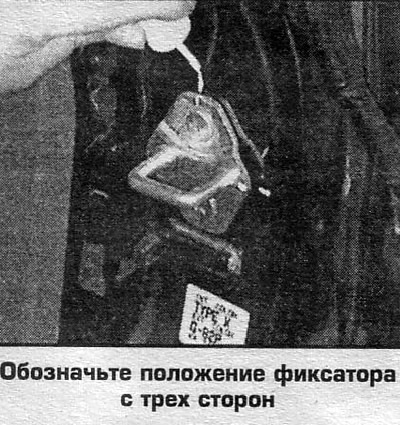
In addition, when closing the door, it should rest against the seals to ensure the tightness of the interior; the seal should be compressed halfway along the entire contour of the door opening. The main adjustment of the door is provided by the bolts that secure the hinges to the body. The door is moving (do it with an assistant) with the hinge bolts loosened. The door depth is adjusted by moving the door with the bolts securing the hinges to the door loosened. This ensures that the pressure on the seal can be adjusted. The front edge of the door should be slightly lower (or not higher) adjacent body panel. The rear edge of the door should be slightly lower than the adjacent body panel. The final adjustment of the door is achieved by moving the door latch retainer (fixed to the body pillar) as follows.

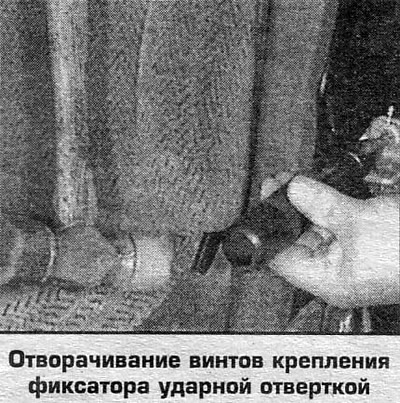
1. Use an impact screwdriver to loosen the retainer mounting screws.

2. Move the outer handle to the position corresponding to opening the door and close the door - the lock will take the position corresponding to the correct position of the slammed door.

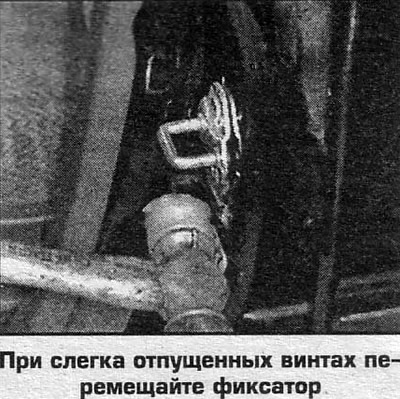
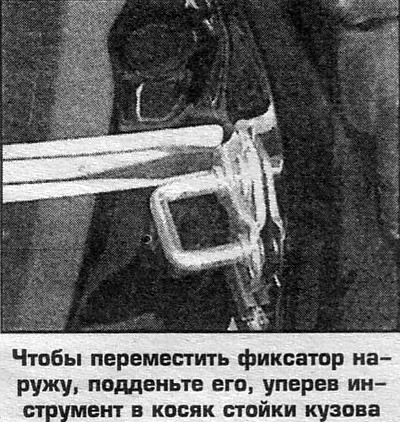
3. Open the door and tighten the screws, the latch can be moved inward or outward, but you need to repeat the door adjustment by loosening the hinge bolts. On some vehicles, adjustment pads are placed under the retainer or under the hinges, which provide additional adjustment.


Attention! It is prohibited to adjust the door height by vertically moving the lock.


4. When finished, check that the door closes. The door should close without vertical movement. Repeat adjustment if necessary (you may even need to move the door a little on its hinges). A slight metallic knock when the door is slammed indicates that the latch is not adjusted accurately enough.
4. When finished, check that the door closes. The…

4. When finished, check that the door closes. The…


(The original is located on the website: «www.HondaBook.ru»)
This article is available at: russian, bulgarian, belarusian, ukrainian, serbian, croatian, romanian, polish, slovak, hungarian
This information has been verified: Emil Safonov
Share with friends:
◀ Previous
CR-V 1: Exterior (external elements)
Next ▶

Doors — removal and installation
Hood — removal, installation and adjustment
Rear Body Door (CR-V Models) — Removal and Installation
Rear Compartment Lid (4-cylinder Odyssey)
Rear Compartment Lid (6-cylinder Odyssey)
Bumpers (CR-V models) — removal and installation
See also other articles from Honda manuals:
Adjustment procedures Honda Accord 3 (1985-1989)
Doors — removal, installation and adjustment Honda Civic 3 and 4 (1983-1991)
Clutch pedal — checking and adjustment Honda Fit 1 (2001-2008)
Timing Belt — Tension Adjustment Honda HR-V 1 (1998-2006, petrol)
Seat adjustment Honda Avancier 1 (1999-2003, petrol)
Link in different formats to this article
Comments and feedback from visitors
No comments yet


How much will 43 + 27 ?


CR-V 2 (2002-2006, petrol) 
  • General information
  • User manual
  • Technical data
  • Maintenance
  • Power unit
  • Engine repair
  • Lubrication system
  • Cooling system
  • Exhaust system
  • Fuel system
  • Engine management
  • Engine electrical equipment
  • Transmission
  • Clutch
  • Manual gearbox
  • Automatic gearbox
  • Rear differential
  • Drive shafts
  • Chassis and running gear
  • Steering
  • Front suspension
  • Rear suspension
  • Brake system
  • Body and interior
  • Exterior (external elements)
  • Interior (internal elements)
  • Doors, locks and windows
CR-V 1 (1995-2001, petrol) 
  • General information
  • Maintenance
  • Tips for car owner
  • Power unit
  • Engine repair
  • Engine overhaul
  • Cooling and lubrication system
  • Engine electrical equipment
  • Control system
  • Fuel system
  • Transmission
  • Clutch and drive shafts
  • Car gearbox
  • Chassis and running gear
  • Front suspension
  • Rear suspension
  • Steering
  • Brake system
  • Body and interior
  • Body service
  • Exterior (external elements)
  • Interior (internal elements)
  • Electrical equipment
  • Equipment and devices
  • Electrical circuits
HondaBook.ru © 2018–2026 • Mobile version • Sitemap: EN BG BY UA RS HR RO PL SK HU • Feedback • Driver Information • Search system • Bookmark
Accord 3 (1985-1989) • Accord 6 (1997-2002) • Civic 3 and 4 (1983-1991) • Civic 5 and 6 (1991-2000) • Civic 6 (1995-2000) • Civic 7 (2000-2005) • Civic 8 (2005-2011) • Fit 1 (2001-2008) • CR-V 1 (1995-2001) • CR-V 2 (2002-2006) • HR-V 1 (1998-2006) • Avancier 1 (1999-2003) •
 
This website uses cookies to ensure proper functioning. By clicking "OK," you agree.