
HondaBook.ru
Auto companies Volkswagen Auto companies Ford Auto companies Lada Auto companies Skoda Auto companies BMW Auto companies Mazda Auto companies Peugeot
English Русский
Български
Беларускі
Український
Српски
Hrvatski
Română
Polski
Slovenský
Magyar
Bookmark Contacts Sitemap   


Accord Civic Fit / Jazz CR-V HR-V Others Articles
Accord 3 (1985-1989) Accord 6 (1997-2002)

Front brake disc — inspection and regrinding (Honda Accord 3)

  • Main
  • Honda Accord
  • 3 (1985-1989)
  • Chassis and running gear
  • Brake system
  • Front brake disc — inspection and regrinding
0
Contents: Inspection ⇊ Regrinding ⇊

Inspection


1. The brake disc gets circular scratches when braking due to the capture of dust and road sand. Excessive scratching not only creates a squealing brake, but also shortens the service life of the brake pads. However, slight damage to the disc surface, not exceeding 0.38 mm in depth, also occurs during normal operation. It is not dangerous when braking. If the grooves are deep enough to catch a fingernail, then appropriate measures must be taken.

Differences between the left and right surfaces of the disc may result in uneven braking.


2. Disc runout occurs when the disc moves from side to side, warps, or deforms. Excessive runout causes wobble or knocking in the brake pedal. Place a dial indicator on the center of the worn surface of the pad and rotate the disc, watching the readings. If the disc runout exceeds 0.10 mm, replace or regrind the disc.
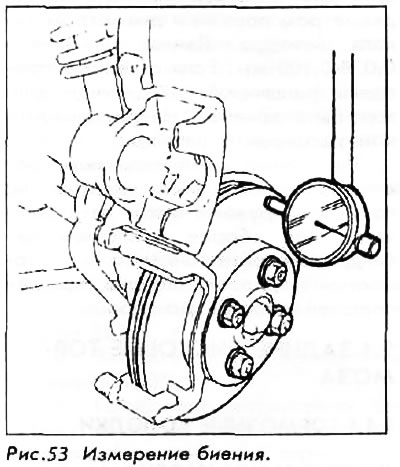
2. Disc runout occurs when the disc moves from…


3. The parallelism of the disc is checked by measuring the thickness of the disc at different positions around the disc's circumference. To check the parallelism of the disc, place a mark on the disc and measure the thickness of the disc with a micrometer. Repeat this measurement eight times, moving around the disc's circumference (each time by approximately 45 degrees). If the measurements change by more than 0.015 mm, replace the disc.


Regrinding


Brake discs can be restored subject to mandatory compliance with the following rules:
  • Nowhere should the disc be thinner than the minimum thickness. (The limits are specified in Specifications for Brakes in this Chapter). The difference between the thickness of a new disc and the absolute limit is usually very small; if the disc has been used for several years, it is already close to the limit, and regrinding will not be able to eliminate the defects without going beyond the wear limits. It is always better to replace the disc.
  • If the disc is reground, the procedure must be performed on an automotive lathe.
  • Always replace the brake pads at the same time as installing new or resurfacing old discs.
This article is available at: russian, bulgarian, belarusian, ukrainian, serbian, croatian, romanian, polish, slovak, hungarian
This information has been verified: Yaroslav Shiryaev
Share with friends:
◀ Previous
Accord 3: Brake system
Next ▶

Front brake disc — removal and installation
Front Brake Caliper — Repair
Front Brake Caliper — Removal and Installation
Front Disc Brake Pads — Removal and Installation
Front Disc Brake Pads — Inspection
Rear drum brakes
Rear brake drums — removal and installation
Rear Drum Brake Shoes — Removal and Installation
Rear Wheel Cylinder — Removal and Repair
Rear Disc Brake Pads — Removal and Installation
See also other articles from Honda manuals:
Inspection of the front brake disc Honda Civic 8 (2005-2011)
Removal the front brake pad support Honda Fit 1 (2001-2008)
Front disc brake pads Honda CR-V 1 (1995-2001, petrol)
Front Brake Disc — Checking Runout Honda HR-V 1 (1998-2006, petrol)
Front Brake Discs — Brake Disc Grinding Honda Avancier 1 (1999-2003, petrol)
Link in different formats to this article
Comments and feedback from visitors
No comments yet


How much will 28 + 20 ?


Accord 6 (1997-2002) 
  • General information
  • Introduction to the guide
  • User manual
  • Maintenance
  • Power unit
  • Four-cylinder engines
  • Six-cylinder engines
  • Engine overhaul
  • Cooling system
  • Heater and air conditioner
  • Power and exhaust systems
  • Engine electrical equipment
  • Engine management
  • Transmission
  • Mechanical gearbox
  • Automatic gearbox
  • Clutch and drive shafts
  • Chassis and running gear
  • Brake system
  • Car suspension
  • Steering
  • Body and interior
  • Exterior (external elements)
  • Interior (internal elements)
  • Electrical equipment
  • Equipment and devices
  • Electrical circuits
Accord 3 (1985-1989) 
  • General information
  • Maintenance
  • Power unit
  • Engine adjustment
  • Engine repair
  • Engine electrics
  • Emission management
  • Engine management (carburetor)
  • Electronic injection
  • Programmable injection
  • Schematic of emission system
  • Fuel system
  • Feedback management
  • Transmission
  • Manual gearbox
  • Automatic gearbox
  • Clutch
  • Chassis and running gear
  • Front suspension
  • Rear suspension
  • Steering
  • Brake system
  • Electrical equipment
  • Ventilation and heating
  • Air conditioner
  • Cruise control system
  • Equipment and devices
HondaBook.ru © 2018–2026 • Mobile version • Sitemap: EN BG BY UA RS HR RO PL SK HU • Feedback • Driver Information • Search system • Bookmark
Accord 3 (1985-1989) • Accord 6 (1997-2002) • Civic 3 and 4 (1983-1991) • Civic 5 and 6 (1991-2000) • Civic 6 (1995-2000) • Civic 7 (2000-2005) • Civic 8 (2005-2011) • Fit 1 (2001-2008) • CR-V 1 (1995-2001) • CR-V 2 (2002-2006) • HR-V 1 (1998-2006) • Avancier 1 (1999-2003) •
 
This website uses cookies to ensure proper functioning. By clicking "OK," you agree.