
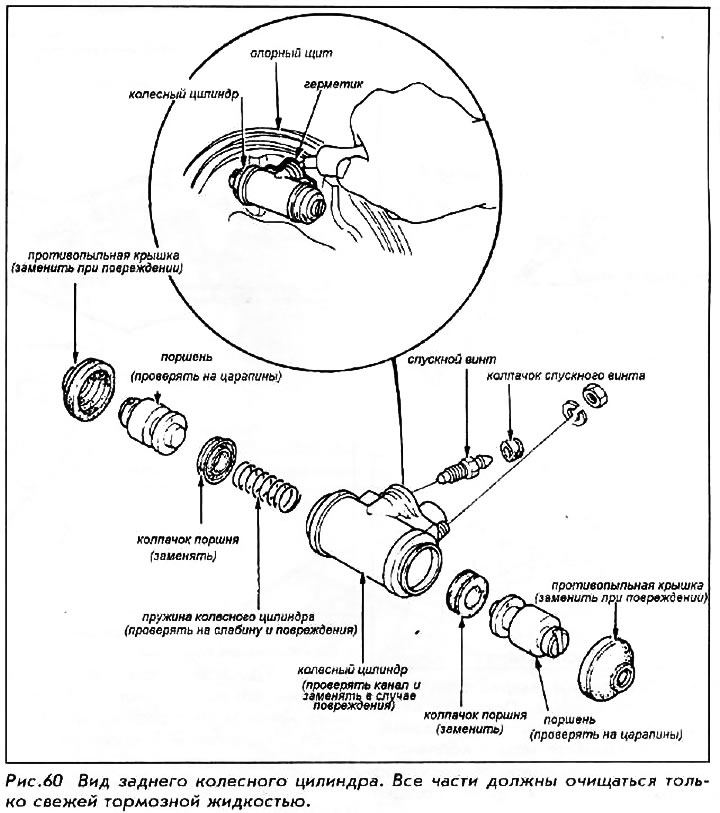
When checking the cylinders for leaks, lift the outer edge of the boot and check the fluid. A little moisture, usually covered with brake dust, is normal. Any significant moisture or fluid leak should be replaced immediately.
Removal
1. Raise and securely support the vehicle.
2. Remove the wheel.
3. Remove the brake drum and shoes.
4. Disconnect the brake system pipe from the wheel cylinder. Plug the pipe.
5. Loosen the 2 wheel cylinder lock nuts on the inside of the support shield; take off wheel cylinder.
To install:
6. Apply a thin layer of grease to the grooves on the wheel cylinder piston.
7. Install the cylinder, tightening the nuts to 8 Nm.
8. Connect the brake line and tighten to 15 Nm.
9. Install the brake shoes and drum.
10. Bleed the brakes.
11. Install the wheel; lower the car to the ground.
Repair
Remove the wheel cylinder dust seals from the grooves so that the cylinder pistons can be removed.
Wash all parts in fresh brake fluid and check the cylinder bore and pistons for scratches and other damage, replacing when necessary. Check the clearance between the piston and the cylinder bore by measuring the difference between the piston diameter and the cylinder bore diameter. This value is 0.020-0.100 mm. If the holes are corroded, the cylinder must be replaced. Do not bore or expand the cylinder.
Repair kits include the necessary seals; the pistons and spring may be missing. When assembling the wheel cylinder, apply a thin layer of brake fluid to the pistons, piston caps and cylinder walls.