
Contents: Air Conditioning Compressor Clutch…⇊ Crankshaft Position Sensor (CKP) ⇊ Engine Coolant Temperature (ECT)…⇊ Idle Air-Fuel Mixture Regulator…⇊ Ignition timing regulator ⇊ Fuel injection advance and duration ⇊ Intake Air Temperature (IAT) Sensor ⇊ Knock sensor ⇊ Manifold Absolute Pressure (MAP)…⇊ Primary heated oxygen sensor…⇊ Secondary heated oxygen sensor…⇊ Launch control ⇊ Throttle Position Sensor (TP) ⇊ Top Dead Center (TDC) Sensor ⇊ Vehicle Speed Sensor (VSS) ⇊
The Programmed Fuel Injection (PGM-FI) system is a sequential multi-port fuel injection system.
Air Conditioning Compressor Clutch Relay (A/C)
When the ECM/PCM receives a cooling signal from the A/C system, it delays the compressor power and enriches the mixture to ensure a smooth transition to A/C mode.
Crankshaft Position Sensor (CKP)
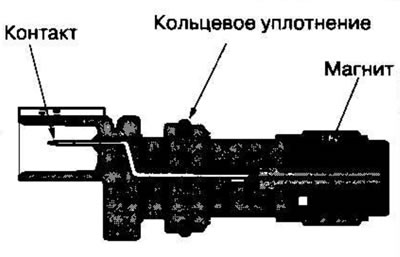
The CKP sensor detects the crankshaft speed and determines the ignition timing and fuel injection moment for each cylinder, and also detects misfires.
Engine Coolant Temperature (ECT) Sensor
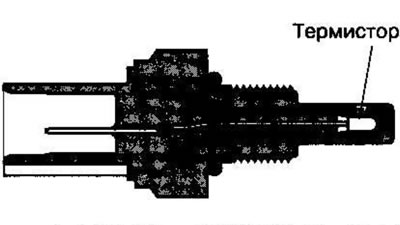
The ECT sensor is a temperature-dependent resistor (thermistor). The thermistor's resistance decreases as the engine coolant temperature increases.
Idle Air-Fuel Mixture Regulator (IMA) (on models without TWC catalytic converter)
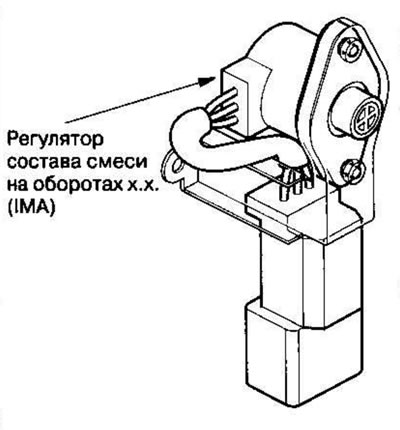
The idle air mixture control (IMA) is a device with adjustable resistance for regulating the air mixture at idle speed.
Ignition timing regulator
The ECM/PCM memory stores basic ignition timing values at different engine speeds and manifold absolute pressures. The ignition timing values are also adjusted for the engine coolant temperature.
Fuel injection advance and duration
The ECM/PCM memory contains basic values of injection duration at different engine speeds and manifold pressures. After reading this duration from memory, corrections are made based on signals from various sensors and the final injection duration is formed.
By monitoring long-term fuel injection compensation, the ECM/PCM detects long-term deviations in the fuel system and stores a diagnostic trouble code (DTC) in memory.
Intake Air Temperature (IAT) Sensor
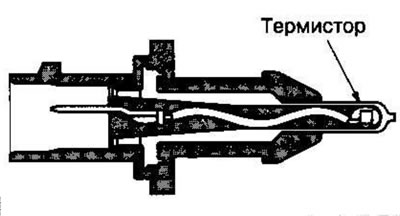
The IAT sensor is a temperature dependent resistor (thermistor). The thermistor's resistance decreases as the intake air temperature increases.
Knock sensor
The system that prevents the occurrence of detonation combustion adjusts the ignition advance angle in such a way as to minimize detonation.
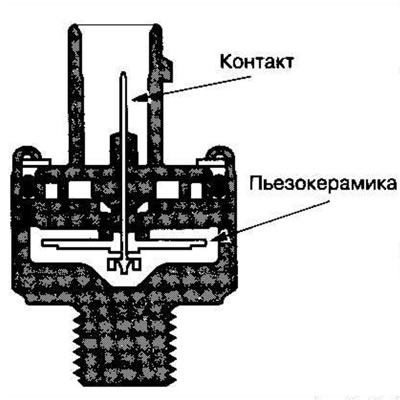
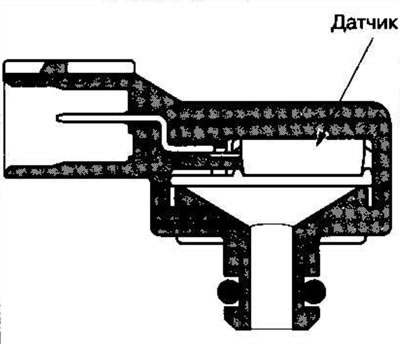
Manifold Absolute Pressure (MAP) Sensor
The sensor (MAP) converts the absolute pressure in the manifold into electrical signals and supplies them to the ECM/PCM unit.
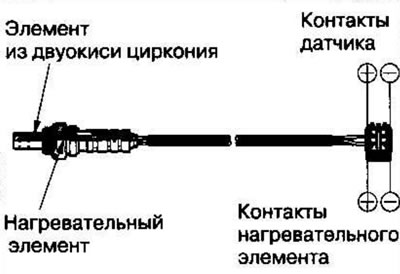
Primary heated oxygen sensor (primary HO2S)
The primary HO2S detects the oxygen concentration in the exhaust gas and signals the ECM/PCM, which adjusts the fuel injection duration accordingly. The stabilization of the sensor output signals is achieved by means of a built-in heating element. The primary HO2S is installed in the catalytic converter (TWC). During the regulation of the air-fuel ratio using the primary HO2S and secondary HO2S, the failure of the primary HO2S can be determined by the feedback period. When the feedback period exceeds a certain value under steady state driving, the sensor is considered to be faulty. At the same time, the ECM/PCM unit records the DTC code in memory.
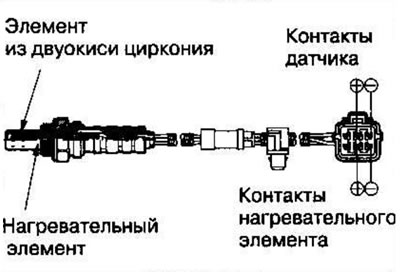
Secondary heated oxygen sensor (secondary HO2S)
The secondary HO2S detects the oxygen concentration in the exhaust gas downstream of the catalytic converter (TWC) and signals the ECM/PCM, which adjusts the fuel injection duration accordingly. The stabilization of the sensor output signals is achieved by means of a built-in heating element. The secondary HO2S is installed in the neutralizer (TWC).
Launch control
When the engine is started, the ECM/PCM provides a richer mixture by increasing the fuel injection duration.
Throttle Position Sensor (TP)
The TP sensor is a potentiometer connected to the throttle shaft. When the throttle position changes, the sensor changes the signal voltage supplied to the ECM/PCM. The TP sensor is replaced together with the throttle body.
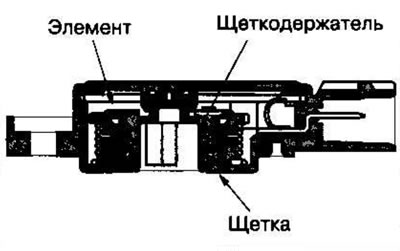
Top Dead Center (TDC) Sensor
The TDC sensor detects the piston position of cylinder #1, which is used as a reference point for sequential fuel injection into each cylinder.
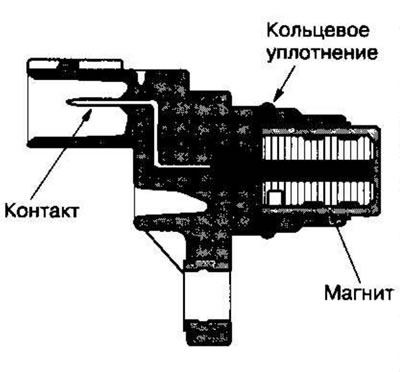
Vehicle Speed Sensor (VSS)
The VSS sensor is driven by the differential. It generates a pulse signal with an input voltage of 5V. The pulse frequency increases/decreases depending on the vehicle speed.