
1. Check the power steering fluid level.
2. Carefully disconnect the pump outlet hose (A) from the pump pipe so as not to spill power steering fluid on the frame or other parts. Connect the power steering (pump) connector to the pump pipe (B).
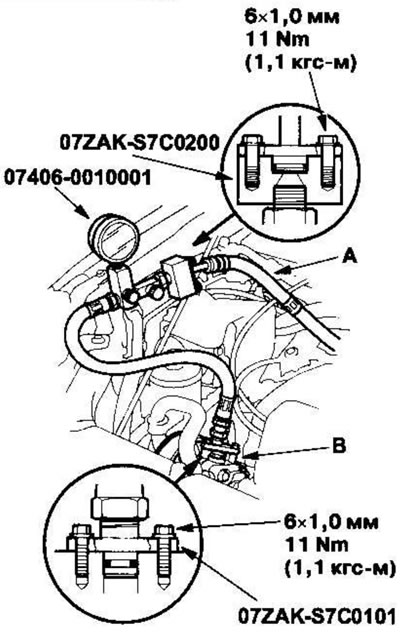
3. Connect the power steering coupling adapter (hose) to the power steering pressure gauge, then connect the pump outlet hose (A) to the power steering coupling adapter (hose).
4. Connect the power steering pressure gauge to the power steering connection adapter (pump).
5. Open the shut-off valve (A) fully.
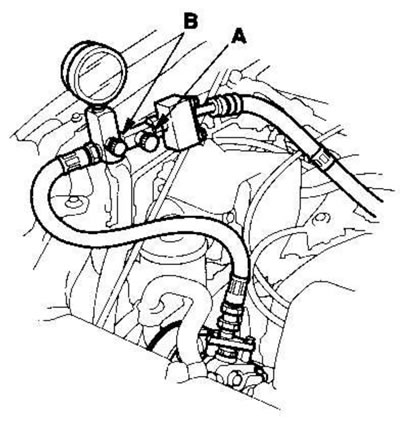
6. Fully open the pressure regulating valve (B).
7. Start the engine and let it run at idle speed.
8. Turn the steering wheel from lock to lock several times and warm up the fluid to an operating temperature of 70°C.
9. Measure the steady-state fluid pressure while the engine is running at idle speed. If the pump is in good working order, the pressure should not exceed 1500 kPa (15 kgf/cm²). If the pressure is higher, check the outlet pipe or valve body (see "Troubleshooting the Steering System").
Increase engine speed to 3000 rpm and measure fluid pressure. If the pump is in good condition, the pressure should be at least 1500 kPa (15 kgf/cm²).
If the pressure is higher, troubleshoot or replace the pump.
10. Reduce engine speed and let it run at idle speed. Close the shut-off valve, then gradually close the pressure regulating valve until the pressure gauge needle settles. Take readings.
Warning. Do not close the shut-off valve for more than 5 seconds, otherwise the pump may be damaged due to overheating.
11. Immediately open the pressure regulating valve fully. If the pump is in good condition, the pressure gauge readings should be no less than those indicated below:
Engines of models K20A4 and K20A5: 6900-7500 kPa (70-77 kgf/cm²)
Engines model K24A1: 7500-8100 kPa (76-83 kgf/cm²)
If the readings are lower, this means that the pump capacity is insufficient for the power steering to function properly. Repair or replace the pump.