
HondaBook.ru
Auto companies Volkswagen Auto companies Ford Auto companies Lada Auto companies Skoda Auto companies BMW Auto companies Mazda Auto companies Peugeot
English Русский
Български
Беларускі
Український
Српски
Hrvatski
Română
Polski
Slovenský
Magyar
Bookmark Contacts Sitemap   


Accord Civic Fit / Jazz CR-V HR-V Others Articles
CR-V 1 (1995-2001, petrol) CR-V 2 (2002-2006, petrol)

Brake Booster — Check for Leaks (Honda CR-V 2)

  • Main
  • Honda CR-V
  • 2 (2002-2006, petrol)
  • Chassis and running gear
  • Brake system
  • Brake Booster — Check for Leaks
0
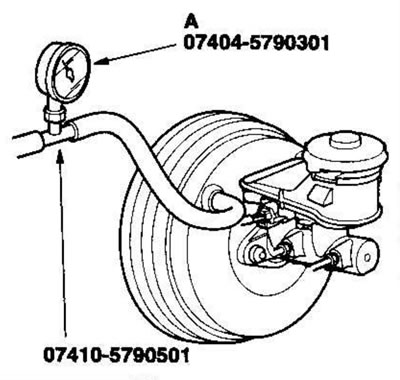
1. Connect a vacuum gauge (A) between the brake booster and the check valve.

1. Connect a vacuum gauge (A) between the brake…


2. Start the engine, adjust the engine speed with the accelerator pedal so that the vacuum gauge readings are equal to 40.0-66.7 kPa (300-500 mmHg.), then turn off the engine.

3. Take readings from the vacuum gauge. If after 30 seconds the vacuum gauge readings drop by 2.7 kPa (20 mmHg.) or more, check for leaks on the following components:
  • Check valve
  • Vacuum hose, tube
  • Seals
  • Brake booster
  • Master cylinder

Note: Do not attempt to disassemble the brake booster. Replace the brake booster assembly with a new one.
This article is available at: russian, bulgarian, belarusian, ukrainian, serbian, croatian, romanian, polish, slovak, hungarian
This information has been verified: Mikhail Kopasov
Share with friends:
◀ Previous
CR-V 2: Brake system
Next ▶

Adjusting the clearance of the brake booster push rod
Assembling the master cylinder
Disassembling the master cylinder
Replacing the master cylinder
Front Wheel Brake Caliper Repair
Brake booster — checking functionality
Brake Booster — Checking the Check Valve
Replacing the brake booster
Checking the rear brake pads
Replacing rear brake pads
See also other articles from Honda manuals:
Brake booster — removal and installation Honda Accord 3 (1985-1989)
Vacuum brake booster Honda Civic 7 (2000-2005)
Vacuum brake booster — check Honda Fit 1 (2001-2008)
Master cylinder, brake booster — check Honda HR-V 1 (1998-2006, petrol)
Transfer Case (4WD) — Check for Oil Leaks Honda Avancier 1 (1999-2003, petrol)
Link in different formats to this article
Comments and feedback from visitors
No comments yet


How much will 34 + 26 ?


CR-V 2 (2002-2006, petrol) 
  • General information
  • User manual
  • Technical data
  • Maintenance
  • Power unit
  • Engine repair
  • Lubrication system
  • Cooling system
  • Exhaust system
  • Fuel system
  • Engine management
  • Engine electrical equipment
  • Transmission
  • Clutch
  • Manual gearbox
  • Automatic gearbox
  • Rear differential
  • Drive shafts
  • Chassis and running gear
  • Steering
  • Front suspension
  • Rear suspension
  • Brake system
  • Body and interior
  • Exterior (external elements)
  • Interior (internal elements)
  • Doors, locks and windows
CR-V 1 (1995-2001, petrol) 
  • General information
  • Maintenance
  • Tips for car owner
  • Power unit
  • Engine repair
  • Engine overhaul
  • Cooling and lubrication system
  • Engine electrical equipment
  • Control system
  • Fuel system
  • Transmission
  • Clutch and drive shafts
  • Car gearbox
  • Chassis and running gear
  • Front suspension
  • Rear suspension
  • Steering
  • Brake system
  • Body and interior
  • Body service
  • Exterior (external elements)
  • Interior (internal elements)
  • Electrical equipment
  • Equipment and devices
  • Electrical circuits
HondaBook.ru © 2018–2026 • Mobile version • Sitemap: EN BG BY UA RS HR RO PL SK HU • Feedback • Driver Information • Search system • Bookmark
Accord 3 (1985-1989) • Accord 6 (1997-2002) • Civic 3 and 4 (1983-1991) • Civic 5 and 6 (1991-2000) • Civic 6 (1995-2000) • Civic 7 (2000-2005) • Civic 8 (2005-2011) • Fit 1 (2001-2008) • CR-V 1 (1995-2001) • CR-V 2 (2002-2006) • HR-V 1 (1998-2006) • Avancier 1 (1999-2003) •
 
This website uses cookies to ensure proper functioning. By clicking "OK," you agree.