
Contents: Cars with 5-door hatchback body ⇊ Vehicle Identification Number (VIN) ⇊ Engine number ⇊ Transmission number ⇊

VIN Structure Improvement of manufactured products is a continuous process of any flow production. At the same time, except for cases of major design changes of models coming off the conveyor, the results of the modification process are not covered in the vehicle operating manual. However, the manufacturer issues numbered lists of manufactured spare parts, due to which the information encoded in the vehicle identification numbers is of particular importance when purchasing the latter. When ordering the necessary spare part, try to provide the seller with as much information about your car as possible. Be sure to provide the model name, year of manufacture, as well as the body and powertrain numbers.
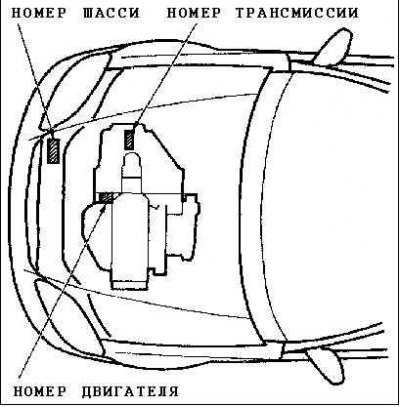
1. The chassis number is stamped on the front panel of the car body.
2. The engine number is stamped on the cylinder block.
3. The transmission number plate is attached to the top of the transmission housing.
Do not confuse the transmission number with the engine number.
Cars with 5-door hatchback body
Chassis number on the front cross member of the body (above the radiator) absent.
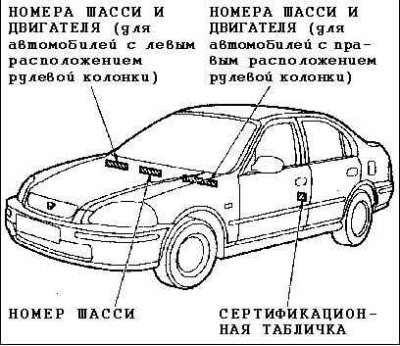
On some vehicle modifications, the chassis and engine numbers are duplicated on a plate that is attached to the front body shield.
On other vehicle modifications, the chassis number plate is located on the front crossmember of the body (above the radiator).
Some vehicle versions provide for the location of the certification plate on the rear end of the driver's door.
Cars with 5-door hatchback body
The certification plate on the end of the driver's door is missing.
Vehicle Identification Number (VIN)
This extremely important number is stamped on the rear bulkhead of the engine compartment, as well as on a plate attached to the dashboard under the windshield on the driver's side of the car. The VIN is also entered into the vehicle title and registration certificate. The number contains encrypted information about the date/place of manufacture and the type of car body (see accompanying illustration).
Note: Engine code and model year
The two main components of the VIN are the model year code and the assembly line/body/engine code.
Counting from left to right, the assembly line/body/engine code refers to the 4th, 5th and 6th positions of the number. Thus, Civic models are defined by the following combinations:
- EJ6 = 3-door/D16Y7
- EJ7 = 2-door/D16Y5
- EJ8 = 4-door/D16Y8
The following combinations are typical for Integra models:
- DB7 = 4-door/B18B1
- DB8 = 4-door/B18C1
- DC2 = 3-door/B18C1, B18C5
- DC4 = 3-door/B18B1
The tenth position of the VIN determines the year of model production:
- R = 1994
- S = 1995
- T = 1996
- V = 1997
- W = 1998
Engine number
The engine number, which is essential when ordering parts for the power unit, is located on the right (from the passenger side of the car) on the block, next to the exhaust manifold. The first five positions of the number determine the engine code. This Manual covers models equipped with the following four engine types:
Civic
- D16Y5 = 1.6L, SOHC, 16-valve, VTEC-E
- D16Y7 = 1.6L, SOHC, 16-valve
- D16Y7 = 1.6L, SOHC, 16-valve, VTEC
Integra
- B18B1 = 1.8 L, DOHC, 16-valve
- B18C1 = 1.8L, SOHC, 16-valve, VTEC
- B18C5 = 1.8L, DOHC, 16-valve, VTEC
Transmission number
This number is required when ordering parts for transmission line repair. On models equipped with manual transmission, the transmission number is stamped on the clutch dome, next to the starter. On models with automatic transmission, the number is located on the right in the front part of the transmission case, near the dipstick. On models equipped with CVT, the number is on a vertical platform, also near the dipstick.
[The article is based on information from the website HONDABOOK.ru]