
Disassembling the secondary shaft
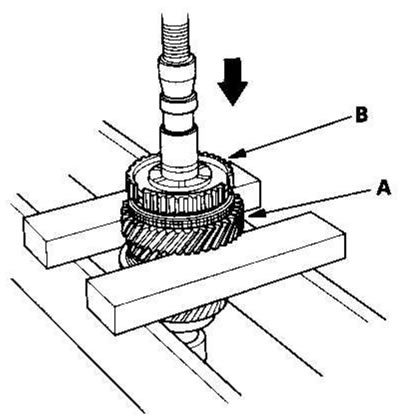
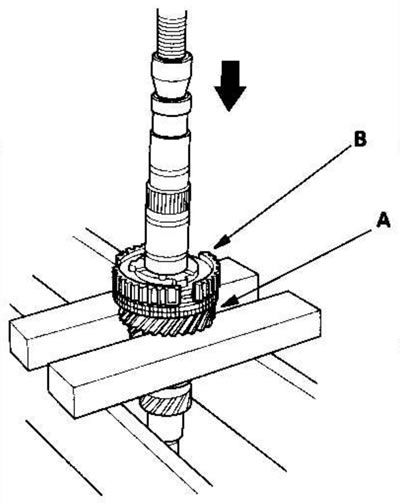
Note: Remove the synchronizer hubs using a press and steel blocks as shown in the figure. If you use a puller with jaws, you may break the gear teeth.
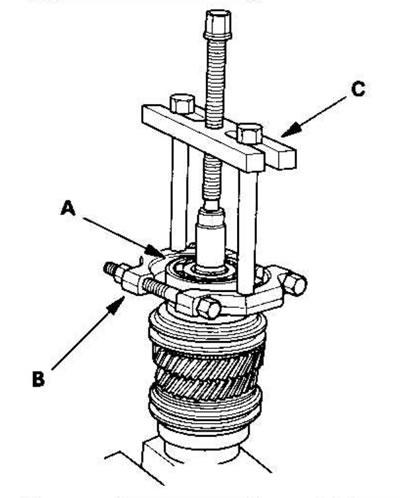
1. Remove the angular contact ball bearing (A) and tapered ring using the bearing separator (B) and bearing puller (C). Make sure the bearing separator is located under the tapered ring.
2. Place the 5th gear pinion (A) on steel blocks and press the secondary shaft out of the 5th gear synchronizer hub (B). If you use a puller with jaws, you may break the gear teeth.
3. Place the 3rd gear pinion (A) on steel blocks and press the secondary shaft out of the 3rd/4th gear synchronizer hub (B). If you use a puller with jaws, you may break the gear teeth.
Checking the secondary shaft
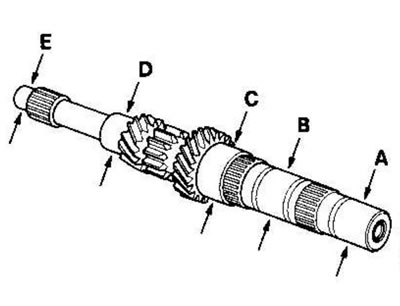
1. Check the gear and bearing surfaces for wear and damage, then measure the secondary shaft at points A, B and C. If any part of the secondary shaft is less than the specified limit, replace it with a new one.
| Standard | Limit | ||
| A | Ball bearing surface (from the gearbox housing side) | 27,987 - 28,000 mm | 27.94 mm |
| IN | Surface of the spacer sleeve | 31,984 - 32,000 mm | 31.93 mm |
| WITH | Needle bearing surface | 38,984 - 39,000 mm | 38.93 mm |
| D | Ball bearing surface | 27,977 - 27,990 mm | 27.94 mm |
| E | Surface of the bushing | 20.80 - 20.85 mm | 20.75 mm |
2. Check the runout by placing the secondary shaft with both ends on supports. Rotate the secondary shaft two full revolutions. If the runout exceeds the specified limit, replace the secondary shaft with a new one.
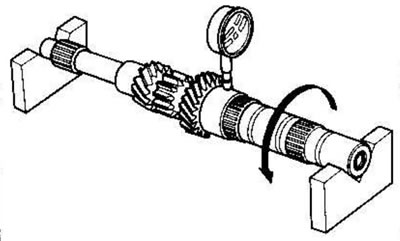
| Standard | max 0.02 mm |
| Limit | 0.05 mm |