
Contents: Main Directorate ⇊ Electronic Brakeforce Distribution…⇊ Self-diagnosis function ⇊ Function of the on-board diagnostic…⇊ ABS modulator ⇊ Wheel sensors ⇊
Main Directorate
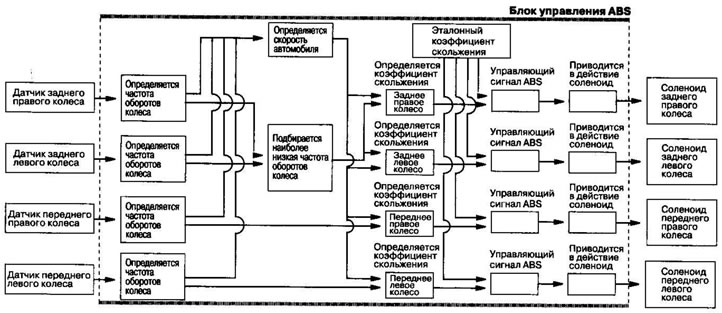
The ABS control unit determines the wheel speed based on the signals received from the wheel sensors, then calculates the vehicle speed based on the wheel speed.
The control unit determines the vehicle speed during deceleration based on the intensity of the deceleration.
The ABS control unit calculates the degree of slippage of each wheel and, if it is high, sends a control signal to the modulator solenoid valve.
The pressure regulator operates in three modes: pressure reduction, pressure maintenance and pressure increase.
Electronic Brakeforce Distribution (EBD)
The Electronic Brake-force Distribution (EBD) function helps to brake the vehicle by regulating the braking force on the rear wheels before the ABS system is activated. By receiving signals from the wheel sensors, the ABS control unit, via the modulator, separately applies the brakes to the rear wheels.
When the rear wheel speed is less than the front wheel speed, the ABS control unit maintains the current fluid pressure in the rear brakes by closing the inlet valve in the modulator. As the rear wheel speed increases and approaches the front wheel speed, the control unit increases the rear brake fluid pressure by instantly opening the inlet valve. The whole process happens very quickly. At the same time, a kickback is felt on the brake pedal.
If, during self-diagnosis, the ABS control unit detects a malfunction that affects the EBD function, it lights the brake system indicator and the ABS indicator.
Self-diagnosis function
1. The ABS control unit has a main central processing unit (CPU) and an auxiliary central processing unit that perform mutual verification when a fault occurs.
2. CPU checks the system circuit.
3. When the central processor detects a malfunction, the ABS control unit lights the ABS indicator and stops the system.
4. Self-diagnosis can be divided into the following two categories:
- Primary diagnostics
- Regular diagnostics
Function of the on-board diagnostic system
The ABS system can be diagnosed using the Honda PGM tester.
The ABS Checker cannot be used with this system. When performing bleeding and checking the signals from the wheel sensors, use the Honda PGM tester. For specific instructions, see. in the Honda PGM tester operating manual.
ABS modulator
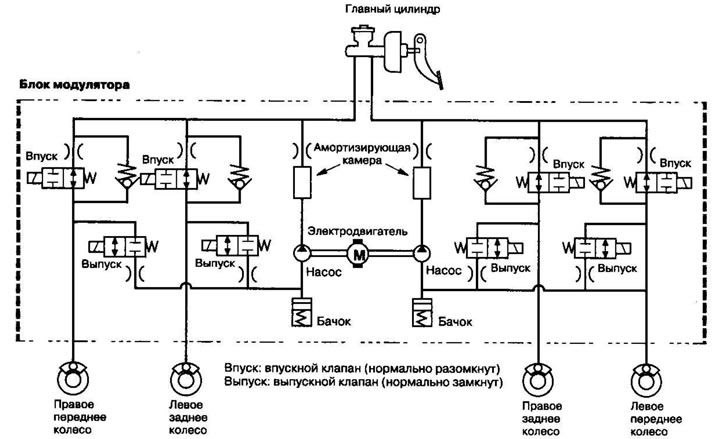
The ABS modulator consists of an inlet solenoid valve, an outlet solenoid valve, a reservoir, a pump, a pump motor and a shock-absorbing chamber. The modulator reduces the fluid pressure directly in the caliper. This is a circulation type modulator, as the brake fluid circulates through the caliper, reservoir and master cylinder. The hydraulic regulator operates in three modes: pressure increase, pressure maintenance and pressure reduction.
The hydraulic circuit is an independent four-channel type, one channel for each wheel.
Pressure increase mode:
The inlet valve is open, the outlet valve is closed. The fluid from the smooth cylinder is pumped to the caliper.
Pressure holding mode:
The inlet valve is closed, the outlet valve is closed. The fluid is retained in the caliper by the inlet and outlet valves.
Pressure reduction mode:
The inlet valve is closed, the outlet valve is open. The fluid from the caliper flows through the release valve into the reservoir.
Electric motor operating mode:
- When switching to pressure reduction mode, the pump motor operates.
- After the ABS system has finished operating, the pump motor does not work.
- The fluid from the reservoir is pumped by a pump through the shock-absorbing chamber into the master cylinder.
Wheel sensors
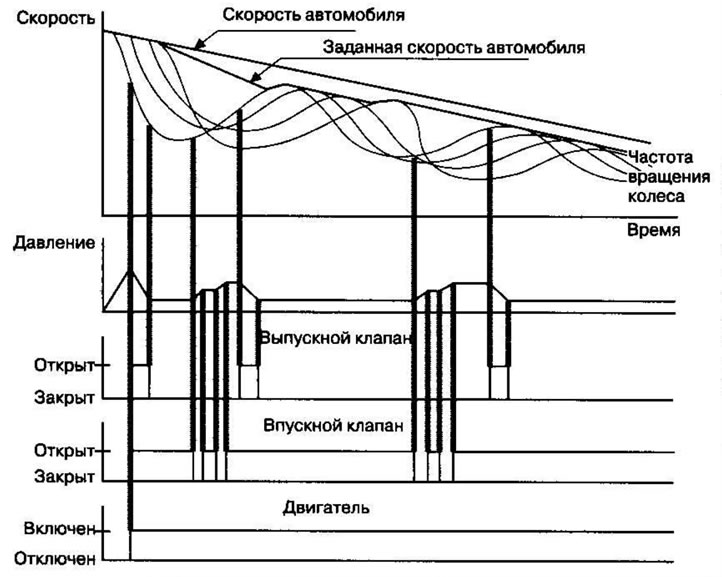
Wheel sensors are semiconductor type. Wheel sensors detect changes in magnetic polarity at a magnetic sensor in the wheel bearing. The ABS control unit calculates the wheel speed based on signals from the wheel sensors. When the wheel speed drops sharply below the vehicle speed, the release valve instantly opens and reduces the fluid pressure in the caliper. At this point, the pump's electric motor turns on. When the wheel speed is restored, the inlet valve instantly opens and increases the fluid pressure in the caliper.
[The original text of the article is located on the website «hondabook.ru»]