
Contents: Crankshaft ⇊ Pistons and connecting rods ⇊
Before assembly, the cylinder block should be cleaned and checked; it is recommended to apply an aerosol composition to the block to protect it from corrosion (for example WD-40). Replace all oil channel plugs.
Crankshaft
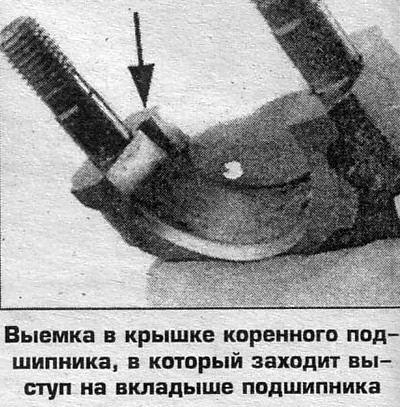
1. Install the liners in the cylinder block bed and in the bearing caps (when installed in the lids, the protrusion of the insert must enter the recess on the lid). Make sure that the lubrication holes of the bearing shell and cylinder block are aligned. If the crankshaft journals have been reground, select liners from the appropriate repair group.
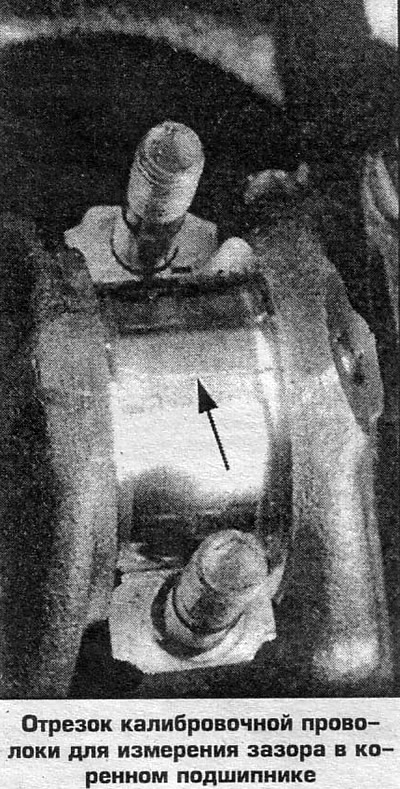
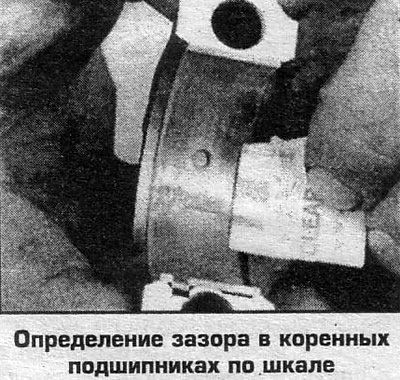
2. Install the crankshaft and check the main bearing clearances using a plastic gauging wire. To do this, place a piece of calibration wire on each main journal of the crankshaft parallel to its axis. Clean the bearing surfaces of the caps, install the caps and tighten the cap bolts to the specified torque. Loosen the bolts and carefully lift the covers, compare the thickness of each of the crushed wires with the scale on the package and determine the size of the gap.
3. If the gaps are larger than the norm, replace the liners with repair ones from the standard size group (0.025-0.05 mm thicker than installed). If the gap is still larger than normal, grind the crankshaft journals and install repair liners.
4. Remove any remaining wire. Lubricate the crankshaft main journals, install all covers except the middle one in their original places and tighten the bolts to the specified torque.
5. Install the middle cover and tighten the bolts by hand.
6. Move the crankshaft forward until it stops against the surface of the upper bearing shell. While holding the crankshaft, move the center cover back. This will align the thrust surfaces of the liners in the cover.
7. Without releasing the force on the crankshaft, tighten the center cover bolts to the specified torque.
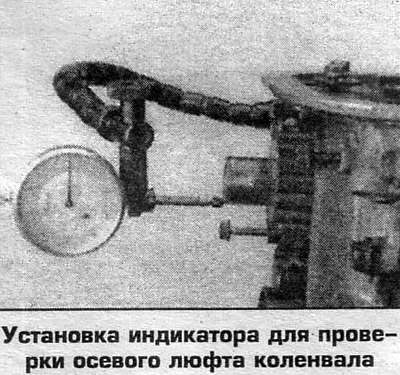
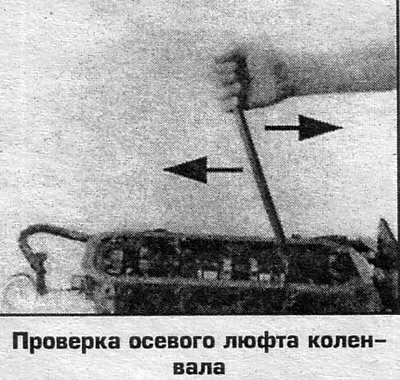
8. Check the crankshaft axial play by installing an indicator and moving the crankshaft first backwards, then forwards until it stops.
9. If the clearance is not within the norm, replace the middle main bearing with a new one. If this measure does not bring the axial clearance back to normal, then remove the crankshaft and take it to a car service for inspection and repair
10. Check the freedom of rotation of the crankshaft.
11. Install the rear oil seal.
Pistons and connecting rods
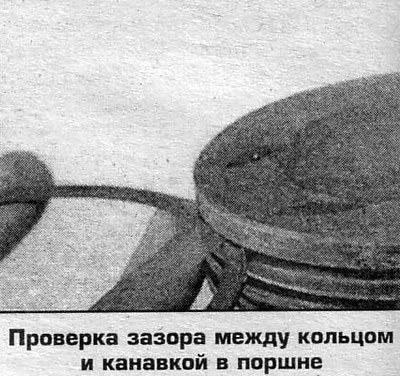
1. Before installing the pistons and connecting rods, lubricate the cylinder surface with low-viscosity engine oil. Select the rings, check the gap in the ring joint by pushing the ring into the cylinder with the piston. As a rule, the gap in the ring joint in a worn cylinder exceeds the norm. If the gap is larger than the norm, select a set of repair rings. Check the gap between the ring and the groove in the piston (photo). The feeler gauge should pass freely between the ring and the wall of the groove. If it is felt that there is a ledge on the inside of the groove wall due to wear, then replace the piston.
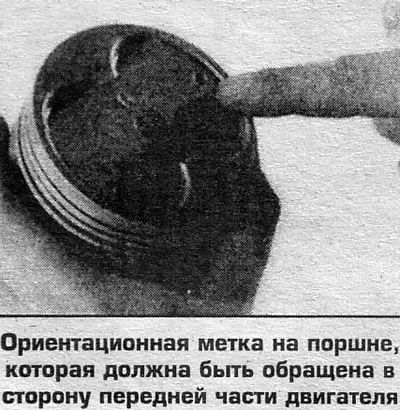
2. If removed pistons are installed, they should be installed in the cylinder from which they were removed. The connecting rods should be installed according to the marks made during disassembly. If the connecting rod is moved to another cylinder, replace the connecting rod bearings with new ones, and punch the number of the cylinder in which the connecting rod is installed. The notch on the connecting rod should face the front of the engine.
3. Install the liners into the caps and connecting rods.
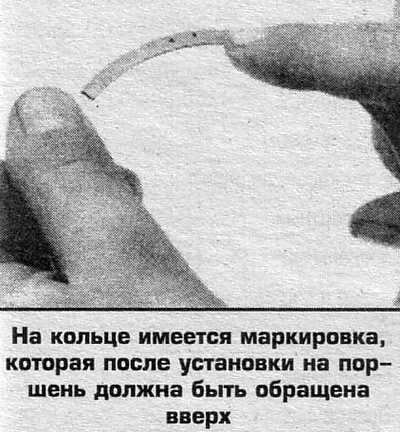
4. Place the rings on the pistons (starting with the oil scraper) using an expander.
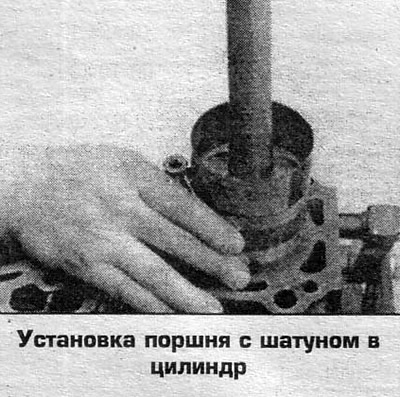
5. Arrange the joints of the piston rings, orient them correctly and install the piston with the connecting rod into the cylinder, covering the rings with a clamp (photo).
6. While pulling each connecting rod toward the crankshaft, check the clearance in each connecting rod journal, repeating the procedure for checking the clearances in the main journals.
7. Assemble the connecting rods with the caps and check the axial clearances of the connecting rods on the crankshaft journals.
8. Fill the oil pump and oil receiver with technical petroleum jelly.
9. On Odyssey models, install the balance shafts.
10. Install the cylinder head, sprockets, drive belts and removed components and assemblies.
11. On 2.2L and 2.3L Odyssey models, install the balance shaft drive belts.
12. Install the engine on the vehicle.
 |
 |
 |
 |
 |
 |
 |
 |
(The text can be found on the website hondabook.ru)