HondaBook.ru
Auto companies Volkswagen Auto companies Ford Auto companies Lada Auto companies Skoda Auto companies BMW Auto companies Mazda Auto companies Peugeot
English Русский
Български
Беларускі
Український
Српски
Hrvatski
Română
Polski
Slovenský
Magyar
Bookmark Contacts Sitemap   


Accord Civic Fit / Jazz CR-V HR-V Others Articles
Accord 3 (1985-1989) Accord 6 (1997-2002)

Removal the crankshaft (Honda Accord 6)

  • Main
  • Honda Accord
  • 6 (1997-2002)
  • Power unit
  • Engine overhaul
  • Removal the crankshaft
0
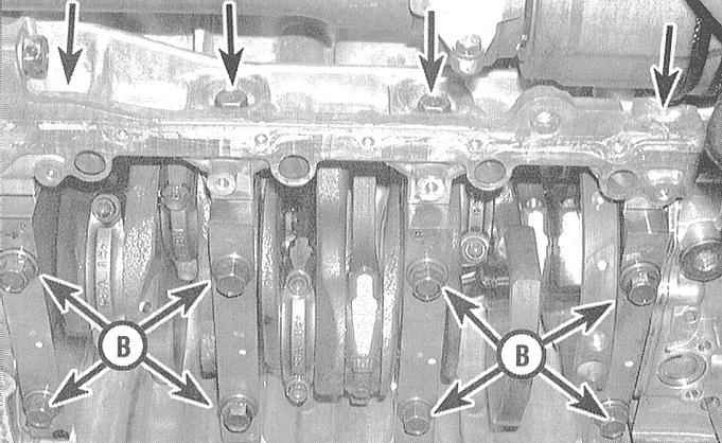
Note: The crankshaft can only be removed from the engine when it is removed from the vehicle. This assumes that the flywheel/drive plate, timing belt, oil pan, oil pickup, oil pump and connecting rod and piston assemblies have already been removed. On 4-cylinder engines, the connecting bridge must be removed before removing the connecting rods (see Section Removal connecting rod and piston assemblies). Before removing the crankshaft, it is also necessary to unbolt and separate the rear oil seal holder from the cylinder block.

Note: The crankshaft can only be removed from the…


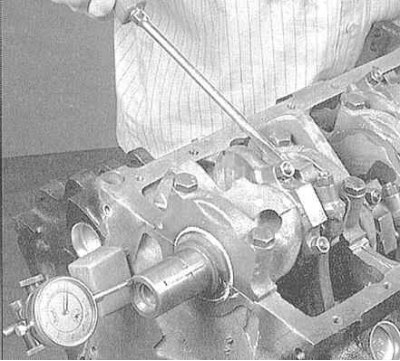
1. Before removing the crankshaft from the engine, measure its axial play. Attach the DTI gauge to the block, coaxial with the crankshaft, resting its plunger against the cheek of one of the cranks.

Note: The main bearing caps and their connecting bridge (4-cylinder engines) must remain in place and their fasteners tightened to the required torque.


2. Push the crankshaft back as far as it will go and reset the gauge indicator. Now push the shaft in the opposite direction and read the gauge reading. The amount of free play of the shaft in the longitudinal direction is its axial play. Compare the measurement result with the requirements of the Specifications. If the play exceeds the maximum permissible value, check the thrust surfaces of the shaft for signs of excessive wear. If there are no obvious signs of wear, installing new thrust washers will usually help correct the situation.


2. Push the crankshaft back as far as it will go…


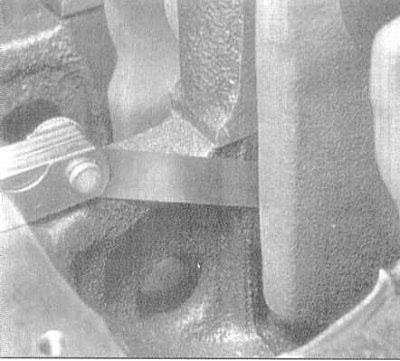
3. If you don't have a dial gauge at hand, you can use a regular blade-type feeler gauge. Carefully move the shaft forward along the engine until it stops, then determine the size of the resulting gap between the crank cheek and the rear wall of the thrust (front) main bearing by tightly fitting a feeler gauge blade(s) of the appropriate thickness into it.
3. If you don't have a dial gauge at hand, you…


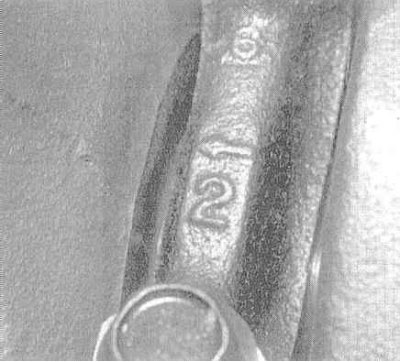
4. Check the main bearing caps for installation markings. The caps should be numbered sequentially from front to back on the engine. If necessary, apply the markings yourself using a center punch. In addition to the serial number, the caps usually have markings in the form of cast arrows. On correctly installed caps, the arrow should point in the direction of the timing belt.


5. On 4-cylinder engines, loosen the main bearing cap/bridge bolts in several steps (1/4 turn per approach) until they can be unscrewed by hand. Remove the bridge. Using a soft-faced hammer, carefully tap the bearing caps and separate them from the block; use the bolts as levers if necessary. Try not to drop the main bearing shells.
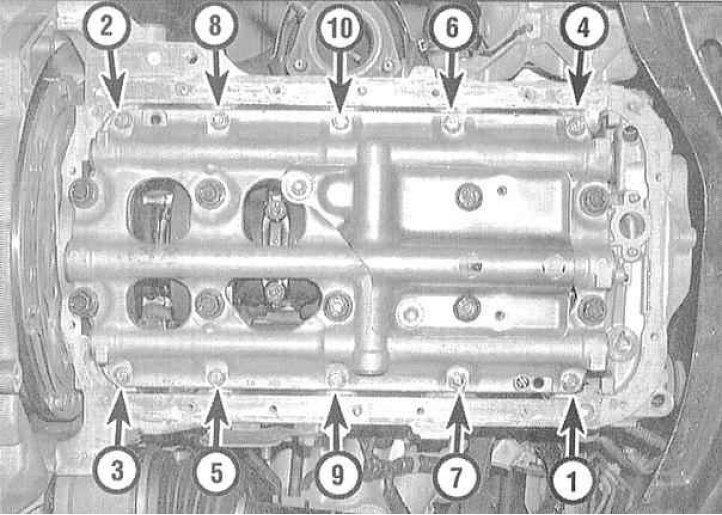
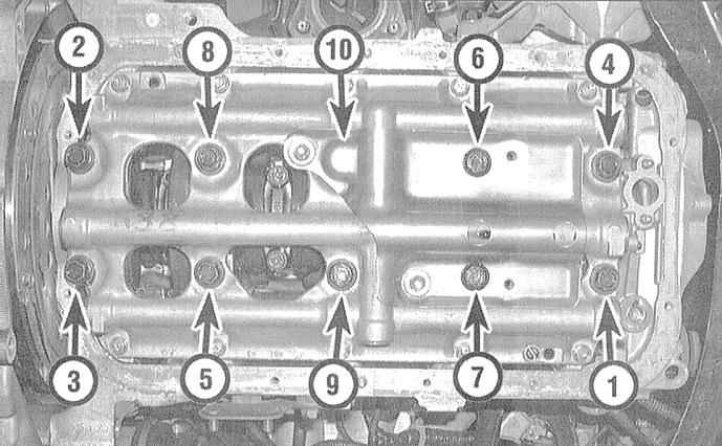
5. On 4-cylinder engines, loosen the main bearing…


5. On 4-cylinder engines, loosen the main bearing…


5. On 4-cylinder engines, loosen the main bearing…


6. On V6 engines, each main bearing cap is secured with four bolts - two bolts are screwed in vertically (looking at the block from below) and two more are screwed in horizontally on each side. Make sure all bolts are removed before attempting to separate the caps from the block.

7. Carefully remove the crankshaft from the engine (use an assistant). Make sure that the main bearing shells remain in their beds in the block and covers. Install the covers on the block, then hand tighten the bolts that secure them.

[You will find the original on the portal «www.hondabook.ru»]
This article is available at: russian, bulgarian, belarusian, ukrainian, serbian, croatian, romanian, polish, slovak, hungarian
This information has been verified: Timofey Goryachev
Share with friends:
◀ Previous
Accord 6: Engine overhaul
Next ▶

Removal connecting rod and piston assemblies
Removal and checking the condition of the balance shafts (4-cylinder engines)
Cylinder head assembly
Valve maintenance
Cleaning and checking the condition of the cylinder head
Cleaning the engine block
Checking the condition of the engine block
Honing of cylinder mirrors
Checking the condition of the connecting rod and piston group components
Checking the condition of the crankshaft
See also other articles from Honda manuals:
Crankshaft oil seal — replacement Honda Civic 3 and 4 (1983-1991)
Checking the axial clearance of the connecting rod and crankshaft Honda Fit 1 (2001-2008)
Crankshaft pulley — removal and installation Honda CR-V 1 (1995-2001, petrol)
Crankshaft Pulley — Replacement Honda HR-V 1 (1998-2006, petrol)
Replacing the crankshaft pulley and pulley bolt Honda Avancier 1 (1999-2003, petrol)
Link in different formats to this article
Comments and feedback from visitors
No comments yet


How much will 39 + 29 ?


Accord 6 (1997-2002) 
  • General information
  • Introduction to the guide
  • User manual
  • Maintenance
  • Power unit
  • Four-cylinder engines
  • Six-cylinder engines
  • Engine overhaul
  • Cooling system
  • Heater and air conditioner
  • Power and exhaust systems
  • Engine electrical equipment
  • Engine management
  • Transmission
  • Mechanical gearbox
  • Automatic gearbox
  • Clutch and drive shafts
  • Chassis and running gear
  • Brake system
  • Car suspension
  • Steering
  • Body and interior
  • Exterior (external elements)
  • Interior (internal elements)
  • Electrical equipment
  • Equipment and devices
  • Electrical circuits
Accord 3 (1985-1989) 
  • General information
  • Maintenance
  • Power unit
  • Engine adjustment
  • Engine repair
  • Engine electrics
  • Emission management
  • Engine management (carburetor)
  • Electronic injection
  • Programmable injection
  • Schematic of emission system
  • Fuel system
  • Feedback management
  • Transmission
  • Manual gearbox
  • Automatic gearbox
  • Clutch
  • Chassis and running gear
  • Front suspension
  • Rear suspension
  • Steering
  • Brake system
  • Electrical equipment
  • Ventilation and heating
  • Air conditioner
  • Cruise control system
  • Equipment and devices
HondaBook.ru © 2018–2026 • Mobile version • Sitemap: EN BG BY UA RS HR RO PL SK HU • Feedback • Driver Information • Search system • Bookmark
Accord 3 (1985-1989) • Accord 6 (1997-2002) • Civic 3 and 4 (1983-1991) • Civic 5 and 6 (1991-2000) • Civic 6 (1995-2000) • Civic 7 (2000-2005) • Civic 8 (2005-2011) • Fit 1 (2001-2008) • CR-V 1 (1995-2001) • CR-V 2 (2002-2006) • HR-V 1 (1998-2006) • Avancier 1 (1999-2003) •
 
This website uses cookies to ensure proper functioning. By clicking "OK," you agree.