
Contents: Removal ⇊ Installation ⇊
Warning! Remember that gasoline is highly flammable! When working with fuel system components, observe all accepted fire safety measures. Do not smoke, do not approach the work area with an open flame or unprotected portable equipment. Do not service the system in a room equipped with natural gas heating devices equipped with a pilot flame (such as water heaters and clothes dryers). Do not forget that gasoline is a carcinogen that promotes the development of cancer. Try to avoid fuel contact with exposed areas of the body - use protective rubber gloves, in case of accidental contact, wash your hands thoroughly with warm water and soap. Immediately collect spilled fuel and do not store rags soaked in fuel near open flames. Remember that the fuel system of models equipped with fuel injection is constantly under pressure. Before disconnecting fuel lines, relieve residual pressure in the system. Wear safety glasses when servicing fuel system components. Always keep a Class B fire extinguisher on hand!
The air conditioning system line is also constantly under pressure, so before disconnecting the refrigeration lines, the system must be discharged in a specialized workshop.
The cars of the model in question are equipped with the SRS system, the main component of which is the airbags. Before starting any work near the location of the SRS directional overload sensors, in the area of the steering column or instrument panel, be sure to turn off the system to avoid accidental deployment of the airbags, which is fraught with serious injuries.
Removal
Note: The authors of this Manual recommend removing the engine together with the transmission. The assembly of the unit is lowered down and removed from under the vehicle, therefore, care should be taken to ensure that the vehicle is securely fixed in the raised position.
1. Release the pressure in the fuel system and remove the air cleaner assembly with air hoses (see Chapter Power and exhaust systems).
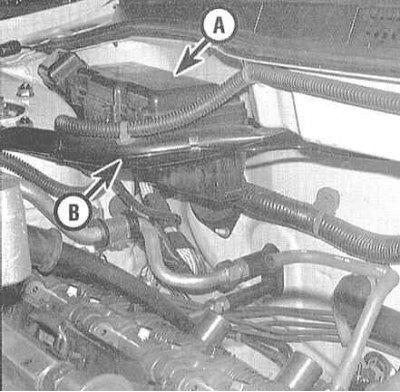
2. Disconnect the negative cable from the battery first, then the positive cable.
Warning! If the car stereo system is equipped with a security code, make sure you have the correct combination to activate the audio system before disconnecting the battery!
Disconnect the battery cables from the fuse/relay box in the engine compartment. With the wiring disconnected from the box, remove the mounting bolts and strut mount spacer bar. On V6 models, remove the battery, battery base, and battery mounting bracket.
3. Cover the fenders and the air deflector under the windshield of the car with special protective covers, or just old blankets. Remove the hood (see Chapter Body).
4. Remove the generator, distributor and spark plug wires (see Chapter Engine electrical equipment).
5. Remove the oil filter, drain the cooling system, drain the engine and transmission oil and remove the drive belts (see Chapter Settings and ongoing maintenance).
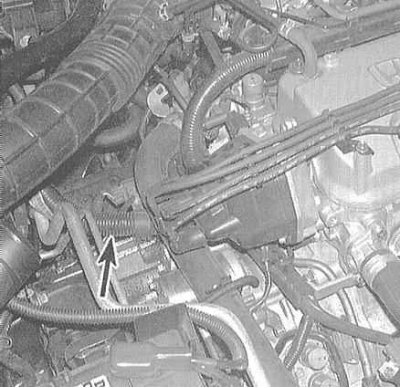
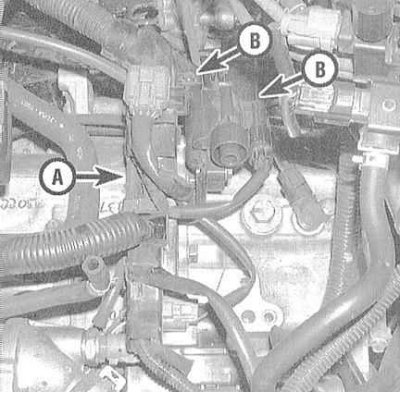
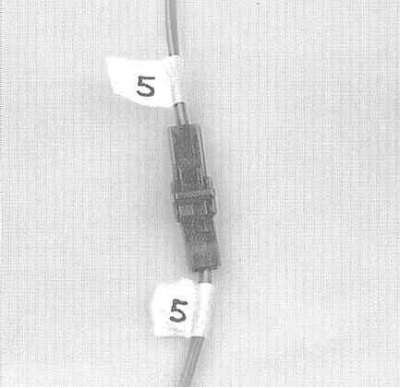
6. Clearly mark and disconnect all vacuum lines, emission control hoses, electrical connectors, ground straps, and fuel lines from the engine. It is best to mark the wiring, lines, and hoses with tape. It is also helpful to draw a diagram of the wiring or take a series of photographs.
Note: The procedure for disconnecting the wiring from the PCM is described in Chapter Engine management.
 |
 |
7. Remove the cooling fan(s) and radiator (see Chapter Cooling and heating systems).
8. Remove the filler cap, release the residual pressure in the fuel tank, then disconnect the fuel lines running from the engine to the chassis (see Chapter Power and exhaust systems). Immediately seal all open tubes and fittings.
9. Disconnect the accelerator rod from the engine, and if the vehicle is equipped with one, also the cruise control drive cable (see Chapter Power and exhaust systems).
10. Unbolt the steering pump and move it to the side without disconnecting the hydraulic lines (see Chapter Suspension and steering). Make sure that the pump is fixed strictly vertically; if necessary, remove it completely.
11. Remove the lower splash shields. On models equipped with air conditioning (A/C), unbolt and move the compressor to the side - do not disconnect the refrigeration lines (see Chapter Cooling and heating systems).
Note: Securely support the removed compressor with wire, not allowing it to hang by the hoses.
12. Disconnect the electrical wiring from the oxygen sensors. Separate the exhaust pipe from the exhaust manifold(s) (see Chapter Power and exhaust systems) and the catalytic converter flange and remove it from under the vehicle.
13. Remove the drive shafts (see Chapter Clutch and drive shafts). Disconnect the transmission shift/speedometer (or VSS) wiring harness and cables (see Chapter Gear shift box). On models with manual transmission, remove the clutch slave cylinder from the transmission (see Chapter Clutch and drive shafts). On models with AT, disconnect the ATF cooling lines from the transmission case (see Chapter Gear shift box).
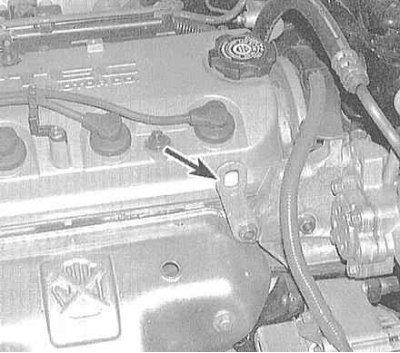
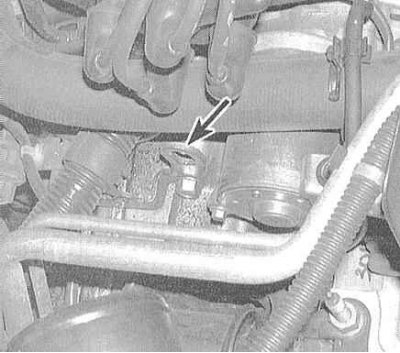
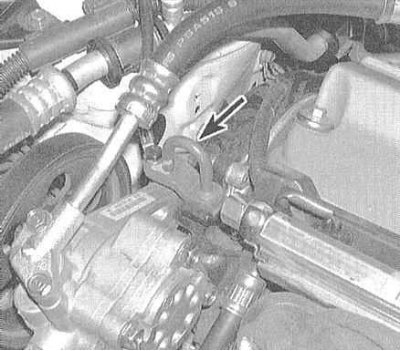
14. Attach the slings to the lifting eyes of the power unit. Raise the vehicle off the ground, leaving enough space underneath to remove the unit. Position the winch/A-frame beams in the operating position (on the vertical axis of the engine compartment). Take up the slack in the slings, achieving a slight tension.
 |
 |
15. Make sure that nothing else connects the power unit to the car. If necessary, disconnect forgotten communication lines, having marked them clearly beforehand.
16. Unscrew the fasteners of the powertrain suspension supports. Mark the position of the subframe relative to the chassis with paint, then loosen the fastening bolts, lower the subframe and remove it from under the car (see Chapter Gear shift box).
17. Slowly lower the powertrain assembly a few inches, making sure once again that no service lines remain connected. Continue lowering the assembly until it rests on the floor or the flatbed of the trolley jack. Remove the powertrain assembly from underneath the vehicle.
18. On models with AT, unscrew the bolts securing the rotation converter to the drive disk. Loosen the bolts securing the engine to the transmission and disassemble the assembly.
19. Remove the flywheel/drive plate and install the engine on a mounting stand.
Installation
1. Check the condition of the powertrain suspension supports. Replace defective components.
Note: For a description of the procedures for checking the correct operation of the active hydraulic support adjustment system, see the relevant Sections of this Chapter.
2. On models with manual transmission, check the condition of the clutch components (it would be correct to replace the entire assembly) (see Chapter Clutch and drive shafts) and lubricate the pilot bearing with high-temperature grease. Install the flywheel and clutch assembly components to the engine (see Chapter Clutch and drive shafts).
3. On models with AT, check the condition of the seals and bushings of the rotation converter, lightly lubricate the nose of the converter and the seal lips with thick grease. Install the drive disk.
4. Carefully connect the transmission to the engine, screw in and tighten the mounting bolts to the required torque (see Chapter Gear shift box). On models with AT, screw in and tighten the rotation converter mounting bolts.
5. Raise the vehicle sufficiently off the ground and position the powertrain assembly underneath. Move the winch/A-frame beams into position and attach slings to the engine/transmission lifting eyes, passing them through the engine bay opening.
6. Raise the power unit assembly to its standard position and install the brackets for its suspension supports. Insert the rubber cushions into the supports and tighten the through bolts/nuts of their mounting studs.
7. Install the subframe, aligning it with the chassis in accordance with the mounting marks made during dismantling. Screw in the fasteners and tighten them to the required torque (see Specifications in Chapter Gear shift box).
8. Finally tighten the through bolts/nuts of the support cushion mounting studs.
Note: Failure to comply with the required tightening forces for the powertrain suspension support fasteners will result in increased vibrations during engine operation.
9. Disconnect the rigging slings from the lifting eyes.
10. Reinstall the remaining components in the reverse order of removal.
11. Add coolant and engine oil to the engine, fill the transmission (see Chapter Settings and ongoing maintenance).
12. Start the engine and check it for proper operation and signs of leaks. Switch off the ignition and check the fluid levels. Replace the hood. Test drive the vehicle. On models equipped with air conditioning, remove and charge the air conditioning system in a specialized workshop.