HondaBook.ru
Auto companies Volkswagen Auto companies Ford Auto companies Lada Auto companies Skoda Auto companies BMW Auto companies Mazda Auto companies Peugeot
English Русский
Български
Беларускі
Український
Српски
Hrvatski
Română
Polski
Slovenský
Magyar
Bookmark Contacts Sitemap   


Accord Civic Fit / Jazz CR-V HR-V Others Articles
Accord 3 (1985-1989) Accord 6 (1997-2002)

Removal, condition check and installation of camshafts (Honda Accord 6)

  • Main
  • Honda Accord
  • 6 (1997-2002)
  • Power unit
  • Six-cylinder engines
  • Removal, condition check and installation of camshafts
0
Contents: Removal ⇊ Examination ⇊ Installation ⇊

Removal


1. Remove the cylinder head covers (see Section Removal and installation cylinder head covers), timing belt and gears (see Section Removal, condition check and installation of the timing belt and timing drive gears).

2. Remove the ignition distributor (see Chapter Engine electrical equipment).

3. Remove the rocker arm assemblies (see Section Removal, condition check and installation of rocker arm assembly).
3. Remove the rocker arm assemblies (see Section…


4. Remove the EGR valve (see Chapter Engine management) in order to provide access to the rear camshaft mounting plate.

Note: Before removing the camshafts, measure their end play.

Note: Before removing the camshafts, measure…


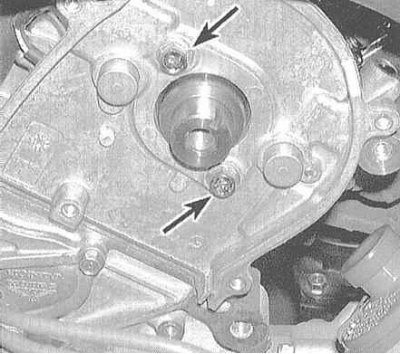
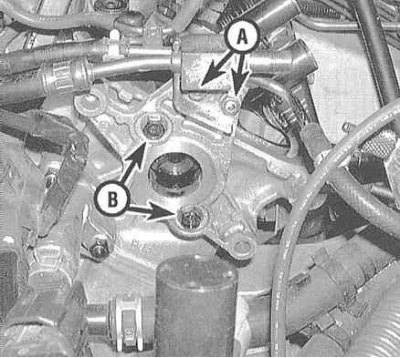
5. Remove the rear camshaft retainer plate.
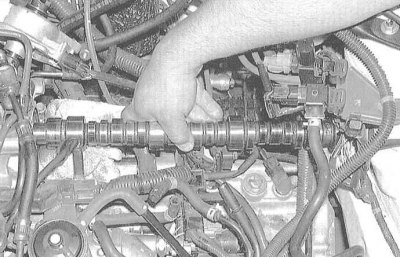


5. Remove the rear camshaft retainer plate.


6. Carefully remove the camshaft from the cylinder head, being careful not to damage its cams and journals.

Examination


Examination


1. Remembering the order of installation of individual parts, dismantle the rocker arm assembly, then bolt the axles freed from components to their regular places in the cylinder head. Tighten the fasteners with the required force.
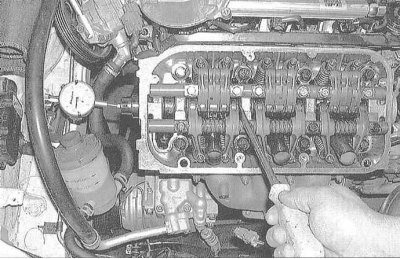
1. Remembering the order of installation of…


2. Secure the dial gauge so that its plunger rests against the end of the camshaft. Pull the shaft back as far as it will go (wrap the end of the lever with tape to avoid damaging the working surfaces of the shaft), zero the gauge, then move the shaft as far as it will go in the opposite direction. Read the gauge readings, record the result and compare it with the standard requirements for axial clearance of camshafts (see Specifications). If the reading taken is outside the permissible range, the shaft must be replaced.


3. After checking the axial clearance, remove the rocker shafts, then remove the shaft from the cylinder head. Measure the journal diameters and cam lobe heights. Compare the measurement results with the requirements Specifications (for V6 engines) Visually assess the degree of wear on the shafts - look for things like scratches, scoring, cavities and signs of overheating.

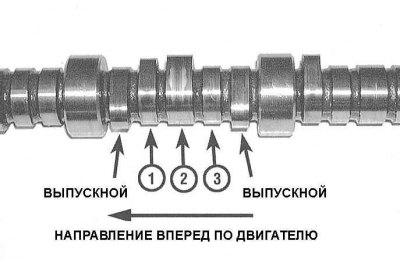
Note: Note the difference in cam lobe placement on the front and rear camshafts.
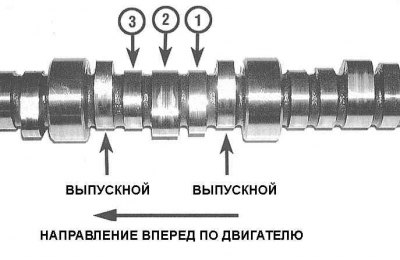

Note: Note the difference in cam lobe placement…

Installation


Installation


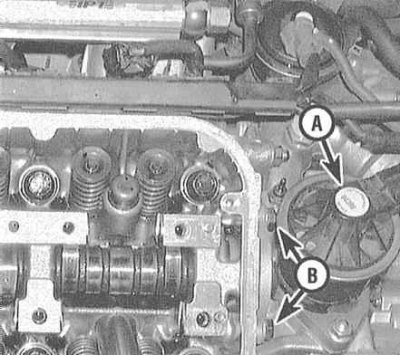
1. Remove the rear timing belt covers from both cylinder heads to gain access to the camshaft seals.
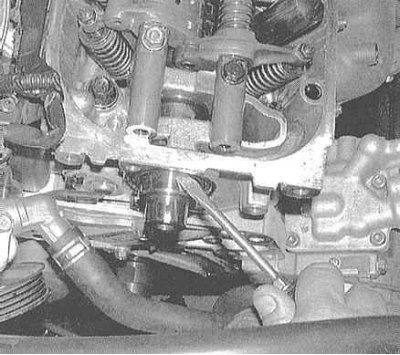


1. Remove the rear timing belt covers from both…


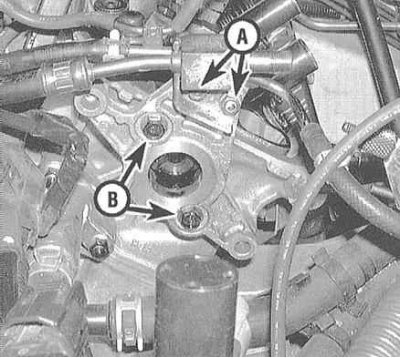
2. The seals must be replaced each time the head is disassembled/the shafts are removed. Old seals are removed by prying them up with a special tool or a flat-bladed screwdriver.
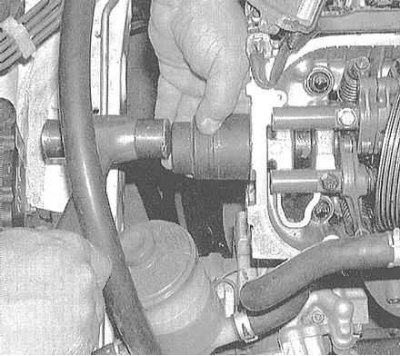
2. The seals must be replaced each time the head…


3. Lubricate the lips of the new seal with clean engine oil, then seat it perpendicularly in its seat to the same depth as the old seal. As a mandrel for seating the seal, you can use a socket head of the appropriate size, or a section of pipe of the appropriate diameter.

4. Carefully wipe the camshaft, its bearing beds in the cylinder head and covers, and the rocker arms of the valve drive with a rag soaked in acetone. Try to completely remove the slightest traces of sludge and dirt. Use only a clean, lint-free rag to wipe the components. Lubricate the journals and cams of the shaft with a special assembly grease and carefully install the shaft in its regular place in its head.
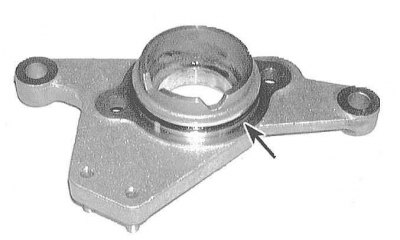


4. Carefully wipe the camshaft, its bearing beds…


5. Lubricate and install a new sealing ring on the shaft holder plate. Bolt the plate into its original place on the cylinder head.

6. Proceeding in a similar manner (see paragraphs 4 and 5), install the second camshaft into your cylinder head.

7. Reinstall all remaining components in the reverse order of removal. Check the valve clearances and adjust them if necessary (see Chapter Settings and ongoing maintenance).

8. Start the engine and check for oil leaks through the camshaft seals. Let the engine run for about five minutes at low speed to remove air from the valve clearance adjuster assemblies. Make sure that the unit functions properly.

Note: During the first five minutes after initial start-up, the valve mechanism will operate with increased noise. If the noise level does not decrease, this may indicate a defect in one of the valve clearance adjusters.


The article was taken from the website hondabook.ru
This article is available at: russian, bulgarian, belarusian, ukrainian, serbian, croatian, romanian, polish, slovak, hungarian
This information has been verified: Timofey Goryachev
Share with friends:
◀ Previous
Accord 6: Six-cylinder engines
Next ▶

Removal, condition check and installation of rocker arm assembly
VTEC System — General Information
Replacing the front crankshaft oil seal
Removal, condition check and installation of the timing belt and timing drive…
Removal and installation of exhaust manifolds
Replacing oil deflector caps and valve springs with plates
Removal and installation cylinder heads
Removal and installation the engine oil pan
Removal, inspection and installation of the oil pump
Removal and installation the drive disk
See also other articles from Honda manuals:
Removal, condition check and installation of rocker arm assembly Honda Civic 6 (1995-2000)
Checking tire pressure and condition Honda Fit 1 (2001-2008)
Gasoline vapor recovery tank — check Honda CR-V 1 (1995-2001, petrol)
Timing Belt — Check Honda HR-V 1 (1998-2006, petrol)
Torque Converter Lockup Solenoid Valve and Shift Solenoid Valve Assy… Honda Avancier 1 (1999-2003, petrol)
Link in different formats to this article
Comments and feedback from visitors
No comments yet


How much will 10 + 43 ?


Accord 6 (1997-2002) 
  • General information
  • Introduction to the guide
  • User manual
  • Maintenance
  • Power unit
  • Four-cylinder engines
  • Six-cylinder engines
  • Engine overhaul
  • Cooling system
  • Heater and air conditioner
  • Power and exhaust systems
  • Engine electrical equipment
  • Engine management
  • Transmission
  • Mechanical gearbox
  • Automatic gearbox
  • Clutch and drive shafts
  • Chassis and running gear
  • Brake system
  • Car suspension
  • Steering
  • Body and interior
  • Exterior (external elements)
  • Interior (internal elements)
  • Electrical equipment
  • Equipment and devices
  • Electrical circuits
Accord 3 (1985-1989) 
  • General information
  • Maintenance
  • Power unit
  • Engine adjustment
  • Engine repair
  • Engine electrics
  • Emission management
  • Engine management (carburetor)
  • Electronic injection
  • Programmable injection
  • Schematic of emission system
  • Fuel system
  • Feedback management
  • Transmission
  • Manual gearbox
  • Automatic gearbox
  • Clutch
  • Chassis and running gear
  • Front suspension
  • Rear suspension
  • Steering
  • Brake system
  • Electrical equipment
  • Ventilation and heating
  • Air conditioner
  • Cruise control system
  • Equipment and devices
HondaBook.ru © 2018–2026 • Mobile version • Sitemap: EN BG BY UA RS HR RO PL SK HU • Feedback • Driver Information • Search system • Bookmark
Accord 3 (1985-1989) • Accord 6 (1997-2002) • Civic 3 and 4 (1983-1991) • Civic 5 and 6 (1991-2000) • Civic 6 (1995-2000) • Civic 7 (2000-2005) • Civic 8 (2005-2011) • Fit 1 (2001-2008) • CR-V 1 (1995-2001) • CR-V 2 (2002-2006) • HR-V 1 (1998-2006) • Avancier 1 (1999-2003) •
 
This website uses cookies to ensure proper functioning. By clicking "OK," you agree.