
Note: The engine should be supported from above using a winch or A-beam.
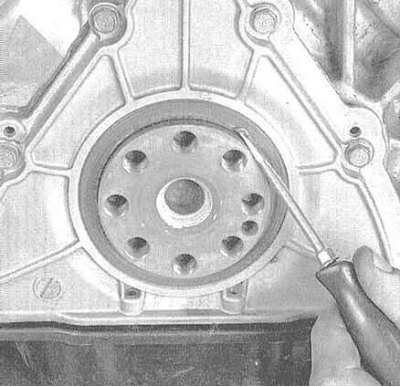
2. The oil seal can be replaced without first dismantling the oil pan and the oil seal holder, but it should be remembered that the new oil seal has fairly hard jaws that can easily be damaged during installation, and there is also a fairly high probability of the oil seal being turned out when it is seated in the socket. In Part General and major engine repairs this Chapter describes special precautions to avoid such troubles, however, all of them require preliminary dismantling of the oil pan and the holder plate. If you want to take a risk, try replacing the seal in situ - remove the old one from its seat in the holder by prying it out with a screwdriver.
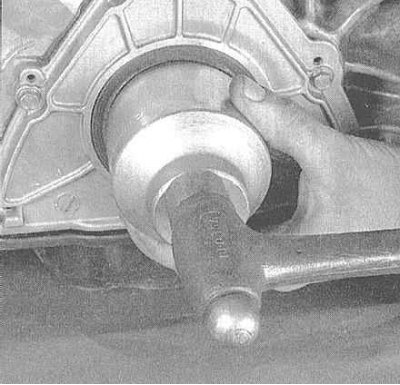
3. Lightly lubricate the edges of the journal and the lips of the new seal with universal grease, then, using a blunt tool, put the seal on the shaft. Using a mandrel and a hammer, seat the seal in the socket (with the expansion spring inside). A socket head of the appropriate size or a section of pipe of a suitable diameter (slightly smaller than the outer diameter of the seal) can be used as a mandrel when seating the seal.
Note: The seal must be flush with the surface of the holder.
4. Further installation is carried out in the reverse order of dismantling the components.