Contents: Removal ⇊ Installation ⇊
Removal
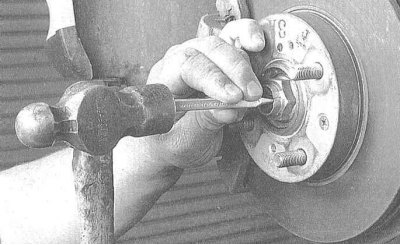
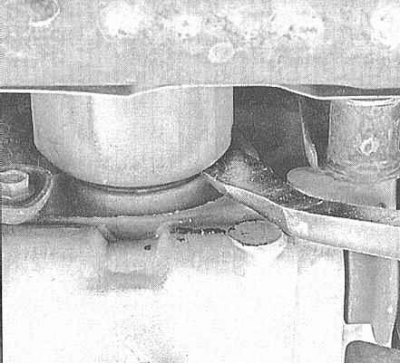
1. Remove the wheel hub cap. If the hub nut is countersunk, bend the locking tab using a center punch or chisel.
Note: On some models, the wheel cap is secured with wheel nuts. In this case, the nuts should be loosened, then the car should be raised off the ground, the cap removed, the nuts screwed back into place, the car should be lowered to the ground, and only then should the hub nut be loosened.
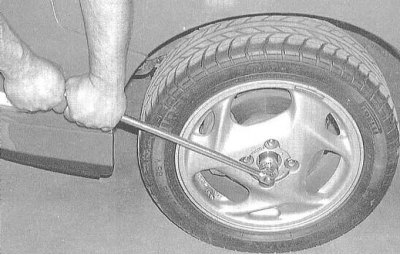
2. Loosen the hub nut using a socket wrench equipped with a long drive collar.
3. Loosen the nuts of the corresponding front wheel, jack up the vehicle and support it. Remove the wheel. Drain the transmission fluid/ATF (see Chapter Settings and ongoing maintenance).
4. Disconnect the damper fork from the shock absorber assembly and the lower control arm of the suspension (see Chapter Suspension and steering).
5. Release the lower control arm of the suspension from the steering knuckle (see Chapter Suspension and steering). Now finally loosen the hub nut.
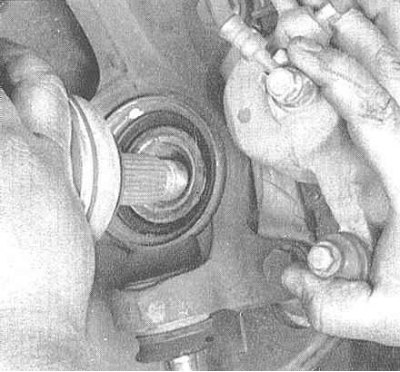
6. Tilt the hub assembly outward, releasing the drive shaft journal from it.
Note: If the drive shaft is "stuck" and cannot be removed from the hub, tap its end with a soft-faced hammer. Tie the outer end of the drive shaft with wire to one of the suspension components, thereby eliminating unnecessary loads on the inner CV joint assembly.
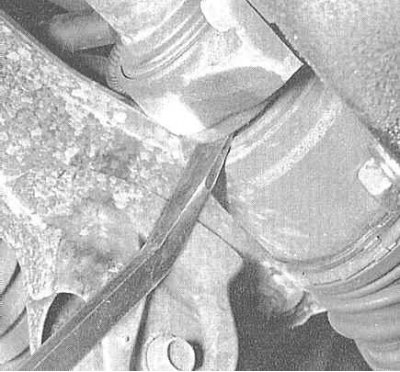
7. Using a gentle prying motion, free the inner end of the drive shaft from the final drive of the transmission or intermediate shaft assembly. A tire iron works well as a lever, inserting it into the gap between the inner CV joint housing and the transmission housing/intermediate shaft bearing support. Holding the CV joints, carefully remove the drive shaft assembly from under the vehicle. To avoid damaging the intermediate shaft/differential seal, try to keep the inner CV joint horizontal until the shaft journal is completely free from its seat.
 |
 |
Installation
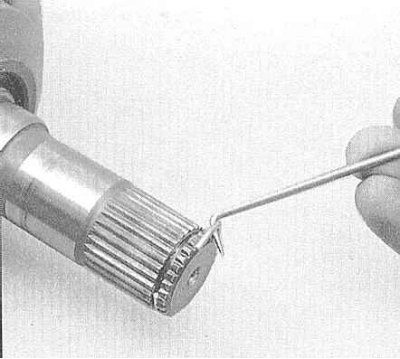
1. Remove the snap ring from the inner end of the drive shaft and replace it with a new one. Lubricate the lips of the intermediate shaft/differential seal with multi-purpose grease, then carefully move the drive shaft into its normal position, holding it by the CV joints.
 |
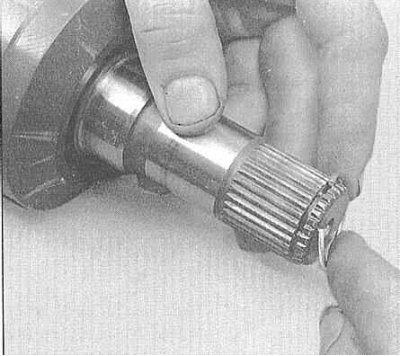 |
2. Carefully insert the splined inner CV joint journal into the mounting socket in the transmission housing or intermediate shaft. Make sure the snap ring snaps securely into the mounting groove.
3. Lightly lubricate the splines of the outer CV joint journal with multi-purpose grease, pull the hub assembly outward and carefully tuck the end of the shaft into it.
4. Insert the lower control arm ball joint stud into the steering knuckle and tighten the nut to the specified torque (see Specifications in Chapter Suspension and steering). Do not forget to replace the cotter pin. Install the damper fork in place (see Chapter Suspension and steering).
5. Screw on the hub nut (if necessary, do not forget to replace the lock washer) and tighten it securely.
Attention! The final tightening of the hub nut with the required force is performed after the car is lowered to the ground.
6. Grasp the inner CV joint housing (not the shaft) and pull it outward, checking to make sure the journal is securely locked into the transmission/intermediate shaft assembly.
7. Replace the wheel, secure it with nuts and lower the car to the ground.
8. Tighten the wheel nuts to the required torque (see Specifications in Chapter Settings and ongoing maintenance) and the hub nut. Using a center punch, countersink the hub nut. Install the wheel hub cap.
9. Fill the transmission with the required amount of oil/ATF of the required grade (see Chapter Settings and ongoing maintenance).