
HondaBook.ru
Auto companies Volkswagen Auto companies Ford Auto companies Lada Auto companies Skoda Auto companies BMW Auto companies Mazda Auto companies Peugeot
English Русский
Български
Беларускі
Український
Српски
Hrvatski
Română
Polski
Slovenský
Magyar
Bookmark Contacts Sitemap   


Accord Civic Fit / Jazz CR-V HR-V Others Articles
Accord 3 (1985-1989) Accord 6 (1997-2002)

Checking the condition, removing and installing the brake disc (Honda Accord 6)

  • Main
  • Honda Accord
  • 6 (1997-2002)
  • Chassis and running gear
  • Brake system
  • Checking the condition, removing and installing the brake disc
0
Contents: Checking the status ⇊ Removal ⇊ Installation ⇊
Note: The procedure applies equally to both front and rear disc brakes.


Checking the status


1. Loosen the wheel nuts, jack up the car and support it. Remove the wheel in question, then screw the pair of wheel nuts back onto the studs, using 3mm washers underneath to secure the brake disc (if the two disc mounting screws are still in place, there is no need to screw the nuts back on). When checking the rear brake disc, remember to release the parking brake.

2. Remove the brake caliper (see Section Removal and installation of disc brake calipers) and tie it to the side with wire to the suspension element without disconnecting the brake hose.
2. Remove the brake caliper (see Section Removal…


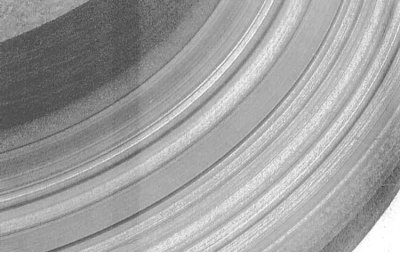
3. Visually inspect the condition of the disc working surface. Minor defects can be removed using fine-grained sandpaper. To remove grooves deeper than 0.38 mm, the disc should be lapped. Remember that the disc should be inspected from both sides.
3. Visually inspect the condition of the disc…


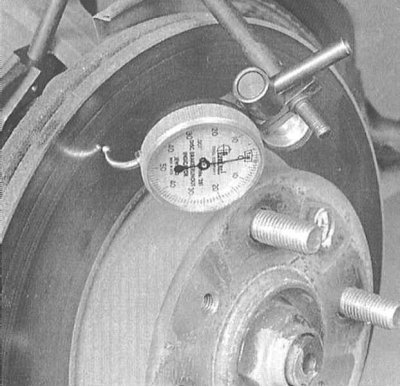
4. If pedal pulsation is observed during braking, the lateral runout of the brake disc should be assessed. Attach a plunger-type dial gauge (DTI) approximately 12.7 mm from the outer edge of the disc.


4. If pedal pulsation is observed during braking,…


5. Zero the device and start rotating the disk. The measurement result should not go beyond the permissible range specified in the Specifications, otherwise the disk must be given for turning.

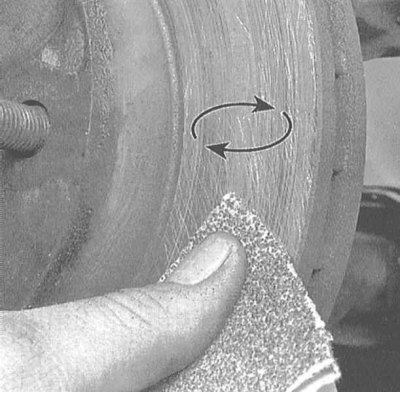
Note. The authors of this Manual recommend turning the disks regardless of their condition in order to remove any defects from the working surfaces. In extreme cases, you can limit yourself to processing the disk with fine-grained sandpaper.

Note. The authors of this Manual recommend…


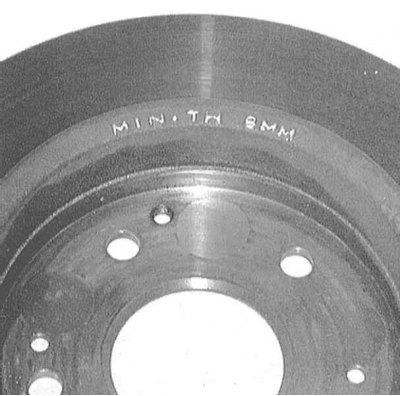
6. When turning the disk, special attention should be paid to compliance with the requirements of the Specifications for its minimum permissible thickness. The corresponding marking is provided on the end surface of the disk.
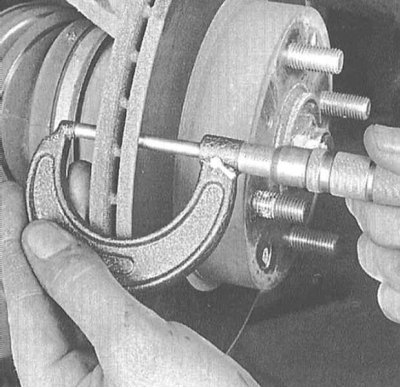
6. When turning the disk, special attention…


7. The thickness of the disc is measured using a micrometer.


Removal
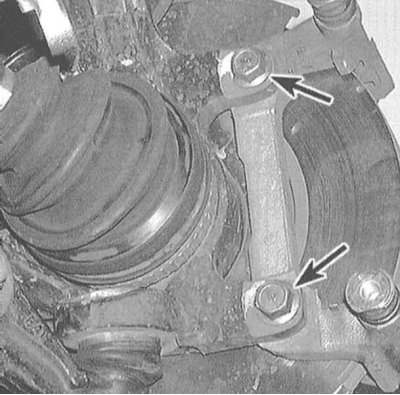


Removal


1. Remove the two bolts securing the caliper anchor bracket to the steering knuckle,
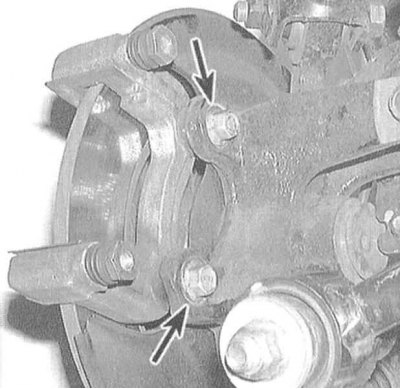
1. Remove the two bolts securing the caliper…


2. or (on the rear wheel brake mechanism) the bolts securing the bracket to the hub assembly. Remove the bracket.
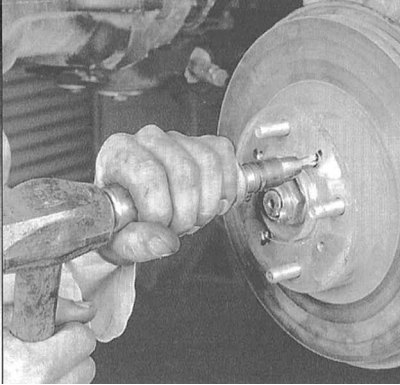
2. or (on the rear wheel brake mechanism) the…


3. Remove the two wheel nuts used to secure the disc to the hub/unscrew the two mounting screws. Remove the disc from the wheel hub.
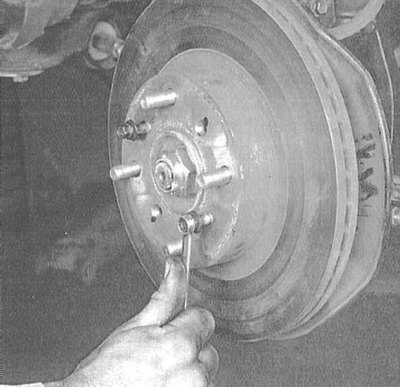


3. Remove the two wheel nuts used to secure the…


4. If the disc is "stuck" to the hub, it can be pressed out by screwing a pair of bolts of the appropriate size into the mounting holes. Tighten the bolts evenly and gradually until the disc is completely free. When removing the disc, try not to damage the threads of the wheel mounting studs.

Installation


1. Carefully place the disc on the hub (again, be careful not to damage the wheel studs). Screw in and tighten the mounting screws securely.

2. Install the caliper anchor bracket onto the disc. Tighten the bracket and caliper mounting bolts to the required torque.

3. Replace the wheel, lower the vehicle to the ground and tighten the wheel nuts to the specified torque (see Specifications in Chapter Settings and ongoing maintenance). Press the brake pedal/cock the parking brake lever several times to seat the pads on the disc. If the brake hoses were not disconnected, there is no need to bleed the hydraulic system. Before operating the vehicle, make sure that the brakes are functioning properly.
This article is available at: russian, bulgarian, belarusian, ukrainian, serbian, croatian, romanian, polish, slovak, hungarian
This information has been verified: Timofey Goryachev
Share with friends:
◀ Previous
Accord 6: Brake system
Next ▶

Removal and installation of disc brake calipers
Replacement of brake pads of disc brake mechanisms
Anti-lock Brake System (ABS) — General Information and Error Codes
Brake system — general information
Brake system specifications
Replacing the shoes of the rear wheel drum brake mechanisms
Removal and installation wheel cylinders
Removal and installation the master brake cylinder
Checking the condition and replacing brake lines and hoses
Bleeding the brake system
See also other articles from Honda manuals:
Checking the condition, removing and installing the brake disc Honda Civic 6 (1995-2000)
Checking tire pressure and condition Honda Fit 1 (2001-2008)
Battery — Checking, Removing and Installing Honda CR-V 1 (1995-2001, petrol)
Front Brake Disc — Checking Runout Honda HR-V 1 (1998-2006, petrol)
Front Brake Discs — Brake Disc Grinding Honda Avancier 1 (1999-2003, petrol)
Link in different formats to this article
Comments and feedback from visitors
No comments yet


How much will 46 + 43 ?


Accord 6 (1997-2002) 
  • General information
  • Introduction to the guide
  • User manual
  • Maintenance
  • Power unit
  • Four-cylinder engines
  • Six-cylinder engines
  • Engine overhaul
  • Cooling system
  • Heater and air conditioner
  • Power and exhaust systems
  • Engine electrical equipment
  • Engine management
  • Transmission
  • Mechanical gearbox
  • Automatic gearbox
  • Clutch and drive shafts
  • Chassis and running gear
  • Brake system
  • Car suspension
  • Steering
  • Body and interior
  • Exterior (external elements)
  • Interior (internal elements)
  • Electrical equipment
  • Equipment and devices
  • Electrical circuits
Accord 3 (1985-1989) 
  • General information
  • Maintenance
  • Power unit
  • Engine adjustment
  • Engine repair
  • Engine electrics
  • Emission management
  • Engine management (carburetor)
  • Electronic injection
  • Programmable injection
  • Schematic of emission system
  • Fuel system
  • Feedback management
  • Transmission
  • Manual gearbox
  • Automatic gearbox
  • Clutch
  • Chassis and running gear
  • Front suspension
  • Rear suspension
  • Steering
  • Brake system
  • Electrical equipment
  • Ventilation and heating
  • Air conditioner
  • Cruise control system
  • Equipment and devices
HondaBook.ru © 2018–2026 • Mobile version • Sitemap: EN BG BY UA RS HR RO PL SK HU • Feedback • Driver Information • Search system • Bookmark
Accord 3 (1985-1989) • Accord 6 (1997-2002) • Civic 3 and 4 (1983-1991) • Civic 5 and 6 (1991-2000) • Civic 6 (1995-2000) • Civic 7 (2000-2005) • Civic 8 (2005-2011) • Fit 1 (2001-2008) • CR-V 1 (1995-2001) • CR-V 2 (2002-2006) • HR-V 1 (1998-2006) • Avancier 1 (1999-2003) •
 
This website uses cookies to ensure proper functioning. By clicking "OK," you agree.