
Carburetor engines
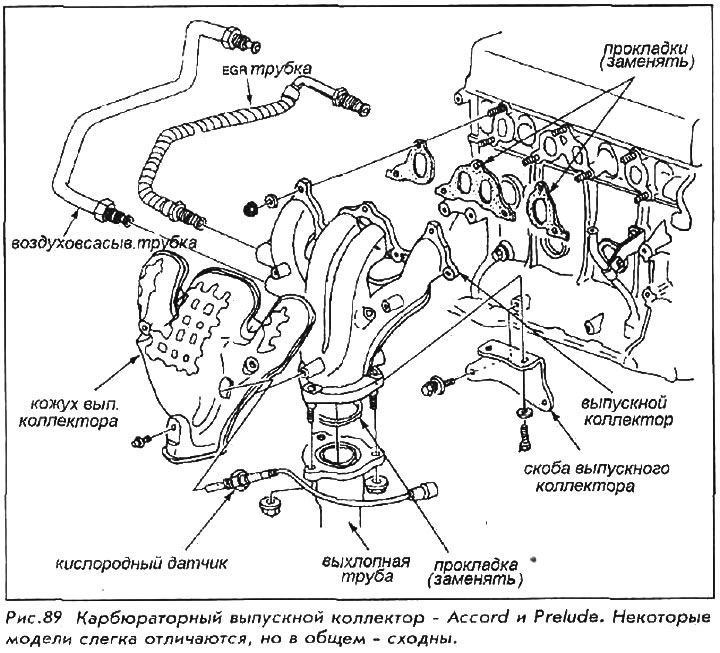
WARNING: DO NOT perform this procedure on a hot or even warm engine.
1. Raise and secure the vehicle.
2. Unscrew the nuts securing the manifold to the exhaust pipe, remove the pipe, move the pipe away from the manifold, not allowing it to dangle by itself.
3. Disconnect and remove the oxygen sensor.
4. Remove the exhaust manifold cover or heat shield.
5. Remove the mounting post bolts.
6. In a crisscross pattern (starting from the center), remove the nuts securing the exhaust manifold to the cylinder head, the exhaust manifold itself, and the gaskets. (Do not reuse the gaskets)
Removal the exhaust manifold bolts is a very labor-intensive operation, as they become covered with a layer of carbon and rust. The work is made easier if the bolt threads are coated with oil or kerosene several hours before installation.
7. Using a putty spatula or other suitable tool, clean the surfaces in contact with the gasket. Check the surfaces with a ruler for possible distortion.
To install:
8. Using new gaskets, place the manifold in place and, supporting it, install the nuts onto the rods.
9. Install the support stands below the manifold and tighten the mounting bolt to 28 Nm.
10. Starting with the inner or central nut, tighten them in a crisscross pattern to the correct torque. For all carburettor engines, this is 32 Nm. This is necessary to prevent leakage, which is inevitable when the load on the manifold cover is unevenly distributed.
11. Install the heat protection cover.
12. Attach the exhaust pipe using new gaskets and nuts. Tighten the nuts securing the pipe to the manifold with a tightening torque of 55 Nm.
For fuel injected engines
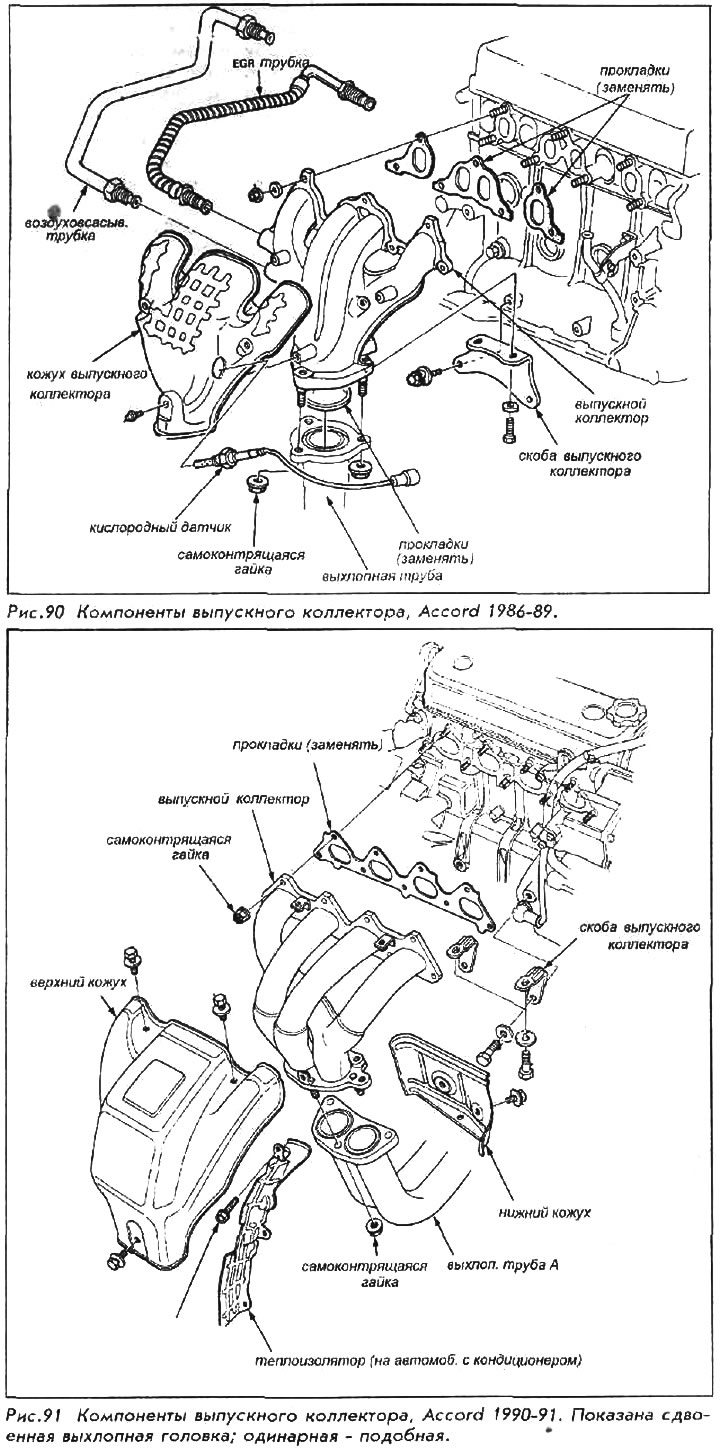
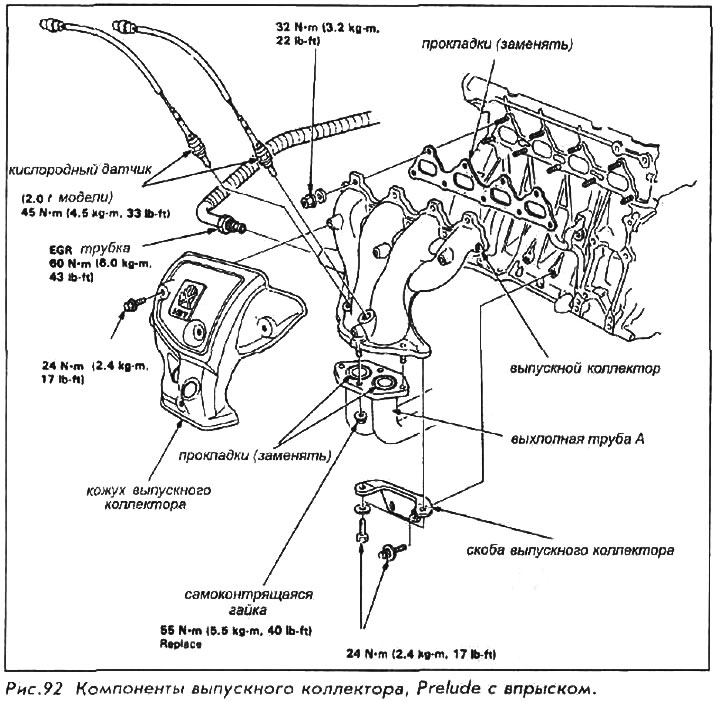
ATTENTION! Perform this manipulation only on a cold engine.
1. Raise and securely support the vehicle.
2. To gain access, remove the front grille, disconnect the contacts from the oxygen sensor and remove the sensor itself from the exhaust manifold.
3. Remove the nuts securing the exhaust pipe to the exhaust manifold. Disconnect the exhaust pipe and remove the gasket.
4. Remove the bolt securing the heat shield to the exhaust manifold and the shield itself. Remove the bolts securing the exhaust manifold struts to the engine, the nuts securing the exhaust manifold to the cylinder head, their washers, the manifold and gaskets (gaskets are not reused).
5. Clean the surfaces adjacent to the gasket. Using a ruler, check the curvature of the surfaces; if the surfaces in contact with the cylinder head are curved, they require processing on a machine.
To install:
6. Using new gaskets, install the manifold in place and, supporting it, install the nuts on the rods.
7. Install the support posts under the manifold, tighten the bolt securing the posts to the manifold with a force of 28 Nm.
8. Starting with the center or inner nuts, tighten them in a crisscross pattern with uniform tightening torque across the entire surface of the manifold to prevent leaks. The required tightening torque is 32 Nm for all vehicles.
9. Install the heat shield.
10. Attach the exhaust pipe to the manifold using new nuts and gaskets. Tightening torque of the nuts is 55 Nm.
11. Install the oxygen sensor, tightening it to 45 Nm. Connect the wires to it.
12. Install the EGR pipe (exhaust gas recirculation pipe), if it was removed, use a new gasket.
13. Install the front grille.