
The best way out in this situation is not to rush, but to start collecting your set with those tools that will be used most often. Do not be deceived by the low price of tools when buying, sometimes it is much better to spend a little more, but win in quality.
A handful of tools, plus some skill with them, are all that's required to get started. A basic mechanic's kit consists of wrenches, sockets, and torque wrenches. In addition to the normal assortment of screwdrivers, nippers, and pliers, you should have the following tools for routine maintenance on your car (virtually every fastener on your Accord or Prelude is metric):
- 1. Wrenches, socket wrenches and combination wrenches with sizes from 3 mm to 19 mm, and spark plug sockets (20.6 cm or 15.9 cm). If possible, purchase socket wrenches of different lengths.
- 2. Supports for the vehicle.
- 3. Oil filter wrench.
- 4. A groove or funnel for pouring oil.
- 5. A small oil can and syringe(s) for injecting grease.
- 6. Hydrometer for checking the battery.
- 7. Low-sided flat oil drain pan.
- 8. A large quantity of rags for wiping.
In addition to the above items, there are several others that are not absolutely necessary but are handy to have on hand. These include a spill absorbent pad, a transmission fluid funnel, and commonly used lubricants, antifreeze, and fluids, although these can be purchased as needed. This is a basic list for routine maintenance, but only your personal needs and desires can determine the exact list of tools you will need. After doing a few jobs on your car, you will be amazed at the other tools and items you have on your workbench. Some common household items that would be useful to have nearby include a siphon, empty coffee cans, a roll of string, electrical tape for mounting, small rolls of colored tape for labeling, markers and pens, a strong magnet, and a small mirror (for inspecting under the manifold).
The second list of tools is for adjustments. Since these tools are not much more complicated, they should not be prohibitively expensive. A basic list of adjustment equipment might include:
1. A device for determining the speed of rotation of a shaft in degrees.
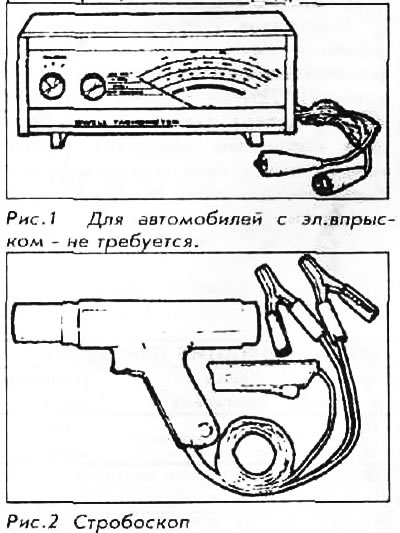
2. Candle key.
3. Stroboscope (battery powered is best, although a regular 220V socket will do). It will save a little time, allowing you to examine the illuminated object faster than if you disconnected and removed it.
4. Measuring and adjusting tools for spark plugs.
5. A set of feeler gauges for adjusting the spark plug gap.
In addition to these basic tools, there are several other tools and measuring devices that you will find useful. These are:
1. Compression gauge. The screw-in type is slower to use, but eliminates the possibility of erroneous readings by releasing pressure. The push-in type is faster, but less accurate. Also, the push-in type is not suitable for use on certain types of engines with deep-cut spark plug holes.
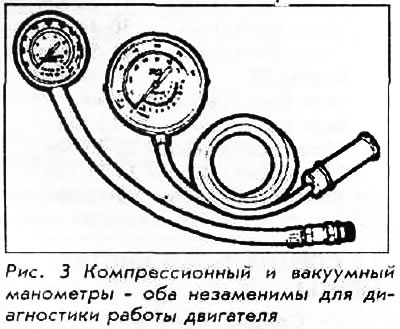
2. Manifold vacuum gauge.
3. Test lamp.
4. Induction meter. Used to determine whether there is current in the wire or not. It is convenient if there is a break in the harness wire.
5. In the age of electronics, almost any diagnostics cannot be done without a voltmeter or ohmmeter. Fortunately, they are often combined into one volt-ohmmeter. An analog type with an arrow indicator is suitable for most diagnostic work. But if you need to work on an entire block or circuit, you will need a high-resistance digital volt-ohmmeter.
As a final note, you'll probably find that a torque wrench is necessary for almost everything, but primarily for basic work. Regular, beam wrenches are fine, although newer breakaway wrenches are more accurate and don't require you to crane your neck to check the torque. Breakaway wrenches are more expensive and require periodic calibration.
A good torque wrench will be deservedly expensive. If you have one, handle it with care. Its accuracy can be impaired by throwing or other forms of "vandalism". Keep it away until needed. Also, do not use a torque wrench for tightening that does not require precise torque - a regular ratchet will do.
The torque value for each fastener will be specified for those procedures where it is required. If torques are not specified, use the following values as a guide based on the size of the fastener:
Bolts 6T
- 6mm bolt/nut - 4-5 Nm
- 8mm bolt/nut - 9-13 Nm
- 10mm bolt/nut - 17-25 Nm
- 12mm bolt/nut - 30-44 Nm
- 14mm bolt/nut - 41-56 Nm
Bolts 8T
- 6mm bolt/nut - 4-7 Nm
- 8mm bolt/nut - 10-15 Nm
- 10mm bolt/nut - 20-30 Nm
- 12mm bolt/nut - 34-51 Nm
- 14mm bolt/nut - 55-75 Nm