
Checking the fluid level
1. The car must be parked on a smooth, level surface and the engine must be warmed up. The test is performed with the engine off.
2. Remove the dipstick from the meter tube and wipe it clean. Insert the dipstick into place until it stops in the pipe, then remove the dipstick and determine the level by the position of the liquid film, which should be between the marks on the dipstick.
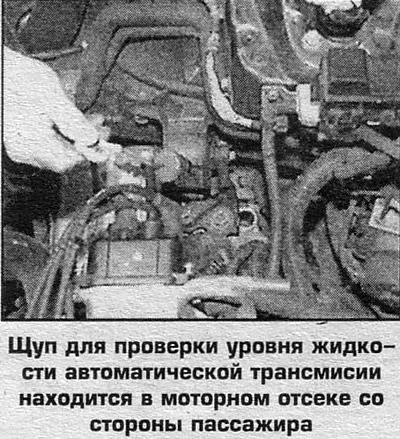
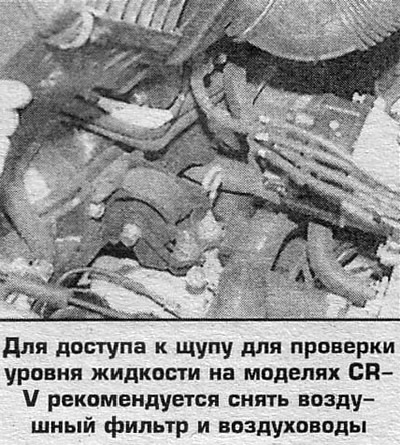
3. If the level is below the lower mark, add liquid through the measuring pipe by inserting a funnel (on CR-V and 4-cylinder Odyssey models), or through a hole in the transmission housing next to the level gauge, closed with a plug with a hexagonal recess for a key (on Odyssey V6). The upper liquid level must not be exceeded.
Transmission fluid replacement
1. Warm up the fluid by driving. Raise the front of the car.
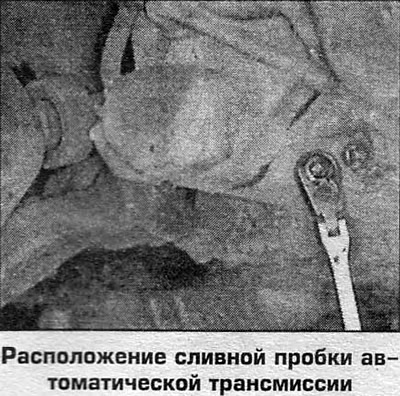
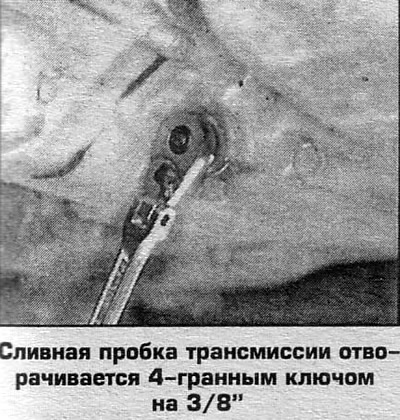
2. Unscrew the drain plug (photo) and drain the liquid. Screw the plug back on, replacing the seal. Tighten the plug to 49 Nm.
3. Pour the liquid through the measuring pipe, inserting a funnel (on CR-V and 4-cylinder Odyssey models), or through a hole in the transmission housing next to the level gauge, closed with a plug with a hexagonal recess for a key (on Odyssey V6). The upper liquid level must not be exceeded.
4. Run the engine for 1 minute and add fluid so that the level is 3 mm below the upper mark on the dipstick. Warm up the engine and check the level, which should be in the HOT range. If necessary, add fluid to the upper mark of the HOT range.