
General parameters
| I-probe voltage, V | |
| When the circuit is open | 0.1÷0.2 |
| With a closed circuit | 0.1÷0.9 |
| Crankshaft Position/TDC Sensor Resistance (CKP/TDC), Ohm | 1850÷2450 |
| Resistance of the piston position sensor (CYP), Ohm | 800÷1500 |
Layout of engine management/emission control components in the engine compartment of 4-cylinder models
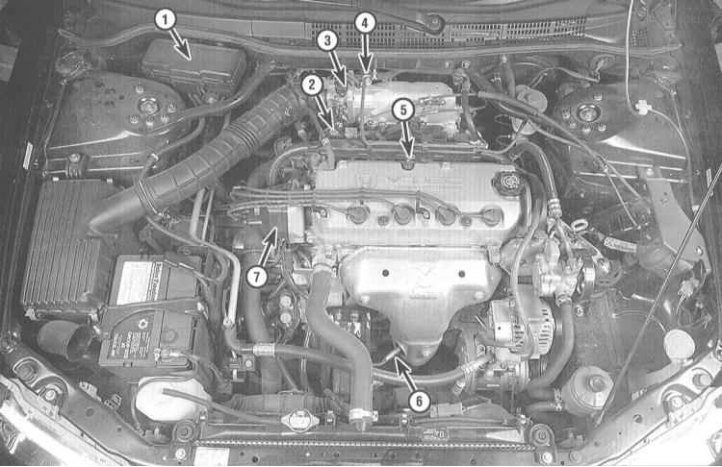
1 - Electrical Load Detector (ELD) (included in central fuse/relay box); 2 - Exhaust gas recirculation (EGR) valve; 3 - Absolute pressure sensor in the pipeline (MAP); 4 - Idle speed control valve (IAC); 5 - Valve of the crankcase controlled ventilation system (PCV); 6 - Oxygen sensor (l-probe); 7 - Piston position sensor (CYP) (part of the ignition distributor)
Engine compartment layout of engine management/emission control components for V6 models
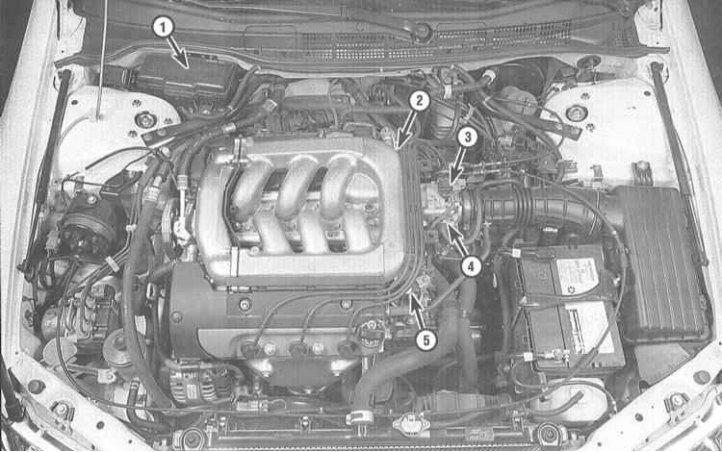
1 - Electrical Load Detector (ELD) (under fuse box); 2 - Valve of the crankcase controlled ventilation system (PCV); 3 - Absolute pressure sensor in the pipeline (MAP); 4 - Throttle Position Sensor (TPS); 5 - Exhaust gas recirculation (EGR) valve
In order to reduce the level of emissions into the atmosphere of toxic components that enter the composition of engine exhaust gases as a result of evaporation and incomplete combustion of fuel, as well as to maintain engine efficiency and reduce fuel consumption, the vehicles discussed in this Manual are equipped with a number of special systems that could be combined under the general name of engine management and exhaust toxicity reduction systems.
The systems related to engine management and exhaust gas toxicity control include the following:
- a) On-Board Diagnostics (OBD) system;
- b) Electronic engine management system (PGM-FI);
- c) Electrical Load Detector (ELD);
- d) Exhaust gas recirculation (EGR) system;
- e) Evaporative emission control system (EVAP);
- f) Controlled crankcase ventilation (PCV) system;
- g) Catalytic converter.
The operation of all of the listed systems is, one way or another, directly or indirectly, connected with the management of reducing the toxicity of exhaust gases.
The following Sections provide general descriptions of the operating principles of each system, and procedures for diagnostic testing and reconditioning (if possible) of system components that are within the skill level of the average amateur mechanic.
Before concluding that any of the emission control systems has failed, carefully check the proper functioning of the fuel and ignition systems (see Chapters Power and exhaust systems and Engine electrical equipment). Diagnostics of some of the units of the toxicity reduction systems requires the use of special, difficult-to-use equipment and a certain qualification of the performer, and therefore, it would be reasonable to entrust its implementation to professional mechanics of a specialized service station.
The above does not mean that maintenance and repair of emission control system components are difficult to perform in practice. Remember that one of the most common causes of failure is a basic violation of the quality of vacuum or electrical connections, and therefore, first of all, you should always check the condition of the nipples and electrical connectors. The car owner can independently and quite easily perform a number of checks, as well as perform many routine maintenance procedures for most system components at home, using a standard set of adjustment and plumbing tools. Note: Do not forget about additional federal warranty obligations, which fall under the components of emission control and engine management systems. Before starting any repair procedures for units and parts of these systems, consult about the conditions for compliance with these obligations at a representative office of Honda.
Please take all precautions specified in the following Sections when servicing the electronic components of the systems in question. It should be noted that the illustrative material may not always exactly correspond to the actual placement of components on the vehicle. Such discrepancies are due to the ongoing modification process within the standard design of each model.
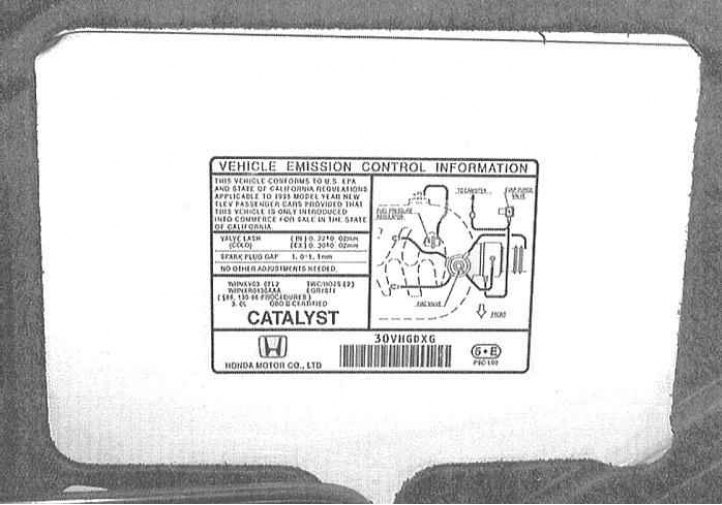
The Vehicle Emission Control Information Label (VECI) is located in the engine compartment of the vehicle. The label contains the necessary information on the settings and tests of the systems under control, taking into account all modifications made to the specific vehicle, as well as a diagram of the vacuum hose routing with identification of the various components. Before servicing the emission control and engine management systems, carefully read the VECI data.
[Material obtained from the website: HONDABOOK]