


Contents: Examination ⇊ Replacement ⇊
Knock sensors respond to increased engine vibrations, usually caused by detonation of the air-fuel mixture. Based on the information received from the sensor, the PCM adjusts the ignition timing, trying to maintain it at the maximum possible level, which guarantees sufficient engine efficiency. The sensor generates an alternating current signal, the amplitude of which increases proportionally to the vibration level. To compensate for detonations, the PCM, if necessary, issues a command to shift the ignition timing towards retarding.
Examination
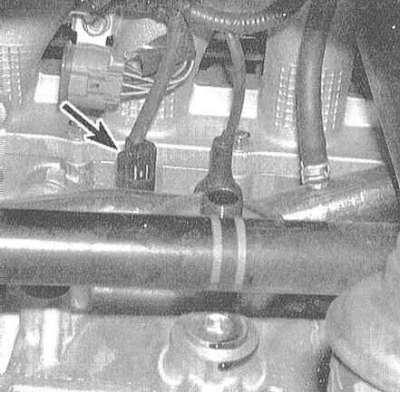
Disconnect its electrical connector from the knock sensor and drain the coolant from the engine (see Chapter Settings and ongoing maintenance). Unscrew the knock sensor from the engine block. Reconnect the connector to the sensor. This type of sensor is checked by recording voltage fluctuations using a voltmeter. Switch the device to the low voltage AC scale. Connect the negative probe of the meter to the sensor body, and the positive probe to the contact terminal. Lightly tap the bottom of the sensor with a hammer, simulating vibration. If the voltmeter does not register voltage fluctuations, the sensor should be replaced.
Note: In principle, this check can be performed without removing the sensor from the engine.
Replacement
Attention! Before starting the procedure, wait until the engine has completely cooled down.
1. Disconnect the negative cable from the battery.
Warning! If the car stereo system is equipped with a security code, make sure you have the correct combination to activate the audio system before disconnecting the battery!
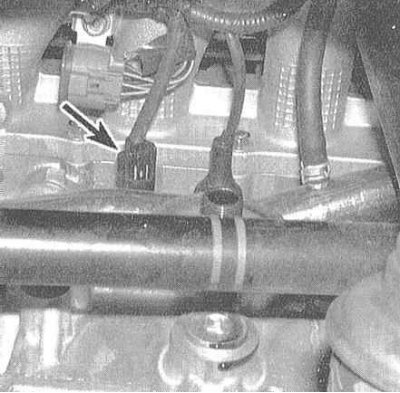
2. The knock sensor is screwed into the engine block cooling tract channel and its unscrewing is associated with certain losses of coolant, which can be avoided by draining the block in advance (see Chapter Settings and ongoing maintenance). Disconnect the electrical connector and unscrew the sensor from the engine.
3. New sensors are usually supplied with the threaded part coated with anti-seize sealant. Screw the replacement sensor into the regular place and tighten it to the required torque (approximately 19 Nm).
Note: Overtightening the knock sensor may cause permanent damage. Reconnect the sensor wiring and fill the cooling system (see Chapter Settings and ongoing maintenance). Check the engine for signs of coolant leaks.
(The original is located on the website «HONDABOOK»)