HondaBook.ru
Auto companies Volkswagen Auto companies Ford Auto companies Lada Auto companies Skoda Auto companies BMW Auto companies Mazda Auto companies Peugeot
English Русский
Български
Беларускі
Український
Српски
Hrvatski
Română
Polski
Slovenský
Magyar
Bookmark Contacts Sitemap   


Accord Civic Fit / Jazz CR-V HR-V Others Articles
Accord 3 (1985-1989) Accord 6 (1997-2002)

Checking the serviceability and replacing the idle speed control valve (IAC) (Honda Accord 6)

  • Main
  • Honda Accord
  • 6 (1997-2002)
  • Power unit
  • Engine management
  • Checking the serviceability and replacing the idle speed control valve (IAC)
0
Contents: General information ⇊ Examination ⇊ Replacement ⇊

General information


When the engine is idling, the air-fuel mixture is controlled by the idle speed stabilization valve (IAC). The IAC valve is activated by the PCM, depending on the current engine load (air conditioning on, power steering on, engine temperature, etc.). The valve regulates the amount of air flow supplied to the intake manifold bypassing the throttle valve. The PCM receives initial data from the VSS, ECT, PSP and A/C compressor clutch sensors. Depending on the current engine load, the module adjusts the engine idle speed accordingly. To avoid disruption of idle speed stability when starting the engine, the IAC valve opens when the engine is cranking and remains open for some time immediately after starting, providing additional air supply to the intake manifold.

Examination


Caution: When working in the engine compartment, try to keep hands, hair and clothing away from moving components such as drive belts, fan blades, etc.


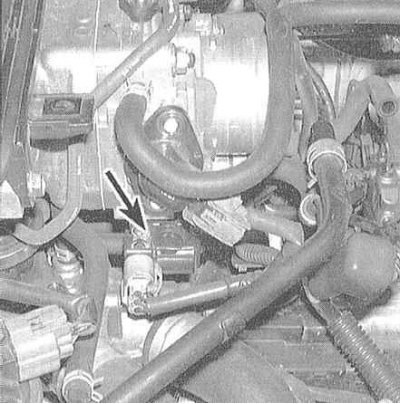
1. Set the parking brake, chock the vehicle wheels and shift the transmission into neutral (manual transmission) or into position "P" (automatic transmission). Connect a tachometer to the engine in accordance with the manufacturer's instructions. Start the engine and increase its speed to 3000 rpm. Wait until the cooling fan starts, then reduce the speed to idle and record the tachometer readings (the cooling fan and all electrical consumers must be switched off). If the crankshaft speed is 650-700 rpm, the system is functioning properly. If the measurement result is below 650 rpm, disconnect the electrical connector of the IAC valve. When disconnecting the valve, there should be a noticeable decrease in engine speed, otherwise the valve is most likely faulty. If the RPM drop occurs and the problem of maintaining RPM stability persists, check the condition of the wiring harness and its connections between the IAC valve and the PCM.


1. Set the parking brake, chock the vehicle…

2. If the tachometer registers a value greater than 750 rpm, stop the engine and disconnect the air intake duct from the throttle body. Run the engine at idle speed. Block the lower port of the throttle body (connected to the IAC valve) with your finger - if the speed drops noticeably, adjust the idle speed setting to match the requirements of the Specifications (see Chapter Settings and ongoing maintenance). If adjustment fails, replace the IAC valve. If there is no drop in speed, check the intake tract for signs of vacuum loss.

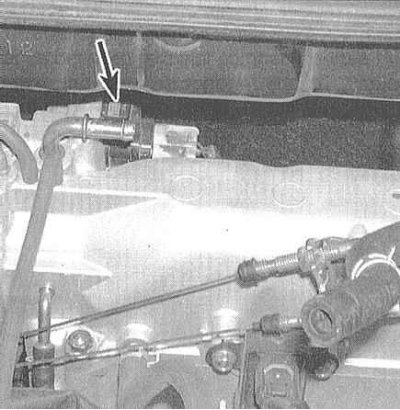
3. If the test confirms that the IAC valve is working properly, but the problem with the instability of speed remains, check the condition of the electrical wiring and its contact connections in the area between the valve and the PCM.


3. If the test confirms that the IAC valve is…


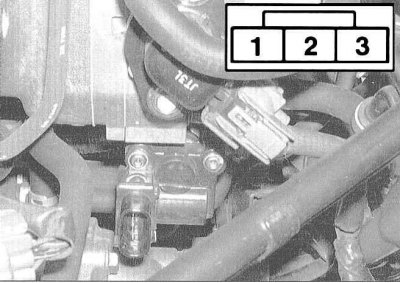
4. Check for proper battery power to the IAC valve. Disconnect the wiring from the valve, turn on the ignition (do not start the engine) and measure the voltage between terminal No.2 of the harness side connector and ground. The nominal value is equal to battery voltage. If there is no power, check the condition of the wiring in the circuit between the IAC valve and the PGM-FI main relay (see the wiring diagrams in Chapter On-board electrical equipment).

5. Using an ohmmeter, measure the resistance between terminal 1 of the IAC valve and ground. The device should register continuity, otherwise, perform restorative repairs to the ground.

6. If the results of both tests are positive, take the car to a service station for more detailed diagnostics.

Replacement


1. Disconnect the electrical wiring from the IAC valve.

2. On V6 models, remove the throttle body from the intake manifold (see Chapter Power and exhaust systems).

3. Remove the two mounting screws and remove the valve from the intake manifold (4-cylinder models) or throttle body (V6 models).

4. Installation is carried out in the reverse order. Do not forget to replace the sealing ring.

(The text can be found on the website: HONDABOOK.ru)
This article is available at: russian, bulgarian, belarusian, ukrainian, serbian, croatian, romanian, polish, slovak, hungarian
This information has been verified: Timofey Goryachev
Share with friends:
◀ Previous
Accord 6: Engine management
Next ▶

Checking the condition and replacing the vehicle speed sensor (VSS)
Checking the condition and replacing the knock sensor
Checking the condition and replacing the oxygen sensor (λ-probe)
Checking the condition and replacing the pressure switch in the power steering…
Checking the condition and replacing the electrical load detector (ELD)
Checking and replacing the air valve for adjusting the air-fuel mixture (FIA)
Controlled Crankcase Ventilation (PCV) System
Exhaust Gas Recirculation (EGR) System — General Information and Testing
Evaporative Emissions (EVAP) System — General Information, Testing, and…
Catalytic Converter — General Information, Checking and Replacement
See also other articles from Honda manuals:
Checking and replacing the fast idle speed (FIT) temperature… Honda Civic 6 (1995-2000)
Checking the idle speed on a cold engine Honda Fit 1 (2001-2008)
Idle Air Control Valve (IAC valve) Honda CR-V 1 (1995-2001, petrol)
Idle Speed Control System — Description Honda HR-V 1 (1998-2006, petrol)
Checking idle speed on a cold engine Honda Avancier 1 (1999-2003, petrol)
Link in different formats to this article
Comments and feedback from visitors
No comments yet


How much will 38 + 23 ?


Accord 6 (1997-2002) 
  • General information
  • Introduction to the guide
  • User manual
  • Maintenance
  • Power unit
  • Four-cylinder engines
  • Six-cylinder engines
  • Engine overhaul
  • Cooling system
  • Heater and air conditioner
  • Power and exhaust systems
  • Engine electrical equipment
  • Engine management
  • Transmission
  • Mechanical gearbox
  • Automatic gearbox
  • Clutch and drive shafts
  • Chassis and running gear
  • Brake system
  • Car suspension
  • Steering
  • Body and interior
  • Exterior (external elements)
  • Interior (internal elements)
  • Electrical equipment
  • Equipment and devices
  • Electrical circuits
Accord 3 (1985-1989) 
  • General information
  • Maintenance
  • Power unit
  • Engine adjustment
  • Engine repair
  • Engine electrics
  • Emission management
  • Engine management (carburetor)
  • Electronic injection
  • Programmable injection
  • Schematic of emission system
  • Fuel system
  • Feedback management
  • Transmission
  • Manual gearbox
  • Automatic gearbox
  • Clutch
  • Chassis and running gear
  • Front suspension
  • Rear suspension
  • Steering
  • Brake system
  • Electrical equipment
  • Ventilation and heating
  • Air conditioner
  • Cruise control system
  • Equipment and devices
HondaBook.ru © 2018–2026 • Mobile version • Sitemap: EN BG BY UA RS HR RO PL SK HU • Feedback • Driver Information • Search system • Bookmark
Accord 3 (1985-1989) • Accord 6 (1997-2002) • Civic 3 and 4 (1983-1991) • Civic 5 and 6 (1991-2000) • Civic 6 (1995-2000) • Civic 7 (2000-2005) • Civic 8 (2005-2011) • Fit 1 (2001-2008) • CR-V 1 (1995-2001) • CR-V 2 (2002-2006) • HR-V 1 (1998-2006) • Avancier 1 (1999-2003) •
 
This website uses cookies to ensure proper functioning. By clicking "OK," you agree.