
HondaBook.ru
Auto companies Volkswagen Auto companies Ford Auto companies Lada Auto companies Skoda Auto companies BMW Auto companies Mazda Auto companies Peugeot
English Русский
Български
Беларускі
Український
Српски
Hrvatski
Română
Polski
Slovenský
Magyar
Bookmark Contacts Sitemap   


Accord Civic Fit / Jazz CR-V HR-V Others Articles
Accord 3 (1985-1989) Accord 6 (1997-2002)

Exhaust Gas Recirculation (EGR) System — General Information and Testing (Honda Accord 6)

  • Main
  • Honda Accord
  • 6 (1997-2002)
  • Power unit
  • Engine management
  • Exhaust Gas Recirculation (EGR) System — General Information and Testing
0
Contents: General information ⇊ Examination ⇊ Replacing EGR valve components ⇊

General information


In order to reduce the emission of nitrogen oxides into the atmosphere, the engine design provides for the removal of part of the exhaust gases into the intake manifold through the EGR valve. Such mixing of exhaust gases into the air-fuel mixture leads to a decrease in its combustion temperature.

The system consists of an EGR valve, an EGR valve opening degree sensor, a control module (PCM) and a set of auxiliary information sensors. The PCM is programmed to provide the optimum EGR valve opening degree for any engine operating conditions. A special information sensor constantly monitors the EGR valve opening degree, sending appropriate signals to the control module. The PCM compares the incoming sensor information with the optimum calculated value determined based on data received from other information sensors and, if necessary, makes the required adjustment of the exhaust gas volume entering the engine.

Examination


1. To check the proper functioning of the EGR valve opening degree sensor, disconnect the electrical wiring from the valve and check for presence.

2. Now you should check the operation of the EGR valve itself. Start the engine and warm it up to normal operating temperature. (The cooling fan should turn on). Now turn off the engine and disconnect the wiring from the EGR valve.
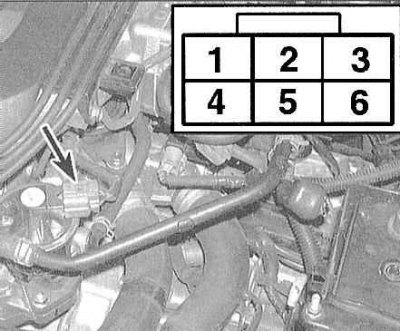
2. Now you should check the operation of the EGR…


3. Connect the positive battery terminal to terminal #4 of the EGR rivet with a jumper wire. Start the engine and connect the negative battery terminal to terminal #6 of the valve. The engine speed should become unstable, until it stops completely, otherwise replace the EGR valve.


4. Further testing of the EGR system requires the use of special tools and diagnostic equipment.

Replacing EGR valve components


1. Disconnect the wiring from the EGR valve opening degree sensor.
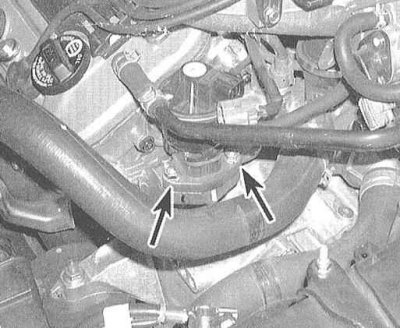
1. Disconnect the wiring from the EGR valve…


2. Loosen the two mounting nuts and remove the EGR valve.

3. Clean the mating surfaces of the valve and its adapter.

4. Replace the sealing gasket and install the EGR valve in its original place. Tighten the mounting nuts securely.

5. Restore the original electrical wiring connection.

(The original can be found on the resource: hondabook.ru)
This article is available at: russian, bulgarian, belarusian, ukrainian, serbian, croatian, romanian, polish, slovak, hungarian
This information has been verified: Timofey Goryachev
Share with friends:
◀ Previous
Accord 6: Engine management
Next ▶

Controlled Crankcase Ventilation (PCV) System
Checking and replacing the air valve for adjusting the air-fuel mixture (FIA)
Checking the serviceability and replacing the idle speed control valve (IAC)
Checking the condition and replacing the vehicle speed sensor (VSS)
Checking the condition and replacing the knock sensor
Evaporative Emissions (EVAP) System — General Information, Testing, and…
Catalytic Converter — General Information, Checking and Replacement
See also other articles from Honda manuals:
Exhaust Gas Recirculation (EGR) System Honda Civic 3 and 4 (1983-1991)
Catalytic converter and exhaust system Honda Fit 1 (2001-2008)
Recirculation system — general information Honda CR-V 1 (1995-2001, petrol)
Testing the Generator Control System (KG, KE, KQ and KU Models) Honda HR-V 1 (1998-2006, petrol)
Exhaust gas testing Honda Avancier 1 (1999-2003, petrol)
Link in different formats to this article
Comments and feedback from visitors
No comments yet


How much will 42 + 42 ?


Accord 6 (1997-2002) 
  • General information
  • Introduction to the guide
  • User manual
  • Maintenance
  • Power unit
  • Four-cylinder engines
  • Six-cylinder engines
  • Engine overhaul
  • Cooling system
  • Heater and air conditioner
  • Power and exhaust systems
  • Engine electrical equipment
  • Engine management
  • Transmission
  • Mechanical gearbox
  • Automatic gearbox
  • Clutch and drive shafts
  • Chassis and running gear
  • Brake system
  • Car suspension
  • Steering
  • Body and interior
  • Exterior (external elements)
  • Interior (internal elements)
  • Electrical equipment
  • Equipment and devices
  • Electrical circuits
Accord 3 (1985-1989) 
  • General information
  • Maintenance
  • Power unit
  • Engine adjustment
  • Engine repair
  • Engine electrics
  • Emission management
  • Engine management (carburetor)
  • Electronic injection
  • Programmable injection
  • Schematic of emission system
  • Fuel system
  • Feedback management
  • Transmission
  • Manual gearbox
  • Automatic gearbox
  • Clutch
  • Chassis and running gear
  • Front suspension
  • Rear suspension
  • Steering
  • Brake system
  • Electrical equipment
  • Ventilation and heating
  • Air conditioner
  • Cruise control system
  • Equipment and devices
HondaBook.ru © 2018–2026 • Mobile version • Sitemap: EN BG BY UA RS HR RO PL SK HU • Feedback • Driver Information • Search system • Bookmark
Accord 3 (1985-1989) • Accord 6 (1997-2002) • Civic 3 and 4 (1983-1991) • Civic 5 and 6 (1991-2000) • Civic 6 (1995-2000) • Civic 7 (2000-2005) • Civic 8 (2005-2011) • Fit 1 (2001-2008) • CR-V 1 (1995-2001) • CR-V 2 (2002-2006) • HR-V 1 (1998-2006) • Avancier 1 (1999-2003) •
 
This website uses cookies to ensure proper functioning. By clicking "OK," you agree.