
HondaBook.ru
Auto companies Volkswagen Auto companies Ford Auto companies Lada Auto companies Skoda Auto companies BMW Auto companies Mazda Auto companies Peugeot
English Русский
Български
Беларускі
Український
Српски
Hrvatski
Română
Polski
Slovenský
Magyar
Bookmark Contacts Sitemap   


Accord Civic Fit / Jazz CR-V HR-V Others Articles
Accord 3 (1985-1989) Accord 6 (1997-2002)

Checking the condition, adjusting the tension force and replacing the drive belts (Honda Accord 6)

  • Main
  • Honda Accord
  • 6 (1997-2002)
  • General information
  • Maintenance
  • Checking the condition, adjusting the tension force and replacing the drive belts
0
Contents: Examination ⇊ Adjustment ⇊ Replacement ⇊
(every 12,000 km [7,500 miles] or every 6 months)

Examination


1. Drive belts, or V-belts as they are sometimes called, are located at the front of the powertrain and play a vital role in the operation of the engine and many other vehicle systems. Over time, belts wear out and should be inspected regularly as part of the vehicle's routine maintenance schedule to avoid serious engine failures, the consequences of which can be costly to repair.

Note: The V-belt family also includes multi-rib belts.


2. The number of drive belts used on an engine depends on the vehicle configuration. Belts are used to drive auxiliary units such as the generator, steering and water pumps, air conditioning compressor, etc. Depending on the pulley arrangement, more than one unit can be driven by one belt.
2. The number of drive belts used on an engine…


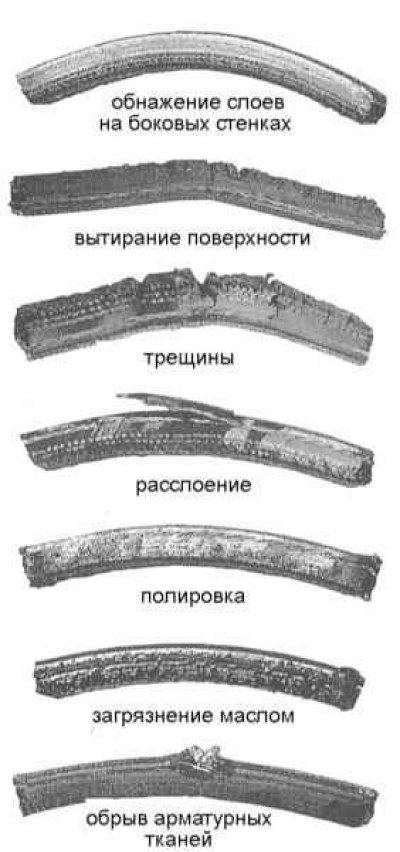
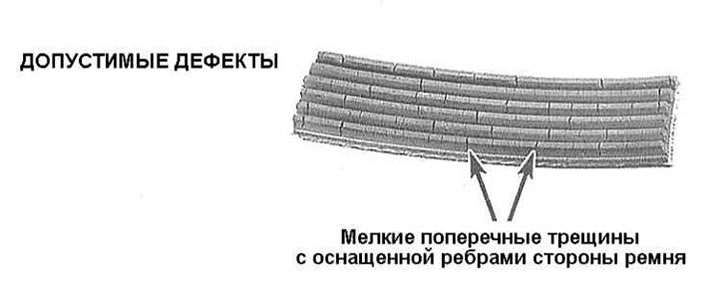
3. Turn off the engine, open the hood and find the drive belts at the front of the power unit. Using a flashlight, feel the belts along their entire length with your fingers, checking for cracks and delamination. The presence of abrasions, polished areas and other obvious defects on the belt is also unacceptable. Inspect the belts from both sides, for which twist them.

3. Turn off the engine, open the hood and find…


3. Turn off the engine, open the hood and find…


3. Turn off the engine, open the hood and find…


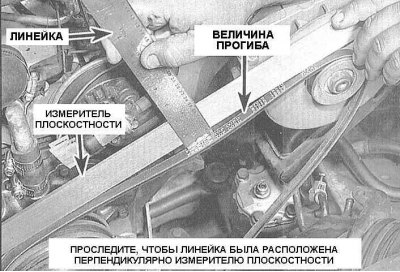
4. The belt tension force is checked by pressing it with the thumb on the section in the middle between two adjacent pulleys. The pressure should be firm enough. The parameter characterizing the belt tension force is the amount of its deflection when pressed. As a rule, if the pulleys are spaced from 180 to 280 mm apart, the deflection should be 6.4 mm, a distance between pulleys of 305÷405 mm corresponds to a deflection of 12.5 mm for a V-belt, and 6.4 mm for a multi-ribbed belt.


4. The belt tension force is checked by pressing…


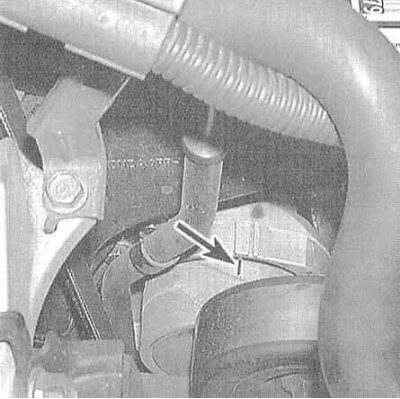
5. On models equipped with V6 engines, the alternator/air conditioner compressor drive belt is equipped with an automatic tensioner, however, the ability to adjust the tension force is not provided. The automatic tensioner includes an indicator of the degree of belt wear (based on the amount of its stretch).

Adjustment


1. On V6 models, the alternator/air conditioning compressor drive belt is equipped with an automatic tensioner. All other belts are manually adjusted by moving the components they drive in the appropriate direction.
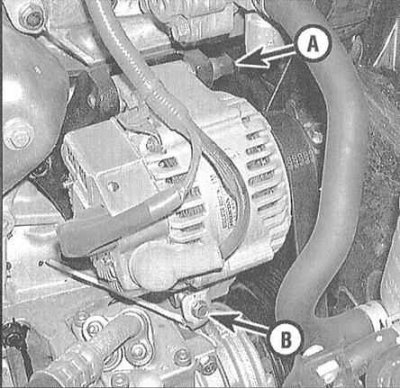
1. On V6 models, the alternator/air conditioning…


2. To adjust the tension of the alternator belt on 4-cylinder models and the steering pump drive belt on V6 models, loosen the mounting bolts of the corresponding units and turn the adjusting bolt in the required direction (clockwise to tighten the belt, counterclockwise to loosen it).
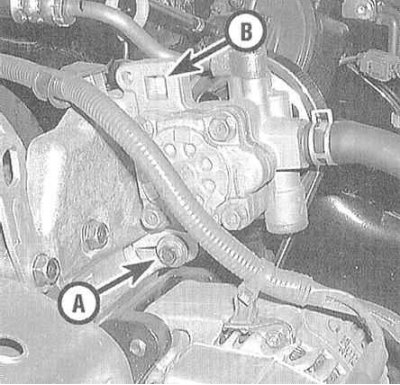


2. To adjust the tension of the alternator belt…


3. The steering pump drive belt on 4-cylinder models is adjusted by loosening the mounting bolts and moving the unit using a 1/2-inch square drive socket wrench.

4. After completing the adjustment, make sure that the belts are tensioned correctly. If necessary, repeat the adjustment procedure.

Replacement


1. On V6 models, place a long spanner of the appropriate size on the center bolt of the tensioner pulley and turn the tensioner counterclockwise to remove the alternator belt. On all other models, release the tensioner tension as per the instructions above to remove the alternator belt from its pulleys. It is a good idea to replace all drive belts at the same time. Before removing the belt completely from the vehicle, mark the direction of belt rotation and the pattern of the belt routing in the pulley grooves.

2. When buying new belts, take the old ones with you as samples - replacement belts must strictly correspond in size to those removed from the car.

3. Once replacement is complete, adjust the tension of the new belts.

[You will find the original on the portal «www.hondabook.ru»]
This article is available at: russian, bulgarian, belarusian, ukrainian, serbian, croatian, romanian, polish, slovak, hungarian
This information has been verified: Timofey Goryachev
Share with friends:
◀ Previous
Accord 6: Maintenance
Next ▶

Checking, servicing and charging the battery
Checking the condition and replacing the windshield wipers
Changing engine oil and oil filter
Checking the Automatic Transmission Fluid (ATF) Level
Checking the power steering fluid level
Checking the condition and replacing the hoses located in the engine compartment
Checking the condition of the cooling system components
Wheel rotation
Checking the brake system
Checking the condition of seat belts
See also other articles from Honda manuals:
Checking, adjusting tension and replacing drive belts (every 12,000… Honda Civic 6 (1995-2000)
Checking and adjusting the clearance in the valve drive (L1ZA) Honda Fit 1 (2001-2008)
Attachment drive belts Honda CR-V 1 (1995-2001, petrol)
Checking and adjusting the alternator drive belt Honda HR-V 1 (1998-2006, petrol)
Checking and adjusting the tension of the alternator and air… Honda Avancier 1 (1999-2003, petrol)
Link in different formats to this article
Comments and feedback from visitors
No comments yet


How much will 37 + 12 ?


Accord 6 (1997-2002) 
  • General information
  • Introduction to the guide
  • User manual
  • Maintenance
  • Power unit
  • Four-cylinder engines
  • Six-cylinder engines
  • Engine overhaul
  • Cooling system
  • Heater and air conditioner
  • Power and exhaust systems
  • Engine electrical equipment
  • Engine management
  • Transmission
  • Mechanical gearbox
  • Automatic gearbox
  • Clutch and drive shafts
  • Chassis and running gear
  • Brake system
  • Car suspension
  • Steering
  • Body and interior
  • Exterior (external elements)
  • Interior (internal elements)
  • Electrical equipment
  • Equipment and devices
  • Electrical circuits
Accord 3 (1985-1989) 
  • General information
  • Maintenance
  • Power unit
  • Engine adjustment
  • Engine repair
  • Engine electrics
  • Emission management
  • Engine management (carburetor)
  • Electronic injection
  • Programmable injection
  • Schematic of emission system
  • Fuel system
  • Feedback management
  • Transmission
  • Manual gearbox
  • Automatic gearbox
  • Clutch
  • Chassis and running gear
  • Front suspension
  • Rear suspension
  • Steering
  • Brake system
  • Electrical equipment
  • Ventilation and heating
  • Air conditioner
  • Cruise control system
  • Equipment and devices
HondaBook.ru © 2018–2026 • Mobile version • Sitemap: EN BG BY UA RS HR RO PL SK HU • Feedback • Driver Information • Search system • Bookmark
Accord 3 (1985-1989) • Accord 6 (1997-2002) • Civic 3 and 4 (1983-1991) • Civic 5 and 6 (1991-2000) • Civic 6 (1995-2000) • Civic 7 (2000-2005) • Civic 8 (2005-2011) • Fit 1 (2001-2008) • CR-V 1 (1995-2001) • CR-V 2 (2002-2006) • HR-V 1 (1998-2006) • Avancier 1 (1999-2003) •
 
This website uses cookies to ensure proper functioning. By clicking "OK," you agree.