

Contents: Seat belts ⇊ Driver and passenger airbags ⇊ Position of seats and their backs ⇊ Headrests ⇊ Rules for the use of passive safety…⇊ Doors ⇊ Front seats ⇊ Headrests ⇊ Seat belts ⇊ Steering column ⇊ Landing on the seat ⇊ Recommendations for pregnant women ⇊ Transportation of children ⇊ Additional recommendations ⇊
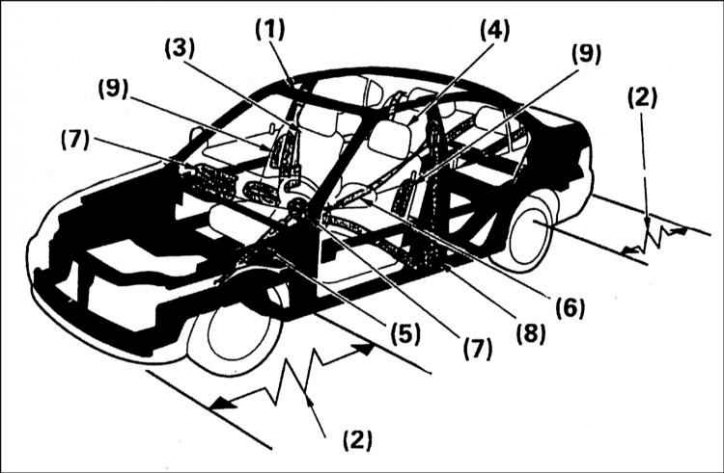
(1) - Cabin with reinforced pillars; (2) - Shock-absorbing deformation zones; (3) - Seats with backrests; (4) - Headrests; (5) - Collapsible steering column; (6) - Seat belts; (7) - Front airbags; (8) - Automatic seat belt tensioners (optional); (9) - Side airbags (optional)
The vehicles covered by this Manual are equipped with a range of safety features designed to protect the driver and passengers in the event of a road accident. These include seat belts installed on all vehicle seats and other devices that effectively supplement the belts.
Some components of the safety system, being an integral part of the car design, do not require additional attention from the owner of the vehicle. These include a strong steel frame that forms the structure of the cabin, inside which the passenger compartment is located, the front and rear deformation zones that absorb the impact energy during a collision; trauma-safe, impact-folding steering column; as well as automatic seat belt tensioners (additional equipment), which automatically tighten the belts in the event of an impact.
Seat belts
To ensure the safety of the driver and passengers, all vehicle seats are equipped with seat belts.
Some models have a special warning light built into the instrument panel to remind the driver and passengers to fasten their seat belts.
Driver and passenger airbags
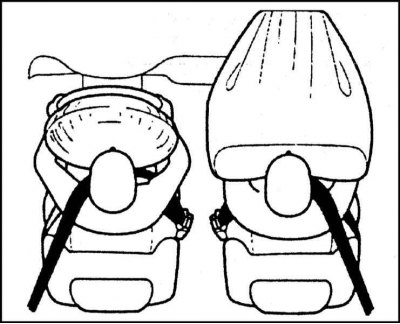
Some models come standard with the Supplemental Restraint System (SRS), better known as airbags, which are designed to help protect the driver and front passenger from being hit in the head or chest against the steering wheel/dashboard in the event of a severe frontal impact.
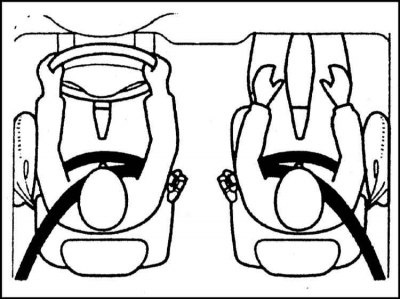
Additional equipment may also include side airbags to provide protection for the driver and front passenger in the event of a side impact.
The owner of a car equipped with an SRS system must know the most important points about the design and operating principle of the system elements:
- a) The presence of airbags can in no way serve as an excuse for not wearing seat belts. SRS should only be used in conjunction with seat belts and other passive safety equipment;
- b) The front airbags do not provide protection in the event of a side impact, or in a rear impact. In addition, the modules are activated only in case of high-intensity directional impacts, i.e. the system does not provide protection in case of weak frontal collisions;
- c) Side airbags do not provide protection in the event of a frontal or rear impact, and they also only deploy when the energy of a side impact exceeds a certain threshold of intensity, which is not always the case when the vehicle rolls over;
- d) Airbag deployment may cause injury.
In order to effectively perform its protective function, the airbag must deploy from the folded state to the working state in a very short time. Therefore, the airbag, while protecting the driver/front passenger from serious injuries, in some cases saving their lives, can cause injury, and sometimes serious injuries up to and including death, if the driver or front passenger were not properly fastened with seat belts or occupied an abnormal position in the seats.
To reduce the risk of injury from an airbag, always wear your seat belt and sit in the driver's seat as far away from the steering wheel/instrument panel as possible.
Position of seats and their backs
The design of the car seats guarantees maximum comfort for the person sitting in them, while simultaneously providing conditions for the most effective performance of their functions by the seat belts and airbags. Soft padding of the cushions and backrests provides additional protection for the occupant in emergency situations.
Adjusting the seat position also affects the safety of the occupant. For example, if the seat is too close to the steering wheel/dashboard, the risk of injury when the airbag deploys increases, as well as the risk of the occupant being thrown through the windshield.
Increasing the angle of the seat back will worsen the body's fixation with the seat belt - the more the seat back is tilted back, the greater the likelihood of the body sliding under the lap section of the seat belt in a severe frontal impact, and the more severe the injuries may be.
Fix the position of the front seat in the position farthest from the steering wheel/instrument panel, bring the backrest to the vertical position.
Headrests
Head restraints prevent injury to the cervical spine and head in the event of a rear impact. The head restraint should be adjusted in height so that its upper edge is level with the upper edge of the occupant's ear.
Rules for the use of passive safety equipment for drivers and passengers
The following instructions will provide the reader with ways to ensure maximum protection for all vehicle occupants.
Doors
After the driver and all passengers have taken their seats in the vehicle, make sure that all vehicle doors are tightly closed.
The car is equipped with a special control lamp that lights up when one or more car doors are not closed tightly.
Front seats
A driver who sits too close to the instrument panel is at increased risk of injury, including serious injury or death, from being struck by the steering wheel or from an airbag deployment in the event of an accident.
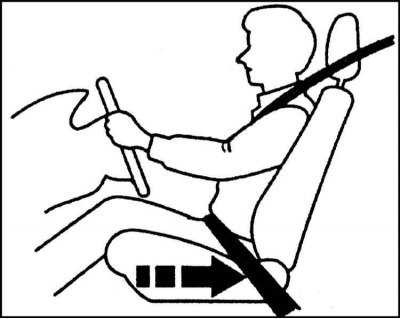
To avoid the risk of injury, fasten your seat belt properly, bring the seatback to an upright position and press your back firmly against it, while moving the seat as far away from the steering wheel as possible. Of course, the driver must ensure that he or she has a good view and can easily operate all the vehicle controls. Make sure that the front passenger seat is also as far away from the instrument panel as possible.
Warning! If the driver and front passenger seats are positioned too close to the steering wheel/instrument panel in an accident, serious injury or even death may occur. Always try to position the front seats as far away from the air bag modules as possible.
The vast majority of drivers (even short ones) can move the driver's seat as far away from the steering wheel as possible, while still being able to reach the pedals. However, if you are concerned about the driver's seat being too close to the steering wheel, the authors of this Guide recommend that you pay attention to certain types of auxiliary equipment - Honda service stations always have comprehensive information on this issue.
Once you have verified that the seat is in the correct position, check that it is securely locked. For instructions on adjusting the front seats, see Section Vehicle equipment, arrangement of instruments and controls.
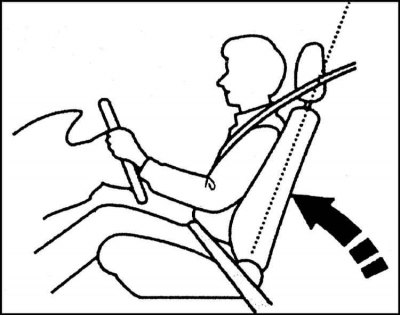
Adjust the angle of the driver's seat back to the most comfortable position for your body type, as close to an upright position as possible, while leaving sufficient space between your chest and the steering wheel hub, in which the airbag is mounted. Remember that placing the driver/front passenger too close to the instrument panel significantly increases the risk of injury if the airbags deploy. If the seat back is tilted too far back, the shoulder section of the belt will not be pressed against the chest, which will significantly reduce the effectiveness of the belt's protective functions. The more the seat back is tilted back, the greater the risk of the occupant's body sliding under the lumbar section in the event of a severe frontal impact, and the more severe the injuries may be. Instructions for adjusting the seat backs are provided in Section Vehicle equipment, arrangement of instruments and controls.
Headrests
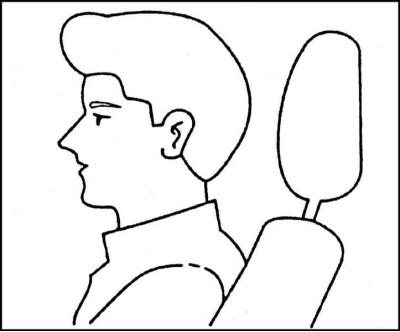
Before driving, make sure that the position of the head restraints on each seat meets the necessary requirements, ensuring proper protection of the cervical spine and head of the occupant in the event of a rear impact. The head restraint should be adjusted in height so that its central part is at the same level as the back of the head. If this cannot be achieved, the head restraint should be set to the highest position.
Warning! Incorrectly positioned head restraints reduce the effectiveness of their protective functions and increase the risk of serious injury in a traffic accident. Instructions for adjusting the position of the head restraints are provided in Section Vehicle equipment, arrangement of instruments and controls.
Seat belts
Snap the belt buckle into the lock, then pull the shoulder section strap up, checking that the buckle is securely locked into the lock. Make sure that the belt strap is not twisted - a twisted belt is dangerous in itself.
Lower the lap section of the belt as much as possible, placing it as low on the hips as possible. Pull on the shoulder section to take up the slack and try to achieve a tight fit. If necessary, tighten the belt and achieve a tight fit of the shoulder section to the torso. The strap should pass diagonally across the occupant's chest so that the load during an impact falls mainly on the strongest upper torso.
Warning! Failure to wear seat belts can result in serious injury in the event of a traffic accident.
The driver of a vehicle, having fastened his seat belt, must ensure that all passengers are also properly fastened.
The correct position of the lap section of the belt will provide the safest absorption of the body's inertia in an accident, holding it by the strong bones of the hip joint. If the strap passes over the shoulder of the arm, the position of the upper anchor of the belt on the car pillar should be adjusted.
To adjust the position of the upper belt anchor, press the release buttons and slide the anchor up or down along the guide built into the pillar until the shoulder section of the belt is positioned correctly relative to your neck. The anchor has four locking positions.
Warning! Never pass the shoulder section of the belt under your arm or behind your back - this can have the most serious consequences in an accident.
An improperly functioning seat belt will not provide adequate protection for the driver/passenger in the event of an accident. Improper use of seat belts can result in serious injury, damage or even death. If you are unsure whether the adjustments are correct, have your Honda service technician check the seat belts for proper operation. For more information on seat belts on your vehicle, see Section Vehicle equipment, arrangement of instruments and controls.
Steering column
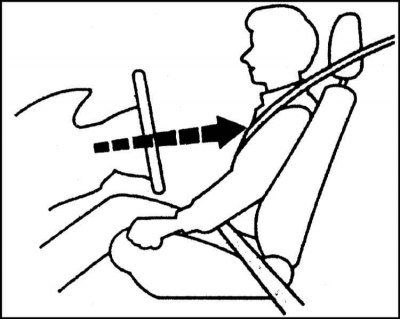
The steering column should be adjusted so that the steering wheel hub is opposite the driver's chest. A position in which the steering wheel hub is opposite the driver's face is incorrect, since it reduces the protective functions of the front airbag built into it. A description of the procedure for adjusting the steering wheel position is provided in Section Vehicle equipment, arrangement of instruments and controls.
Landing on the seat
After the driver and all passengers have taken their seats in the car, adjusted their seats and put on their seat belts, they must position their bodies correctly, with their backs pressed firmly against the seat back and their feet firmly on the floor of the car. Their feet should not come off the floor until the car has come to a complete stop and the engine has been turned off.
Failure to sit correctly while driving increases the risk of injury in a traffic accident. For example, if passengers sit hunched over, lie down, turn to the sides, lean forward or to the side, climb onto the seat with their feet, the risk of them getting seriously injured in an accident increases significantly.
In addition, front passengers who are not seated properly may be seriously injured by interior trim breaking during a crash or by the deployment of the front airbag.
If the front passenger's head is tilted to the side while driving and is in the airbag deployment zone, the risk of serious injury or death in a crash is greatly increased.
Try to maintain proper seating position throughout the entire journey, keeping your back firmly pressed against the seatback and your feet flat on the floor. Remember that sitting upright and using seat belts correctly will improve the effectiveness of all safety features in your vehicle.
Recommendations for pregnant women
Ensuring the safety of a pregnant woman in a traffic accident is the best way to preserve the fetus. Therefore, when driving a car (as a driver or passenger), a pregnant woman must wear a seat belt, paying special attention to the correct placement of its sections relative to her body.
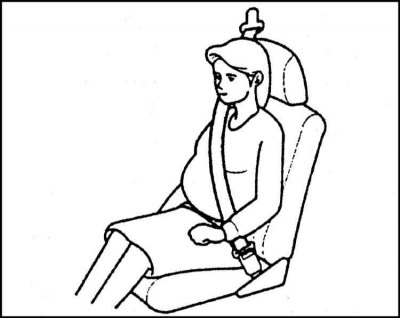
When using diagonal-waist belts, remember that the waist section should be positioned as low as possible.
A pregnant woman should also sit upright in the seat. The front seat should be moved as far away from the dashboard as possible, which will reduce the risk of injury or damage not only to the mother, but also to the fetus in the event of a traffic accident or deployment of the front airbag.
At each visit to your doctor during pregnancy, ask whether it is advisable for you to drive a car.
Transportation of children
To ensure the safety of transporting young and middle-aged children, special child seats and restraints should be used. If necessary, consult with Honda service representatives.
Additional recommendations
It is prohibited to use the same seat belt to fasten two people at the same time. In this case, the belt will not perform its protective functions and passengers may be seriously injured in a traffic accident.
Do not attach pads or other objects to the seat belt webbing. Adding additional objects or changing the position of the shoulder section attachment may reduce the effectiveness of the seat belts and increase the risk of injury in a crash.
Do not place hard or sharp objects between your body and the front airbag.
Carrying hard or sharp objects on your lap, or driving with a smoking pipe or other sharp object in your mouth during an accident can result in serious injury.
To prevent the risk of unauthorized deployment of the front airbags, try to keep your hands away from the locations of their modules on the instrument panel and the steering wheel hub.
On models equipped with side airbags, do not attach hard objects to or near the front door interior panels. If the side airbag deploys, cup holders or other objects attached to the front door interior panel could be torn off, risking injury to the front passenger.
(Publication reprinted from the website: www.hondabook.ru)