
Contents: Operating principle of front airbags ⇊ SRS Malfunction Indicator Lamp…⇊ Additional information about side…⇊ Maintenance of SRS components ⇊ Risk of Carbon Monoxide (CO)…⇊ Posting signs warning of potential…⇊
The devices and components that make up the supplemental safety system (SRS) include:
- a) Two front airbags. The driver's airbag module is housed in the steering wheel hub. The front passenger airbag is housed in a special cavity on the right side of the vehicle's instrument panel. The locations of both airbags are marked with warning signs "SRS AIRBAG";
- b) Directional overload sensors that are triggered in the event of a severe frontal impact;
- c) Electronic self-diagnosis system, which, when the ignition is on, provides continuous testing of the overload sensors, control unit, airbag gas generators and connecting electrical wiring of the corresponding circuits;
- d) Automatic emergency tensioners of front seat belts (see above);
- e) SRS malfunction indicator lamp, mounted in the instrument panel (see Section Vehicle equipment, arrangement of instruments and controls);
- f) A spare autonomous power source designed to duplicate the main power supply system in the event of its failure during a vehicle collision.
Operating principle of front airbags
Directional overload sensors react to the excess of a certain limit value, which may occur during a strong frontal collision. At the signal of the sensors, the control unit turns on the gas generators of the airbags, causing their immediate filling.
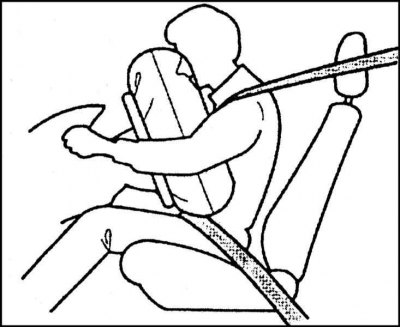
During a collision, the seat belt prevents the lower part of the occupant's body from shifting. The front airbags help prevent injury to the driver and front passenger when their heads and chests hit the steering wheel/dashboard. Since the same sensors trigger both airbags, both airbags are triggered simultaneously. However, it is possible that only one airbag will be triggered. This is possible when the magnitude of the directional overloads that occurred during the collision was on the edge of the gas generator triggering range. In this case, the seat belts provide sufficient protection for the driver and front passenger, while the effect of the airbag triggering will be minimal.
Immediately after the airbags are triggered and perform their functions, the gas is released from them, which allows the driver to maintain visibility and freely manipulate all vehicle controls.
The entire duration of the process from the moment the overload sensors send a signal to the release of gas from the airbags takes a fraction of a second. The airbags are triggered so quickly that the human ear is simply unable to perceive the pop of the gas generators when filling the airbags.
After a traffic accident in which the airbags were deployed, the interior of the car looks slightly smoky. In fact, this is a suspension of fine powder, which is usually sprinkled on the folded airbag shells. People with respiratory diseases may experience some discomfort from the gaseous products contained in the air, emitted by the airbag gas generators.
SRS Malfunction Indicator Lamp Operation Procedure
The SRS indicator lamp is mounted in the vehicle's instrument panel and is designed to warn the driver of failures in the additional safety system detected by the self-diagnosis system. On some vehicle modifications, the indicator lamp's activation indicates possible malfunctions in the side airbag units or automatic emergency seat belt tensioners.
When the ignition is turned on (the ignition key is turned to the "ON" [II] position), the indicator lamp lights up for a short time and then immediately goes out, which confirms that all system components are functioning properly.
If the warning light comes on at any other time, the vehicle owner should contact a Honda service station for assistance as soon as possible. Such situations include the following:
- a) The indicator lamp does not come on when the ignition key is turned to the ON (II) position;
- b) The indicator lamp remains on after the engine has been started;
- c) The indicator lamp has come on and is constantly or flashing while the vehicle is moving.
If the above signs of malfunction are present, the additional safety system may fail in the event of a vehicle accident.
Warning! Failure to heed the SRS warning light may result in serious consequences if the airbags fail during an accident.
Additional information about side airbags
Some models may be equipped with optional driver and front passenger side airbags. The airbag modules are mounted in the outer ends of the front seat backs. The locations of both side airbags are marked "SIDEAIRBAG". The SRS indicator lamp on the vehicle's instrument panel also comes on if a fault is detected in the side airbag initiation circuits.
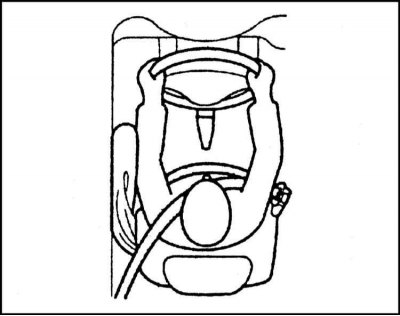
In the event of a severe side impact, the directional overload sensors record the excess of a certain threshold value by the loads that arise and send an information signal to the control unit, which generates a command to trigger the gas generator of the corresponding side airbag. In this case, if the impact occurs from the passenger seat, the passenger side airbag will trigger even if there is no passenger in the front seat.
To ensure that the airbags provide maximum protection, the driver and front passenger must sit upright and wear seat belts.
Maintenance of SRS components
Airbags and automatic emergency seat belt tensioners require virtually no regular inspection or maintenance. However, the owner of a suitably equipped vehicle should keep the following points in mind:
- a) After the airbags have been deployed, they must be replaced together with the system control unit. Do not attempt to dismantle the airbags on your own. These operations must be performed only in a car service workshop;
- b) If the SRS warning light comes on and indicates a malfunction in the system, you should immediately contact your nearest Honda service station for a complete diagnosis and necessary repair of the system. Otherwise, the air bags may not deploy in an accident and may not perform their protective function;
- c) Only specially trained personnel are allowed to work on the additional safety system units. It is prohibited to independently dismantle the airbags and emergency seat belt tensioners from the vehicle. In the event of SRS failure or after emergency deployment of the airbags and seat belt tensioners, it is necessary to contact a Honda service station for repair or replacement of the system units;
- d) Do not open modules or modify the wiring of the airbag systems and automatic emergency seat belt tensioners - such intervention may lead to inadvertent deployment of the airbags and tensioners and cause injury to the operator and nearby people;
- e) Do not replace the front seats without first consulting a Honda dealer.
Careless or incorrect replacement or removal of covers may result in failure of the side airbags to deploy in the event of a traffic accident.
Risk of Carbon Monoxide (CO) Poisoning
The composition of engine exhaust gases includes highly toxic carbon monoxide (CO). If the exhaust system is in good working order and the vehicle is operated correctly, engine exhaust gases should not enter the vehicle interior. Try to check the technical condition of the exhaust system and the tightness of its pipeline connections in the following cases:
- a) When changing the engine oil, when the car is installed on a lift;
- b) If there is a noticeable change in the nature of the noise emitted by the exhaust system;
- c) After an accident in which parts located under the vehicle's bottom may have been damaged.
Warning! Carbon monoxide is a toxic gas. Inhaling carbon monoxide causes unconsciousness and can be fatal. Avoid being in a closed, unventilated room or performing work that forces you to breathe air containing high concentrations of carbon monoxide! In closed, poorly ventilated rooms, such as a garage, the CO concentration can quickly increase to a dangerous level. Therefore, it is prohibited to leave the engine running with the garage door closed. Even with the door open, do not leave the engine running for a long time. Immediately after starting the engine, leave the garage and continue warming up the engine outside.
When driving with the tailgate/trunk lid open, engine exhaust gases may enter the vehicle interior and create a dangerous situation. If a situation arises in which it is not possible to close the door/trunk lid, all windows should be fully opened and the ventilation and air conditioning system should be turned on.
When inside a vehicle with the engine idling (even in an open area), perform the following switches:
- a) Switch the interior ventilation system to fresh air intake mode;
- b) Turn on the heater fan to maximum speed;
- c) Set the regulator to a comfortable air temperature level.
Posting signs warning of potential hazards
The signs are located in the places shown in the illustration and are intended to warn of possible danger. Neglect of these warnings is fraught with serious consequences. Carefully read the text of the warnings.
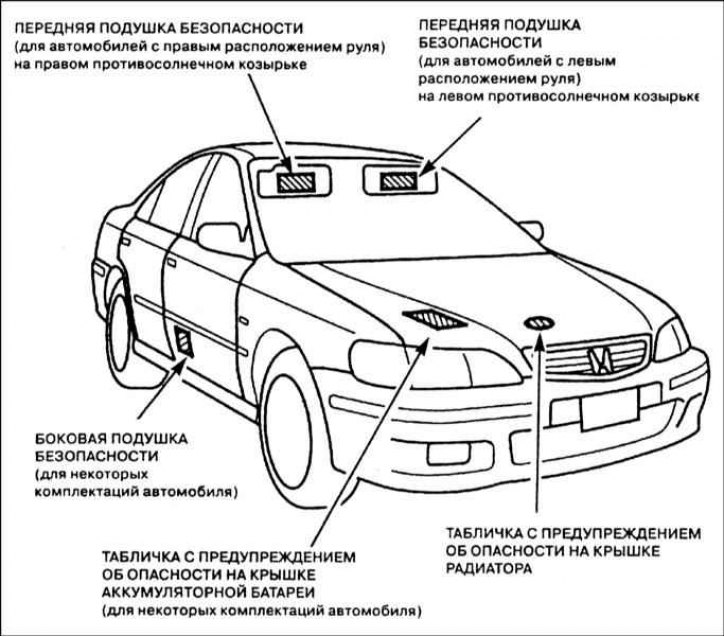
The following warning signs are attached to the underside of the hood:
 SRS airbag.
 SRS airbag.
 Sign warning of potential danger.
 A warning about the need to follow the instructions given in the vehicle's operating instructions.