
Layout of the instrument cluster indicator lights
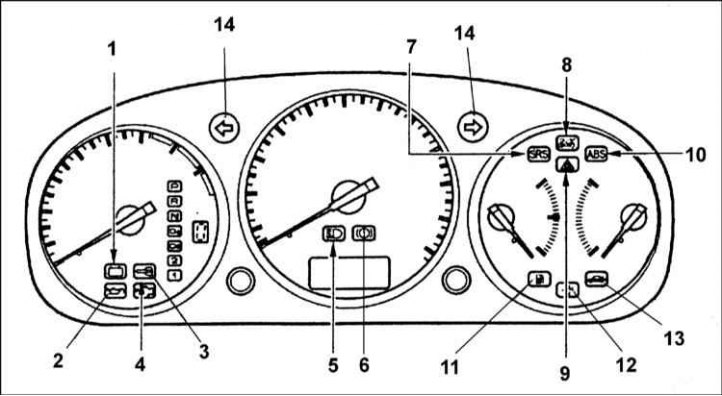
1 - Charge indicator lamp; 2 - Oil pressure indicator light; 3 - Engine immobilization system indicator lamp; 4 - Control lamp for malfunctions of engine systems; 5 - High beam indicator lamp; 6 - Parking brake engaged/brake system failure indicator lamp; 7 - SRS warning light; 8 - Cruise control indicator light; 9 - Hazard warning light (or "Fasten seat belt" light); 10 - ABS warning light; 11 - Fuel reserve indicator lamp; 12 - Door not closing properly indicator light; 13 - Indicator lamp for luggage compartment lid not closing properly; 14 - Direction indicator lamps
Control lamps
The vehicle's instrument cluster assemblies have a whole set of control lamps built in, with the help of which the driver receives important information about the serviceability/malfunction of the vehicle's main units and systems. The layout of the control lamps on the instrument panel is shown in the illustration. Below, the reader's attention is offered information about the operating principle of each of the provided light indicators separately.
Battery charge indicator light

The charge indicator lamp should light when the ignition is turned on and go out immediately after the engine starts. When this indicator lamp lights up with the engine running, it warns the driver about a malfunction in the charging system; the battery goes into discharge mode. You should immediately switch off all power consumers whose operation does not affect road safety and try to prevent the engine from stopping, since an attempt to start it may lead to a final discharge of the battery. The car should be immediately driven to the nearest service station for diagnostics of the failure and the necessary repairs.
Engine oil pressure warning light

The engine oil pressure indicator light should light when the ignition is turned on and go out immediately after the engine starts. Flashing of the light when the engine is running indicates a pulsating decrease in the working pressure of the engine oil in the engine. When the indicator switches to a constant glow mode, it indicates that the oil pressure has dropped to a dangerously low level, which is fraught with serious internal damage to the engine, up to its complete failure. In both cases, urgent measures should be taken to adjust the oil level, identify and eliminate the cause of the pressure drop.
Engine immobilization system indicator light

This indicator lamp is only provided on appropriately equipped models. It should light briefly when the ignition is switched on. Flashing of the indicator lamp indicates that the engine immobilizer system identification device has not identified the ignition key microchip code and the engine cannot be started. The indicator lamp also starts flashing when the ignition key is turned to the ACC and LOCK positions.
Engine system malfunction indicator lamp

The indicator lamp lights up briefly when the ignition is switched on. If it lights up at any other time, it indicates a possible malfunction of one of the engine systems, including the exhaust gas toxicity reduction systems. In the absence of visible signs of failure of the powertrain systems and a decrease in the vehicle dynamics, the violations recorded by the indicator lamp may cause an increase in fuel consumption or an increase in the toxicity of emissions. Ignoring the indicator lamp signals is fraught with serious engine damage, up to and including failure of the unit. If the indicator lamp lights up while driving, you should immediately stop driving, park in a safe place and turn off the engine, then, after a short time, start the car, while observing the behavior of the indicator lamp. If the lamp does not return to normal operation and continues to light, the car should be driven to the nearest service station for detailed diagnostics and the necessary repairs. Until the malfunction of the engine systems is eliminated, try to drive at a moderate speed, avoiding sudden acceleration with full depressing of the gas pedal.
Note: Even if the indicator lamp returns to normal operation (i.e. goes out) when the engine is restarted, you should contact a service station for advice as soon as possible, especially if this is not the first time that the lamp has come on in this way.
Continued operation of the vehicle with the engine malfunction indicator lamp on may result in premature failure of the catalytic converter. Remember that failures and damages resulting from operating the vehicle with the indicator lamp on are not covered by the manufacturer's warranty!
High beam indicator lamp

This indicator light comes on simultaneously with the high beam headlights of the vehicle being switched on (see below).
Parking brake engaged/brake system failure indicator lamp

The indicator light stays on continuously when the parking brake is applied, reminding the driver to release it before driving. Driving with the parking brake applied will cause the rear brakes to overheat and fail quickly, and will cause premature wear of the rear tire treads, and may also cause the anti-lock braking system (ABS) to malfunction (see below).
If the warning light remains on after the parking brake is released, or comes on while driving, this usually indicates that the brake fluid level has dropped excessively. One possible cause of a gradual decrease in the brake fluid level is normal wear of the brake pad friction linings. If the warning light comes on, the vehicle should be taken to the nearest service station to assess the condition of the pads and check the tightness of the hydraulic circuit of the brake system.
The indicator lamp also lights briefly when the ignition is turned on (even when the parking brake is released).
If this indicator lamp comes on simultaneously with the ABS indicator lamp (with the parking brake released), or while the vehicle is moving, this indicates a malfunction in the vehicle's braking system.
Supplemental Restraint System (SRS) Warning Light

This indicator lamp lights up when the ignition is switched on and should go out immediately after the engine is started. If the lamp continues to light up when the engine is running (in a constant or flashing mode), this indicates a malfunction of the SRS system components. If equipped, the operation of this indicator lamp may indicate a malfunction in the side airbag circuits or automatic emergency seat belt tensioners.
CRUISE cruise control indicator light

If the vehicle is equipped with this indicator lamp, it lights up when the automatic cruise control system (cruise control) is switched on (see below).
Fasten seat belts indicator light"

Note: On some models, instead of this indicator lamp, a hazard warning lamp (see below) may be installed in the instrument cluster. This indicator lamp serves to remind the driver and passengers to fasten their seat belts. If the driver forgets to fasten their seat belts, an audible buzzer is also activated, which switches off after a short time. The indicator lamp will remain on until the seat belts are properly fastened.
The indicator lamp and buzzer will not sound if the driver fastens the seat belt before turning on the ignition.
ABS warning light

If the vehicle is equipped with this indicator lamp, it lights up when the ignition is turned on and goes out immediately after the engine is started, thus confirming the proper functioning of the anti-lock brake system circuit. If the indicator lamp comes on in any other situation, it indicates that the self-diagnosis system has detected faults in the ABS circuit. The vehicle should be taken to the nearest service station without delay for a detailed diagnosis of the system and the necessary repairs.
Note: When the warning light comes on, the anti-lock brake system is disabled, but the vehicle's brakes continue to operate normally, providing adequate braking to the vehicle.
Fuel reserve indicator light

The warning light comes on when there is less than 9.0 liters of fuel left in the vehicle's fuel tank and warns the driver of the need to urgently refuel the vehicle.
Door Not Closing Warning Light

When this indicator lamp comes on, it warns the driver that not all of the vehicle doors are closed tightly.
Luggage compartment lid not fully closed indicator lamp


This indicator lamp warns the driver that the vehicle's trunk lid is not closed properly.
Direction indicator lamps
Two indicator lamps in the form of arrows have a green glow and serve to control the proper functioning of the corresponding turn indicators. The direction of the indicator arrows coincides with the selected direction of change of the vehicle's course. The indicator lamps operate in a flashing mode with a frequency corresponding to the flashing frequency of the turn indicators. Rapid flashing of one of the indicator lamps usually indicates that the lamp of one of the indicators of the corresponding turn has burned out. The burned-out lamp should be replaced at the first opportunity in order to avoid creating emergency situations on the roads.
The simultaneous flashing of the indicator lamps of both directions usually accompanies the activation of the hazard warning lights.
Note: On some models, a separate hazard warning light is mounted in the instrument cluster, which is usually installed instead of the "fasten seat belt" indicator lamp. In this case, the indicator lamps of the turn signals should not flash when the hazard warning lights are turned on.