HondaBook.ru
Auto companies Volkswagen Auto companies Ford Auto companies Lada Auto companies Skoda Auto companies BMW Auto companies Mazda Auto companies Peugeot
English Русский
Български
Беларускі
Український
Српски
Hrvatski
Română
Polski
Slovenský
Magyar
Bookmark Contacts Sitemap   


Accord Civic Fit / Jazz CR-V HR-V Others Articles
Accord 3 (1985-1989) Accord 6 (1997-2002)

Additional information on seat belts (Honda Accord 6)

  • Main
  • Honda Accord
  • 6 (1997-2002)
  • General information
  • User manual
  • Additional information on seat belts
0
Contents: Diagonal lap seat belt ⇊ Automatic emergency seat belt…⇊ Seat belt anchor points ⇊

Diagonal lap seat belt


Diagonal lap seat belt


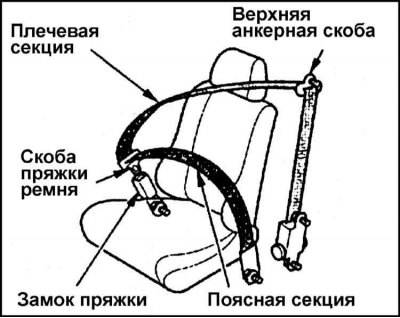
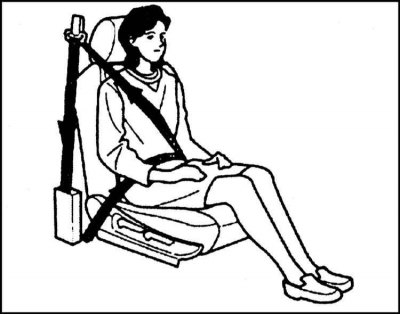
The diagram of the routing and method of fastening the diagonal-lap design seat belt is shown in the illustration.

To unfasten the belt, press the red button marked PRESS, which is located on the buckle lock body. When the belt is wound up by the retractor drum, hold it by the buckle bracket. After leaving the car, check that the belt does not get caught in the door opening or get jammed when the door is slammed.

The diagonal-waist belts are equipped with an inertial-type return device, the drum of which automatically takes up the slack in the straps and constantly maintains a slight preliminary tension of the belt pressed to the body. Inertial belts practically do not restrict the movements of the person fastened with them and allow him to easily change his position on the seat. In the event of a traffic accident or sudden braking of the car, the return device automatically locks the seat belt, ensuring the fixation of the body from dangerous movements.


The diagonal-lap seat belts used in the models of cars under consideration on all seats except the front ones are equipped with additional fasteners that ensure the possibility of reliable fixation of special child seats. More detailed information on this issue can be obtained at official Honda service stations.

When the shoulder section of the belt is pulled out sharply, the locking mechanism of the return device is activated. The drum locks the belt, eliminating the possibility of dangerous movement of the passenger.

Automatic emergency seat belt tensioners


Automatic emergency seat belt tensioners


On some models, to provide additional protection for the driver/passenger, the front seat belts are equipped with devices that, when activated, automatically tighten the belts, which helps to eliminate the possibility of dangerous movement of the driver and passenger in the event of a traffic accident.

The automatic emergency tensioners are triggered by directional overloads that occur during a severe frontal collision. At the same time, the front airbags are ejected.

When the device is triggered, the seat belt remains in a tensioned position until the buckle clip is removed from the lock last.


The supplemental restraint system (SRS) indicator light comes on to alert the driver to possible problems with the automatic emergency seat belt tensioners in Section Vehicle equipment, arrangement of instruments and controls.

Seat belt anchor points


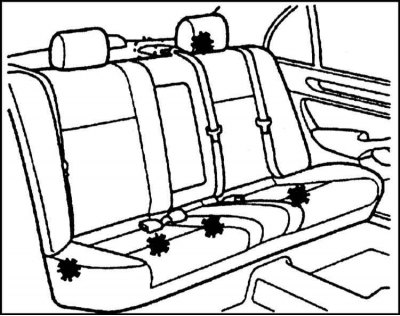
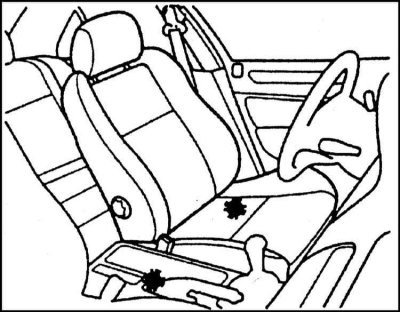
When replacing seat belts, make sure that the correct mounting locations are selected. The seat belt mounting locations are shown in the illustrations.
When replacing seat belts, make sure that the…
This article is available at: russian, bulgarian, belarusian, ukrainian, serbian, croatian, romanian, polish, slovak, hungarian
This information has been verified: Timofey Goryachev
Share with friends:
◀ Previous
Accord 6: User manual
Next ▶

Elements of vehicle safety systems
Anti-theft alarm
Tailgate/trunk lid lock
Child-proof door lock
Remote control for single electric lock
Supplemental Restraint System (SRS)
Location of controls
Instrument cluster and indicator lights
Instrument cluster indicators
Main switch for controlling the operation of external lighting devices
See also other articles from Honda manuals:
Seat belts — control Honda Civic 3 and 4 (1983-1991)
Seat belts Honda Fit 1 (2001-2008)
Attachment drive belts Honda CR-V 1 (1995-2001, petrol)
Driver's seat and controls Honda HR-V 1 (1998-2006, petrol)
Seat belts — checks and adjustments Honda Avancier 1 (1999-2003, petrol)
Link in different formats to this article
Comments and feedback from visitors
No comments yet


How much will 46 + 16 ?


Accord 6 (1997-2002) 
  • General information
  • Introduction to the guide
  • User manual
  • Maintenance
  • Power unit
  • Four-cylinder engines
  • Six-cylinder engines
  • Engine overhaul
  • Cooling system
  • Heater and air conditioner
  • Power and exhaust systems
  • Engine electrical equipment
  • Engine management
  • Transmission
  • Mechanical gearbox
  • Automatic gearbox
  • Clutch and drive shafts
  • Chassis and running gear
  • Brake system
  • Car suspension
  • Steering
  • Body and interior
  • Exterior (external elements)
  • Interior (internal elements)
  • Electrical equipment
  • Equipment and devices
  • Electrical circuits
Accord 3 (1985-1989) 
  • General information
  • Maintenance
  • Power unit
  • Engine adjustment
  • Engine repair
  • Engine electrics
  • Emission management
  • Engine management (carburetor)
  • Electronic injection
  • Programmable injection
  • Schematic of emission system
  • Fuel system
  • Feedback management
  • Transmission
  • Manual gearbox
  • Automatic gearbox
  • Clutch
  • Chassis and running gear
  • Front suspension
  • Rear suspension
  • Steering
  • Brake system
  • Electrical equipment
  • Ventilation and heating
  • Air conditioner
  • Cruise control system
  • Equipment and devices
HondaBook.ru © 2018–2026 • Mobile version • Sitemap: EN BG BY UA RS HR RO PL SK HU • Feedback • Driver Information • Search system • Bookmark
Accord 3 (1985-1989) • Accord 6 (1997-2002) • Civic 3 and 4 (1983-1991) • Civic 5 and 6 (1991-2000) • Civic 6 (1995-2000) • Civic 7 (2000-2005) • Civic 8 (2005-2011) • Fit 1 (2001-2008) • CR-V 1 (1995-2001) • CR-V 2 (2002-2006) • HR-V 1 (1998-2006) • Avancier 1 (1999-2003) •
 
This website uses cookies to ensure proper functioning. By clicking "OK," you agree.