
If the valve clearance is too large, some of the camshaft lift is used to remove the excess clearance, so the valves will not open sufficiently. Under these conditions, the valves become noisy as they work off the excess clearance, and the engine as a whole runs poorly as less fuel/air mixture will enter the cylinders. The exhaust valves will not open sufficiently to allow all the gas to exit the cylinder; the residual pressure (back pressure) will prevent the next portion of the fuel-air mixture from entering.
If the valve clearance is too small, the intake and exhaust valves will not fully seat on the cylinder head when closing. This causes internal leakage in the cylinder and prevents some of the heat from being transferred to the cylinder head for cooling. As a result, the engine will run poorly (due to combustion gases leaking out) and the valves will overheat and warp (since they cannot transfer heat unless they are in good contact with the seat in the cylinder head).
All valve adjustments should be as accurate as possible, it is better to have the valves fit slightly looser than slightly tighter, as too tight a fit will result in valve burn.
Adjustment
Valve clearance should always be adjusted with the engine cool. Cylinder head temperature should be below 100°F (38°C). This usually means allowing the engine to cool for at least 3 hours after running. Overnight cooling is best. If valve adjustments are performed as part of routine or mileage maintenance, do the job before the engine is warm to check ignition timing or idle speed.
The position of the valves - intake, exhaust and auxiliary (if used) - will depend on the engine type. As a guide, the intake valves always line up with the intake manifold ports. The exhaust valves line up with the exhaust manifold tubes.
Adjusting the valves requires positioning the #1 cylinder at TDC, then rotating the engine to a specific, precise position. Rotate the engine using the socket on the crankshaft pulley. (This pulley is the lowest pulley on the engine.) It is much easier to rotate the engine if the spark plugs are removed first, thereby reducing the compression in the cylinders. Always rotate the engine in a counterclockwise direction when viewed from the end of the pulley.
If you miss a mark when rotating in this direction, continue rotating in the same direction until the mark has completed a full circle. Rotating in the opposite direction may cause the tooth on the timing belt to jump or become slack, risking damage to the engine when it is next started. Remember that cylinder number 1 is the one closest to the end of the pulley.
The engine is in TDC position Number 1 if ALL of the following are true:
- The TDC mark on the flywheel aligns with the pointer on the timing inspection window on the rear of the engine. The TDC mark is usually white; and is never red.
- The distributor rotor points toward the cap or spark plug wire number 1. Mark the cap with the wire number, then remove the cap.
- The alignment marks on the camshaft pulley are located and aligned as indicated for the individual procedure.
- The rocker arms for at least one of the valves on cylinder number 1 are loose; the cam points or projections do not exert pressure on the rocker arm shoulders.
1984-1989 Accord, 1984-1987 Prelude, 1988-1990 SOHC Prelude
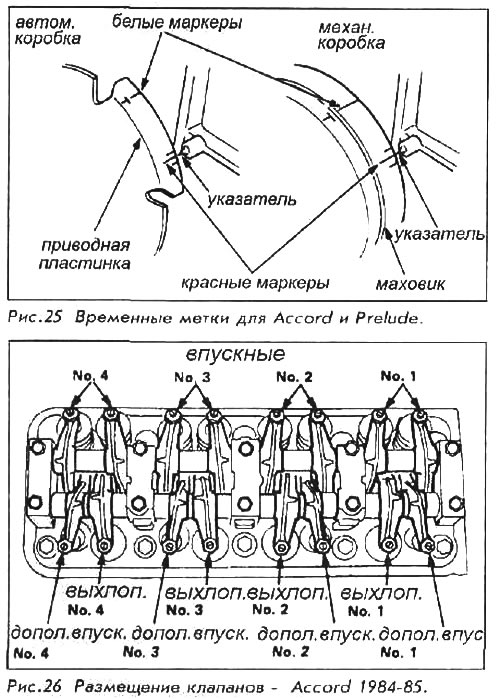
All engines in these vehicles use a single overhead camshaft (SOHC). One cam serves 12 or 16 valves. The engines in the 1984-85 Accord use 2 intake valves, 1 exhaust valve, and 1 pilot valve per cylinder. The pilot valves are located on the exhaust side of the valve and are smaller in size than the other valves. Other vehicles use the same but without the pilot valve.
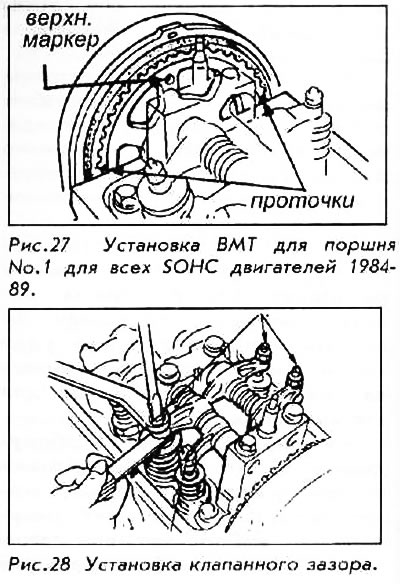
Valve clearances are:
- Inlet: 0.12-0.17 mm
- Issue: 0.25-0.30 mm
- Auxiliary: 0.12-0.17 mm
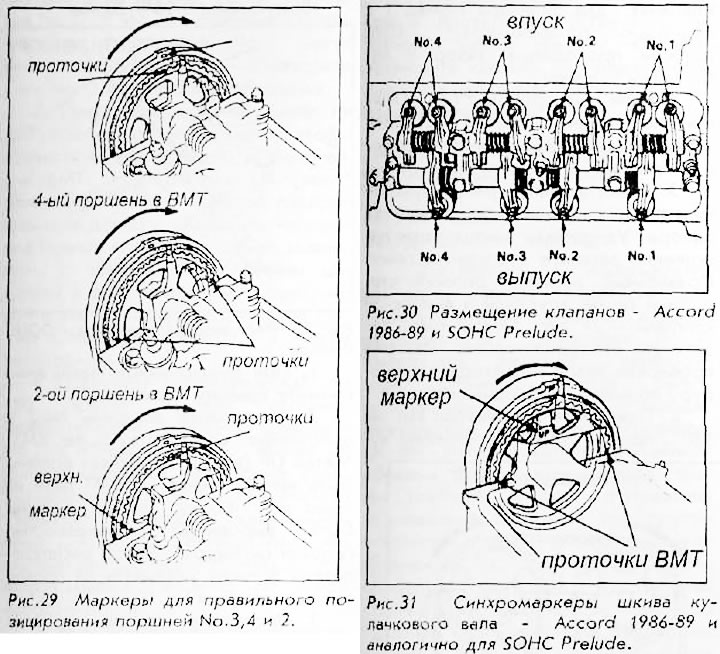
1. With the ignition off, remove the valve cover.
2. Set the engine to the TDC position for cylinder No.1. The UP mark on the camshaft pulley should be at the top of the pulley. The two notches on the back (valve) side of the pulley should both be visible and aligned with the cylinder head surface. The distributor rotor points to terminal or wire No.1.
3. Check the clearances on all valves for cylinder No.1 using a feeler gauge between the valve tip and the contact surface of the rocker arm. The feeler gauge should enter the gap with a little effort.
4. If the feeler gauge does not pass through easily or cannot be inserted, loosen the lock nut on the adjusting screw,
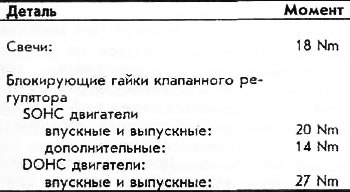
5. Turn the adjusting screw to obtain the required clearance. While holding the screw in this position, tighten the lock nut. The correct tightening torque for the lock nut: inlet and outlet valves - 20 Nm, auxiliary - 14 Nm. After tightening the lock nut, recheck the clearance and repeat the procedure as necessary.
6. Rotate the crankshaft 180°; the camshaft should rotate 90°. One of the grooves in the pulley is now vertical and aligned with the embossed mark on the timing belt cover. The UP mark is not visible and the distributor rotor points to terminal or wire number 3.
7. Adjust all valves for cylinder No.3, repeating Steps 3, 4 and 5 as necessary.
8. Rotate the crankshaft 180°. Both grooves on the pulley are visible and aligned with the cylinder head surfaces. The distributor rotor points to terminal or wire number 4.
9. Adjust all valves for cylinder No.4, repeating Steps 3, 4 and 5 as necessary.
10. Rotate the crankshaft 180°. One of the grooves on the pulley is vertical again, aligned with the notch on the toothed belt cover. The UP mark is visible, but not at the top. The distributor rotor points to terminal or wire No.2.
11. Adjust all valves for cylinder No.2, repeating Steps 3, 4 and 5 as necessary.
12. Install the valve cover back in place.
1990-1991 Accord
The engines on these cars use 2 intake valves and 2 exhaust valves per cylinder.
Valve clearances:
- Intake: 0.24-0.28 mm preferably with 0.26 mm
- Outlets: 0.28-0.32 mm preferably with 0.30 mm
1. With the ignition off, remove the valve cover.
2. Set the engine to the TDC position of cylinder No.1. The UP mark on the camshaft pulley should be at the top of the pulley. The two grooves on the back (valve) side of the pulley should both be visible and aligned with the surface of the cylinder head. The distributor rotor points to the No.1 terminal or wire.
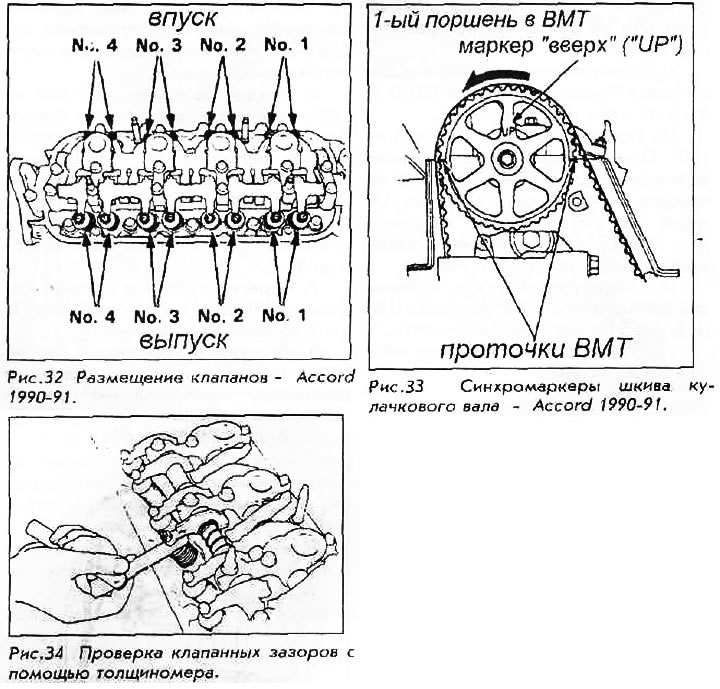
3. Check the clearances on all valves for cylinder No.1 using a feeler gauge between the valve tip and the contact surface of the rocker arm. The feeler gauge should enter the clearance with a slight effort.
4. If the feeler gauge does not slide in easily or cannot be inserted, loosen the lock nut on the adjusting screw.
5. Turn the adjusting screw to obtain the required clearance. Hold the screw in this position and tighten the lock nut. The correct tightening torque of the lock nut: intake and exhaust valves - 20 Nm, auxiliary - 14 Nm. After tightening the lock nut, recheck the clearance and repeat the procedure as necessary.
6. Rotate the crankshaft 180°; the camshaft should rotate 90°. One of the grooves in the pulley is now vertical and aligned with the embossed mark on the timing belt cover. The UP mark is not visible and the distributor rotor points to terminal or wire number 3.
7. Adjust all valves for cylinder No.3, repeating Steps 3, 4 and 5 as necessary.
8. Rotate the crankshaft 180°. Both grooves on the pulley are visible and aligned with the cylinder head surfaces. The distributor rotor points to terminal or wire number 4.
9. Adjust all valves for cylinder No.4, repeating Steps 3, 4 and 5 as necessary.
10. Rotate the crankshaft 180°. One of the notches on the pulley is vertical again, aligned with the notch on the timing belt cover. The UP mark is visible, but not on top. The distributor rotor points to terminal or wire No.2.
11. Adjust all valves for cylinder No.2, repeating Steps 3, 4 and 5 as necessary.
12. Install the valve cover back in place.
1988-91 DOHC Prelude
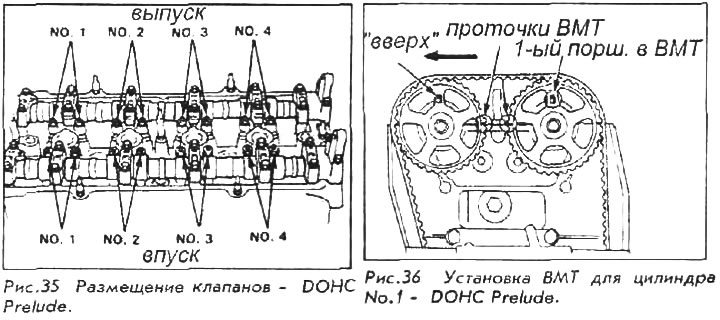
These engines use double overhead camshafts (DOHC) and use 4 valves per cylinder, 2 intake and 2 exhaust. The intake valves are controlled by one cam and the exhaust valves by the other. Valve adjustment on these engines is similar to other engines. Each camshaft pulley has an UP mark and slots; when the engine is turned during adjustment, the marks should align with both the cylinder head and each other.
Twin cam engines use rocker arms mounted below the camshaft; for this reason, checking clearances with straight feeler gauges can be difficult. Use a set of curved feeler gauges if possible. Valve clearances are as follows:
- Inlet: 0.08-0.12 mm
- Graduation: 0.16-0.20 mm
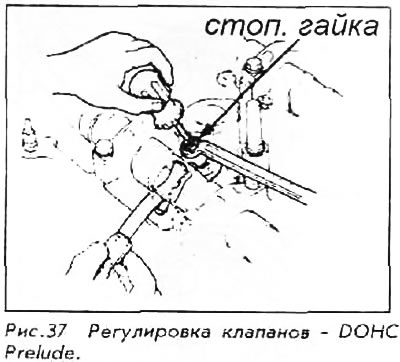
1. With the ignition off, remove the valve cover.
2. Set piston No.1 to the TDC position. The UP marks on the pulleys should be at the top of the pulley, and the TDC grooves on the edge or side of the pulley should be aligned with the surface of the cylinder head. The distributor rotor should point toward spark plug wire No.1.
3. Check the clearances on all valves for cylinder No.1 using a feeler gauge. The feeler gauge should fit into the clearance with a little effort.
4. If the feeler gauge does not slide in easily or cannot be inserted, loosen the lock nut on the adjusting screw.
5. Turn the adjusting screw to obtain the required clearance. Hold the screw in this position and tighten the lock nut. The correct tightening torque for the lock nut: intake and exhaust valves - 27 Nm; After the lock nut is tightened, recheck the clearance and repeat the procedure as necessary.
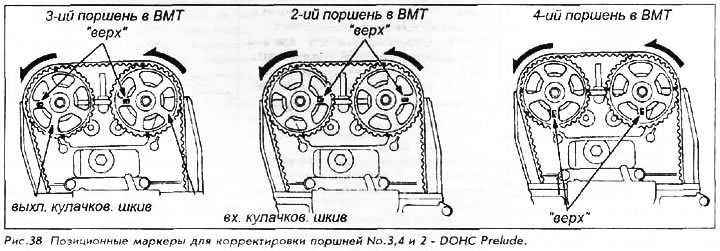
6. Turn the crankshaft 180° counterclockwise, the camshaft should turn 90°. The Up mark should be on the exhaust valve side. The distributor rotor should point towards the No.3 spark plug wire. In this position, the valve clearances on cylinder No.3 can be adjusted. Repeat steps No.3, 4 and 5 if necessary.
7. Rotate the crankshaft 180° counterclockwise to bring piston No.4 to TDC. Both UP marks should be down and the distributor rotor should point toward wire No.4. The grooves in the pulley are aligned with the cylinder head surface and with each other. Adjust all valves for cylinder No.4, repeating Steps 3, 4 and 5 if necessary.
8. Turn the crankshaft 180° counterclockwise to bring the piston of cylinder No.2 to the TDC position. The UP mark should be on the inlet valve side. The distributor rotor points to the No.2 spark plug wire. Adjust all valves for cylinder No.2 by repeating Steps 3, 4 and 5 as necessary,
9. If all valves are adjusted and checked, reinstall the valve cover. Install the distributor cap. Start the engine and check for oil leaks.
Tightening torque specification
The text was taken from the website Hondabook.ru