
In an ideal situation, the air/fuel mixture is ignited and begins to expand rapidly as soon as the piston passes top dead center (TDC). If this is the case, the piston will begin to move just as the compressed and ignited air/fuel mixture begins to expand. The expanding gas will push against the piston and drive the crankshaft.
It takes a fraction of a second for the spark to fully ignite the mixture in the cylinder. Because of this, the spark must be applied just before the piston reaches TDC so that the mixture is fully ignited by the time the piston passes TDC. This measurement is given in degrees of crankshaft rotation before the piston reaches TDC (before TDC or BTDC). If the ignition is set at 6° BTDC, this means that the spark plug must fire when the piston for that cylinder is 6° from the end of its compression stroke. But this is only true at idle. As you accelerate past idle, the engine speed increases. The increase in RPM means that the pistons are now moving up and down even faster. Because of this, the spark plugs must fire even earlier so that the mixture is fully ignited by the time the piston passes TDC. To meet this requirement, the system has provisions for appropriately advancing the ignition timing as speed increases.
A mechanical distributor has two mechanisms for spark advance. The first is a centrifugal advance mechanism that is driven by weights in the distributor. The other is a vacuum advance mechanism and is housed in a large round housing on the side of the distributor. Fully electronic systems use an electronic control unit (ECU) to control the ignition signal to the coil. The computer can provide much more precise ignition timing control than mechanical units.
In addition, some Honda distributors have a vacuum mechanism for reducing the ignition advance angle, which is located in the same housing on the side of the distributor, as the vacuum mechanism for ignition advance. Models with two hoses going to the vacuum boot of the distributor have both vacuum mechanisms: both advance and retard ignition. The function of this mechanism is to regulate the ignition timing under certain (one or another) engine operating conditions. This allows for more complete combustion of the fuel-air mixture in the cylinder and, therefore, reduces exhaust emissions.
If the ignition timing is set too far in advance, the ignition and combustion of the fuel-air mixture in the cylinder will hinder the upward movement of the piston. This causes a "knocking" sound in the engine, similar to a coffee grinder. If the timing is too late, the piston will already begin to move downward when the fuel-air mixture ignites. This will result in the piston moving downward with much less power. This will result in poor engine performance and poor fuel economy.
Checking and adjusting
On vehicles produced between 1984 and 1991, check and adjust the ignition timing (if necessary) after every 100,000 km.
1984-89 Accord, 1984-87 Prelude, 1988 Prelude (carbureted)
The timing marks are located on the flywheel (manual transmission) or on the torque converter plate (automatic transmission), with a pointer on the back of the cylinder block. All are visible from the front right side of the engine compartment after removing the special rubber cover from the timing mark window. In all cases, timing is checked with the engine warmed up to operating temperature and idling.
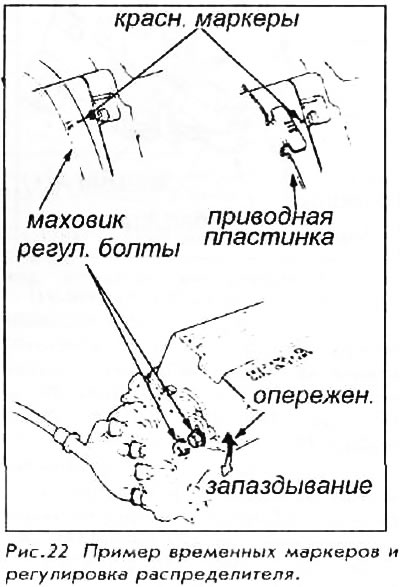
1. Turn off the engine and mount the tachometer on the engine. The positive wire connects to the ignition coil terminal that goes to the distributor, and the negative wire connects to a good ground (or mass), such as a bolt on the engine.
2. Follow the manufacturer's instructions to install the strobe light on the engine. Connect the positive and negative wires to the appropriate battery terminals and the spark plug wire to the number 1 spark plug wire.
3. Make sure no wires are touching the cooling fan or hot exhaust pipes.
4. Set the handbrake and block the front wheels. Start the engine. Check that the idle speed is set according to the specifications for Neutral (manual transmission) or Drive (automatic transmission).
5. If the distributor is equipped with a vacuum advance mechanism, it is necessary to mark and disconnect the vacuum line(s), plug it(them) and reinstall it on the vacuum advance mechanism.
At any engine speed different from the specified one, the ignition timing advance and retard mechanisms will be activated, which will lead to erroneous ignition timing adjustment.
6. Point the strobe light at the timing marks. The flywheel or control plate may have more than one mark. If there is more than one mark, the red mark should be used to adjust the advance timing. The white line or mark indicates TDC or 0°. When the engine is idling, the red mark should align with the pointer. Some timing marks are indicated by three lines; then the central one should coincide with the pointer.
7. If it is necessary to adjust the timing, loosen the bolt(s) holding the distributor and/or nut(s) and slowly rotate the distributor in the required direction while observing the marks.
CAUTION: Do not grasp the upper distributor cap while the engine is running, as you may receive a dangerous electric shock. Instead, grasp the distributor fastener to rotate it.
Some models have two bolts, others a bolt and nut, which can be loosened to adjust the ignition timing. If there is a smaller bolt on the back of the rotating distributor mounting plate, this bolt does not need to be loosened unless you are unable to achieve satisfactory adjustment with the top bolt. This (smaller) bolt is designed to provide additional adjustment range, such as in cases where the distributor has been removed and then reinstalled offset by one tooth.
8. To complete the adjustment procedure, tighten the retaining (locking) bolts, taking care not to disturb the setting. If there is a vacuum advance mechanism, remove the (previously installed) plug and install the vacuum line(s).
9. Turn off the engine. Replace the rubber cover on the timing window and disconnect the test equipment.
1988 Prelude Si, 1989-91 Prelude, 1990-91 Accord
The timing on these vehicles is computer controlled. There is no need for regular timing adjustments during normal maintenance.
1. Remove the rubber cover from the timing window on the back of the engine.
2. Start the engine and let it warm up. The engine is fully warmed up if the cooling fan turns on at least once. Turn off the engine.
3. Remove the cover from the test connector. On Prelude vehicles, the cover is yellow and the connector is located just behind the ignition coil. On Accord vehicles, the connector is blue. The connector on the Accord is located behind the stop panel on the right side, under the instrument panel. Use a jumper wire to connect the two terminals of the service connector.
4. Following the manufacturers instructions, install the strobe light on the engine. Connect the positive and negative wires to the corresponding battery terminals and the spark plug wire to the number 1 spark plug wire.
5. Make sure no wires are touching the cooling fan or hot exhaust pipes.
6. Set the handbrake and block the front wheels. Start the engine. Check that the idle speed is set according to the specifications for Neutral (manual transmission) or Drive (automatic transmission).
7. Point the strobe light at the timing marks. The flywheel or plate may have more than one mark. If there is more than one mark, the red mark should be used to adjust the advance timing. The white line or mark indicates TDC or 0°. When the engine is idling, the red mark should align with the pointer. Some timing marks are marked with three lines; then the central one should coincide with the pointer.
8. If it is necessary to adjust the timing, loosen the bolt(s) holding the distributor and/or nut(s) and slowly rotate the distributor in the required direction while observing the marks.
9. To complete the adjustment procedure, tighten the retaining (locking) bolts, taking care not to disturb the setting. If there is a vacuum advance mechanism, remove the (previously installed) plug and install the vacuum line(s).
10. Turn off the engine. Replace the rubber cover on the timing window and disconnect the test equipment.
(Original material on the website: www.hondabook.ru)