
Contents: Wheel speed sensors ⇊ Control unit ⇊ Hydraulic Modulator ⇊ Battery and Pressure Sensor ⇊ Pump Motor (Power Unit) ⇊ Pump motor and protection relay ⇊ Warning lamp ⇊ Safety measures during work ⇊
CAUTION: The Honda ABS contains extremely high-pressure brake fluid inside the pump, accumulator and modulator. Do not disconnect or loosen lines, hoses, joints or components without properly relieving the system of pressure. Use ONLY tool 07HAA-SG00101 or equivalent for this purpose. Incorrect operation may result in serious injury!
Wheel speed sensors
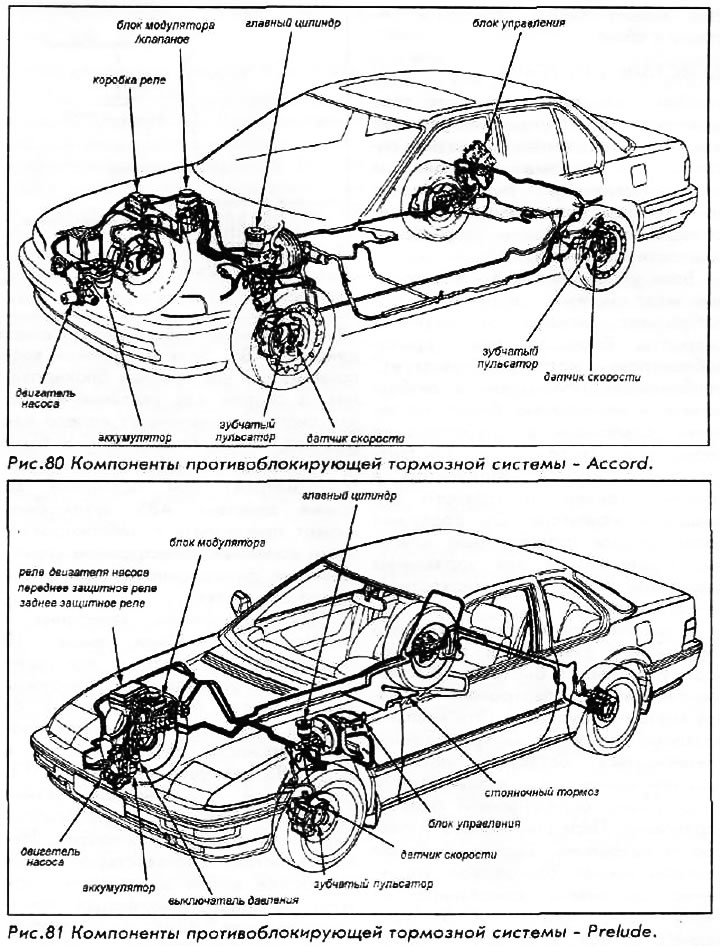
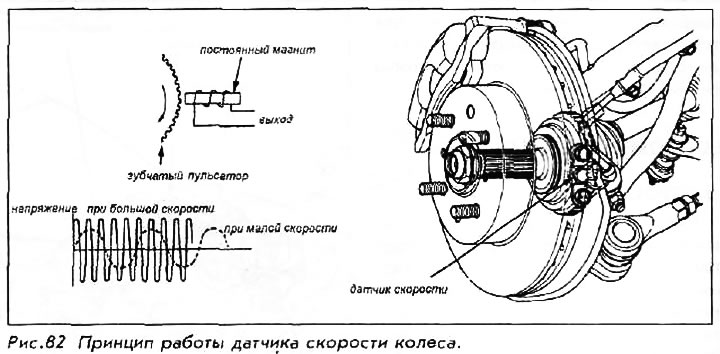
Information about the speed of each wheel is transmitted to the control unit via wheel speed sensors. A small sensor unit is mounted above the gear wheel that rotates with the axle or road wheel.
Wheel speed sensors generate an alternating voltage when a gear passes. The frequency of this voltage is used by the control unit to calculate the speed of rotation of the wheel. By comparing the speeds of the wheels during braking, the control unit determines the approaching locking of the wheel.
Control unit
The control unit performs the main function of controlling the electromagnetic valves of the modulator, processing electrical signals from sensors installed on the wheels of the car. An additional function of the control unit includes self-diagnosis, control of the pump motor and system shutdown.
In addition, the ABS control unit receives signals from the parking brake switch, charging system, ignition switch, brake light switch, pump motor relay and protection relay. Each of the signals is used to "help" the control unit in analyzing the system's operation. Damage to any of the relevant components can cause the ABS to be disabled.
Hydraulic Modulator
The modulator contains electromagnetic valves for each brake circuit. The control unit controls each electromagnetic valve individually (one for each front wheel and one for both rear wheels) based on signals from the wheel speed sensors.
The modulator receives brake fluid from the accumulator under extremely high pressure. This fluid passes into the system through the electromagnetic valve and increases the pressure in the pipeline if necessary. Separate channels allow the fluid to flow back if the pressure needs to be reduced. The assembly contains 4 modulators or pistons with springs, which serve to cushion high-pressure impulses inside the system.
Under certain conditions, system pressures may exceed 20,000 kPa. For this reason, extreme caution is required when working on the modulator or associated piping and fittings. Always properly relieve the system of pressure before performing any work.
Battery and Pressure Sensor
The accumulator stores high-pressure brake fluid from the pump, making it available to the system when needed. When the control module determines that anti-lock is needed, pressurized fluid flows into the modulator control chamber through the solenoid valve inlet. The ball-shaped accumulator is mounted separately under the modulator unit in the right front engine compartment on both the Accord and Prelude.
The pressure sensor installed together with the accumulator monitors the pressure inside the accumulator and transmits a signal to the control unit. If the pressure drops below the minimum requirements (usually due to the anti-lock system), the signal from the control unit is sent to the pump, which restores the pressure. The required pressure is usually restored within 3-5 seconds. If this does not happen within 120 seconds after the pump starts working, the control unit switches off the ABS and turns on the warning lamp on the instrument panel.
Pump Motor (Power Unit)
The pump and its motor are not parts of the modulator; they are installed separately and are located next to the battery. The power unit consists of a motor and a pump. The unit creates high pressure brake fluid and sends it to the battery for storage. The control unit starts the pump every time the car starts and if the speed exceeds 10 km / h. The pump maintains the pressure in the battery at a maximum of 230 kg / cm². The pump motor with a capacity of 200 watts is equipped with a 40-amp fuse located in the fuse box under the hood of the Prelude or in the ABS fuse box in the engine compartment of the Accord.
Pump motor and protection relay
The system's three relays are controlled by the control module. The pump motor relay is located in the fuse box under the hood on the Prelude or in the ABS fuse box in the engine compartment on the Accord. On the Accord, the front and rear protection relays are located in the rear right side of the trunk, next to the control module. The protection relay on the Prelude is located under the hood in the relay box.
The safety relays regulate the power supply to the output control valves inside the modulator. If the control unit detects damage inside the ABS, the relays are de-energized. The valves go to a fully open state, providing no pressure control.
Warning lamp
An amber light on the instrument panel warns the driver that ABS damage has been detected and that the anti-lock function is disabled. The ANTILOCK warning light comes on in the following situations:
- After the first start of the machine, the pump indicates that the self-diagnosis system is in working order and that the warning lamp is working properly. The signal should go off after a few seconds.
- When the parking brake is applied for more than 30 seconds while the vehicle is moving.
- When any rear wheel locks for more than a certain amount of time.
- In the absence of any signal from the wheel speed sensors.
- If the operating time of any solenoid valve exceeds certain limits or the control unit detects an open circuit in the solenoid circuit.
- If the control unit does not detect any action of the electromagnet in response to its signals.
- If the pump operating time exceeds 120 seconds.
Safety measures during work
If the vehicle is equipped with the SRS (air bag) restraint system, always properly disable the system before working on the anti-lock system. Air bag connectors and wiring are yellow; do not use electrical test equipment to test these circuits.
Do not use rubber hoses or other parts not specifically specified for the ABS system. When using repair kits, replace all parts included in the kit. Partial or incorrect repairs may cause functional problems and require replacement of other components.
Lubricate rubber parts with clean, fresh brake fluid to make assembly easier. Do not use oily shop air to clean parts; rubber components may be damaged.
Use brake fluid only from an unopened container. Using contaminated brake fluid may reduce system performance and/or durability. Always use fresh brake fluid during the bleeding or pressure relief procedure.
It is necessary to keep the repair area clean. Perform repairs only after the components have been thoroughly cleaned; use only denatured alcohol for cleaning. Do not allow anti-lock system components to come into contact with substances containing mineral oils or petroleum products; this also applies to used rags.
The control unit is a microprocessor similar to other computing units in a car. Before disconnecting or connecting connectors, make sure the ignition key is in the OFF position. Avoid discharging static electricity near the control unit.
Never disconnect or connect electrical connectors with the ignition switch in the ON position unless specifically instructed to do so in a test procedure.
Avoid touching the connector terminals with your fingers.
Keep new components and assemblies in their original packaging until you are ready to install them.
To avoid static electricity discharge, always touch the vehicle's ground after contact with the seats or vinyl floor mats.
If welding work is to be performed on the vehicle, disconnect the control unit first.
Make sure that welding cables do not cross the vehicle's electrical wiring.
If the vehicle must be dried after painting, disconnect and remove the control unit from the vehicle beforehand.
(The original text of the article is located on the website www.hondabook.ru)