
Warning!
Frequent inhalation of dust from brake pad surfaces, regardless of the material composition, can pose a health hazard.
- Do not inhale dust.
- Do not clean brake surfaces with compressed air or a brush. Use a vacuum cleaner.
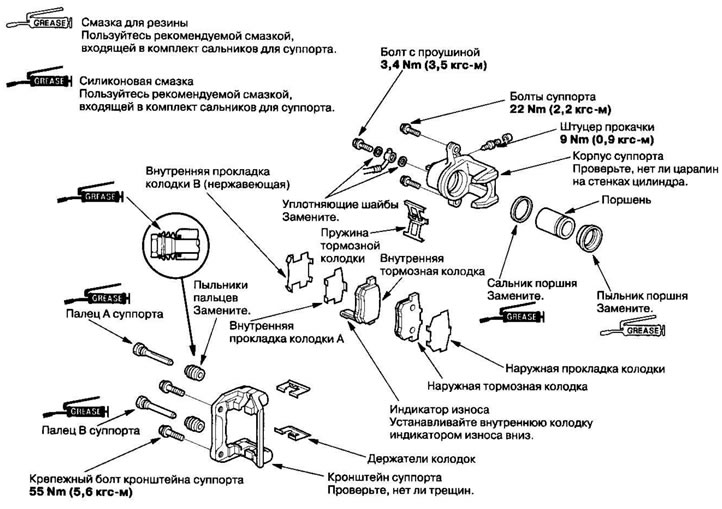
Carry out removal, disassembly, inspection, assembly and installation of the caliper taking into account the following:
- Do not spill brake fluid on your car as it may damage the paintwork; if liquid does spill, wash it off immediately with water.
- Clean all components in brake fluid and dry in open air; blow out all channels with compressed air.
- Before assembly, make sure that the components are free of dust and other foreign particles.
- Replace parts with new ones if indicated by the illustration at the top of the next page. \
- Do not allow dirt or other foreign material to enter the brake fluid.
- Make sure there is no grease or oil on the brake discs or pads.
- When reusing brake pads, always install them in their original position to avoid loss of braking efficiency.
- Do not reuse drained brake fluid.
- Always use Genuine Honda DOT3 brake fluid. Using other fluids may cause corrosion and reduce the life of the brake system.
- Apply clean brake fluid to the piston, into the piston seal groove and to the piston cylinder walls.
- In case of disassembly, replace all rubber parts with new ones.
- After installing the brake caliper, check for leaks at the hose and tube joints or fittings, and check that the brake hoses are not interfering or kinked.