
Contents: Accord 1985 ⇊ Accord 1986 and Prelude 1986-89 ⇊ Accord 1987-89 ⇊ Air Conditioning Idle Speed Increase…⇊ Air Conditioning Idle Speed Increase…⇊
Accord 1985
The air conditioning idle control solenoid valve is initiated when the air conditioner is turned on. When the solenoid valve opens, vacuum is applied to hose #19 between the solenoid valve and the idle diaphragm. There should be at least 9 V between the black/yellow (+) and white/blue (-) terminals of the control box #2 harness.
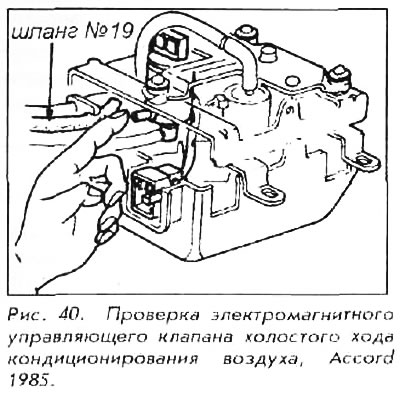
1. Disconnect the wiring harness from control box #2.
2. Disconnect vacuum hose No.19 from the air duct pipe.
3. Start the engine and check for vacuum (with your finger) at the solenoid valve inlet. There should be no vacuum.
4. Connect the positive battery terminal to the black/yellow terminal of the control box connector and the negative terminal to the white/blue terminal.
5. Start the engine and check for vacuum (with your finger) at the open end of the solenoid valve. There should be vacuum.
Accord 1986 and Prelude 1986-89
When current is applied to the solenoid valve, vacuum is directed from vacuum hose #12 to the air conditioning idle speed increase valve through vacuum hose #19.
There should be at least 9 V between the black/yellow terminal (+) and the red terminal (-) of the main control box wiring harness.
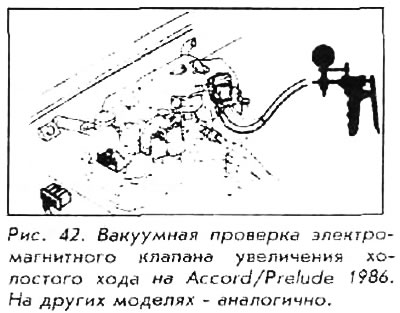
1. Open the control box cover and disconnect the six-pin connector from the box.
2. Disconnect the lower air conditioning idle speed increase solenoid valve vacuum hose from the check valve.
3. Apply vacuum to the hose. The vacuum should be stable. If there is no vacuum, check the check valve. If the check valve is OK, replace the solenoid valve.
4. Connect the positive battery terminal to the black/yellow terminal of the control box connector and the negative terminal to the red terminal.
5. Apply vacuum to the hose. The vacuum should not hold. If the vacuum holds, check the check valve. If the check valve is OK, replace the solenoid valve.
Accord 1987-89
1. Check the vacuum line for improper connections, kinks, blockages or disconnected hoses.
2. Start the engine at idle speed.
3. Disconnect the vacuum hose between the A/C idle speed increase valve and the air box from the valve and connect a pressure gauge to the valve. There should be no vacuum.
4. If there is a vacuum, disconnect vacuum hose #19 from the air conditioning idle speed increase valve and connect a pressure gauge to the hose.
5. If there is no vacuum, replace the A/C idle speed increase valve. If there is vacuum, GO TO AIR CONDITIONING IDLE SPEED INCREASE SOLENOID VALVE CHECK #2.
6. Turn on the air conditioner and fan, check the compressor and condenser cooling fan are on and running. The pressure gauge should show vacuum.
7. If there is no vacuum, disconnect vacuum hose #19 from the air conditioning idle speed increase valve and connect a pressure gauge to the hose.
8. If there is vacuum, replace the A/C idle speed increase valve. If there is no vacuum, go to AIR CONDITIONING IDLE SPEED INCREASE SOLENOID VALVE CHECK #1.
Air Conditioning Idle Speed Increase Solenoid Valve Test #1
Accord 1987-89
1. With the parking brake applied, start the engine at idle speed.
2. Disconnect vacuum hose #12 from the intake manifold and check for vacuum.
3. If there is no vacuum, check the vacuum pipe.
4. Disconnect the six-pin connector.
5. Connect the positive probe of the voltmeter to the black and yellow terminal and the negative probe to the red terminal.
6. Turn on the air conditioner and fan, then check the operation of the compressor and air conditioner fan.
7. If there is voltage, replace the solenoid valve.
8. If there is no voltage, connect the positive probe of the voltmeter to the black and yellow terminal and the negative probe to the ground wire. Check the voltage.
9. If there is no voltage, repair the open circuit in the black/yellow wire between the solenoid valve and fuse #1.
10. If there is voltage, check the red wire between the electromagnetic valve and the on-board computer for a break. If the wire is OK, check the on-board computer.
Air Conditioning Idle Speed Increase Solenoid Valve Test #2
Accord 1987-89
1. Start the engine.
2. Disconnect the six-pin connector.
3. Connect the positive probe of the voltmeter to the black and yellow terminal and the negative probe to the red terminal.
4. If there is voltage, check the red wire between the electromagnetic valve and the on-board computer for a short circuit. If the wire is OK, check the computer.
5. If there is no voltage, replace the solenoid valve.