
Contents: So, question one: how important is…⇊ Question two: how to check if the…⇊ Question three: what should a car…⇊ Some tips for a driver who gets…⇊
We always strive to arrange our workplace. So that everything is at hand, there is good lighting and, importantly, a comfortable chair. And what if the workplace is a car and you have to spend most of your time in it? How is the problem solved in this case: are we comfortable sitting in our cars and what should our seat be like?
So, question one: how important is correct planting?
Early models of domestic cars were equipped with seats that completely ignored the fact that humans belong to the class of vertebrates. Meanwhile, a car seat is, in essence, a workplace: every driver, even a non-professional, spends a tenth of his life in it. The spine experiences the greatest stress in a sitting position. The weight of literally the entire body falls on the lumbar region (even, as strange as it may seem, those parts below the waist). It is no coincidence that, for example, after a spinal injury, the patient is allowed to stand and lie down, but is prohibited from sitting.
The spine has a number of physiological curves: forward cervical bend (cervical lordosis), chest hump back (thoracic kyphosis), lumbar lordosis and sacral kyphosis. From the side, the spine resembles the Latin letter S or, more precisely, the dollar sign - $. The vertical line here shows the gravity vector, and it is at the intersection of this vector that the critical nodes bearing the maximum load are located.
Since the spine has physiological curves, the seat should "indulge" these curves. The back of the chair at the level of the shoulder blades should be as if sunken. The lumbar region, on the contrary, needs to be supported with a pillow. It is desirable if it also encircles the body, providing support to its lateral surfaces and preventing movement during turns.
Question two: how to check if the fit is correct?
When you sit in a chair, every part of your body should fit into a case. Head (or neck) - on the cervical cushion, back - in the dorsal cavity, lower back - on the lumbar pillow; the hips do not slide forward. The weight of the body should not fall on any one part of it. Naturally, when the car starts moving, you will not remain in this position, but will move forward a little. But on the highway, when you don't have to turn your head, you can allow yourself to lean back in your seat and, holding the steering wheel, rest a little.
Question three: what should a car seat be like?
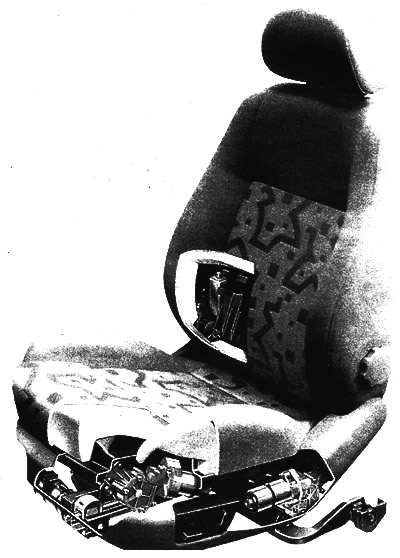
A good car seat should have an adjustable lumbar cushion, adjustable backrest curvature and, of course, a headrest under the neck. The latter serves to prevent whiplash injury (when the car is hit from behind) and to maintain cervical lordosis; even if the car doesn't have a headrest, you need to buy and install it. Pay attention to the side bolsters on the backrest and cushion, which provide lateral support, as well as the front bolster, which prevents the driver from "sliding down".
I would like to say separately about the seat cushion on which we sit. It definitely has to be tough. This is what German cars are famous for: the seat underneath you feels like wood, but it's comfortable to sit in. There is even an expression - "a hard seat in German style". American cars, on the contrary, are equipped with excessively soft seat cushions; in addition, the front seats in them are often made in the form of a single "bench", which does not provide sufficient support for the body. Sometimes the part of the pillow that is under the hips has height adjustment, and the part that is closer to the knees has length adjustment. When "adjusting for yourself" in all these adjustments, you should, of course, be guided by the criterion of convenience. In a good car, in addition to seat adjustment, there is also steering wheel adjustment. People are all different heights; high will make the seat lower (so as not to bang your head on the ceiling), and a short person or a woman - taller. And if the seat can be raised and lowered, then the steering wheel also needs to be adjusted up and down.
Some tips for a driver who gets tired at his workplace
Any driver, especially behind the wheel of a "shaky" car, should rest at least once every two hours - stop, get out of the car, do some exercises. It would also be good to hang from a roadside tree by your hands, or - if the vehicle is a truck - from the side of the body. It is useful to wear a special "industrial belt" - a kind of semi-corset made of dense synthetic material with reinforcing inserts in the lumbar region. This belt relieves the back and protects against excessive stress on the vertebrae. Well, and most importantly, watch the landing. Even if you are used to sitting differently... try putting a pillow under your lower back - and you will definitely feel more comfortable.