Warning! See warnings at the beginning of the Section Relieving pressure in the fuel system.
The procedure is greatly simplified if the gas tank is emptied beforehand. Some tanks are equipped with a drain plug, while others require pumping out the fuel or using it up by the engine beforehand. NEVER suck out fuel with your mouth!
1. To relieve excess pressure, remove the fuel tank filler cap.
2. Release the pressure in the fuel system (see Section Relieving pressure in the fuel system).
3. Disconnect the negative cable from the battery.
Warning! If the car stereo system is equipped with a security code, make sure you have the correct combination to activate the audio system before disconnecting the battery!
4. If the vehicle is equipped with the appropriate equipment, unscrew the drain plug and drain the remaining fuel in the tank into a prepared container of suitable volume. If there is no drain plug, pump out the fuel using a special kit, which can be purchased at almost any car accessory store.
Warning! Never suck out gasoline with your mouth!
5. Disconnect the electrical wiring from the fuel flow sensor and the fuel pump (see Sections Checking the condition and replacing fuel lines and Removal and installation the fuel pump). Also disconnect the fuel hoses from the pump (see Section Checking the condition and replacing fuel lines).
6. Loosen the rear wheel nuts, jack up the rear of the car and place it on supports. Remove the rear wheels.
7. Remove the catalytic converter (see Chapter Engine management).
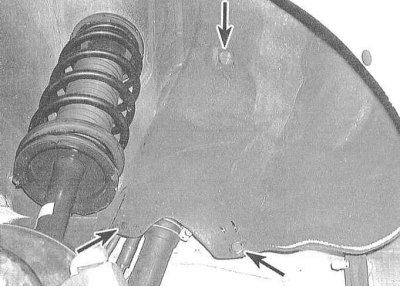
8. Unscrew the mounting bolts and separate the fuel pipe cover from the body.
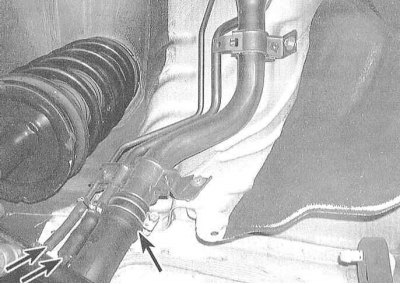
9. Label and disconnect the fuel supply and return hoses from their metal lines, also disconnect the rubber sections of the filler neck and vent lines from the tank.
10. If the vehicle is equipped accordingly, disconnect the electrical wiring from the ABS wheel sensors.
11. Remove the anti-roll bar (see Chapter Suspension and steering), parking brake drive cable bracket (see Chapter Brake system) and a heat shield for the rear suspension.
12. Remove the rear wheel brakes (see Chapter Brake system):
- a) On models with rear disc brakes, disconnect the parking brake cables, unscrew the mounting bolts, remove the brake calipers and tie them with wire to the suspension elements - make sure that the brake lines are not twisted or otherwise deformed;
- b) On models with rear drum brakes, remove the drums and brake shoes. You will also need to disconnect the brake lines from the wheel cylinders at the rear of the brake shields. Disconnect the parking brake cables from the shields (see Chapter Brake system), unbolt the shields from the hub assemblies.
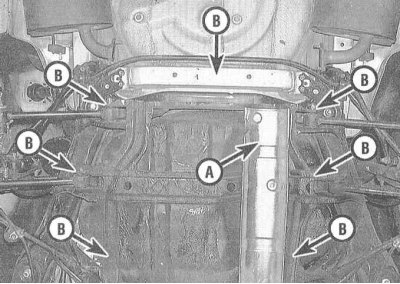
13. Remove the bolt from the lower end of each shock absorber (see Chapter Suspension and steering). Place a trolley jack under the rear suspension subframe and remove the subframe mounting bolts - there are four mounting bolts on 4-cylinder models and twelve on V6 models. Lower the subframe.
14. Support the fuel tank with a floor jack - to distribute the load, place a strong wooden block between the jack head and the bottom of the tank.
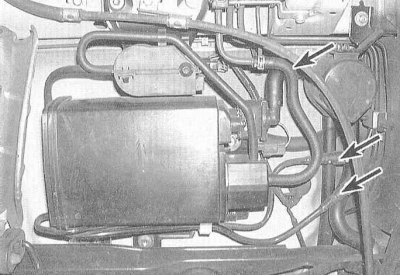
15. The models in question are equipped with an ORVR ventilation system that operates in conjunction with the evaporative emission control system (EVAP). Loosen the clamps and disconnect the corresponding lines from the tank and its filler neck. Disconnect the hoses from the EVAP system charcoal canister.
16. Remove the heat shield.
17. Disconnect both mounting brackets and lower them down, providing enough space to remove the fuel tank.
18. Remove the tank from under the vehicle.
19. Installation is carried out in reverse order.