


Contents: Examination ⇊ Replacement ⇊
Caution! The negative cable should always be disconnected from the battery first and connected last!
Examination
1. Disconnect both wires from the battery.
Caution! The negative cable should always be disconnected first and reconnected last. If the car stereo system is equipped with a security code, make sure you have the correct combination to activate the system before disconnecting the battery!
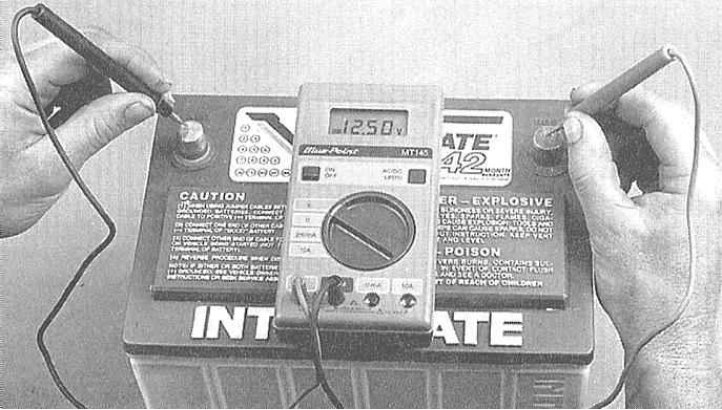
2. Check the electrolyte level in the battery (applies only to batteries requiring maintenance and equipped with removable caps) - the electrolyte must completely cover the lamellas, otherwise the appropriate amount of distilled water must be added to the jars. DO NOT OVERFILL - excess electrolyte will start to spill over the edges of the necks if the battery is overcharged! Use a hydrometer (ask in car accessory stores) to measure the specific gravity of the electrolyte. Remove the caps from the filler necks and use a hydrometer to take a sample of the electrolyte from each of the battery jars in turn. Following the manufacturer's instructions, determine the specific gravity of the electrolyte from the position of the measuring float of the device. At a normal charge level, the specific gravity of the electrolyte should be 1.270 units (green zone of the measuring scale). If the density of the electrolyte is excessively low (red zone of the scale), the battery should be charged (see Chapter Settings and ongoing maintenance). Maintenance-free batteries are usually equipped with a special color indicator. When the spot in the indicator's viewing window turns black, the battery should be charged immediately. After checking the electrolyte density, the battery's output voltage should be measured using a digital voltmeter.
Note. Before connecting the voltmeter, remove the surface charge from the battery - turn on the high beam for about 10 seconds, then turn off all on-board power consumers and wait about two minutes. With the engine off and power consumers disconnected, connect the black probe of the voltmeter to the negative terminal of the battery. Connect the red probe to the positive terminal. The battery output voltage should be 11.5÷12.5 V or slightly higher.
The nominal value of the electrolyte density is determined depending on the ambient temperature (and is directly proportional to it) - use the temperature map supplied by the manufacturers with the battery.
If the results of the above tests are positive, there is no need to test the battery under load (see below).
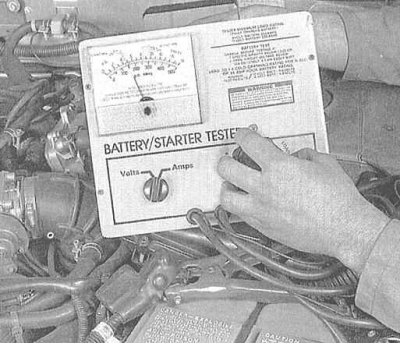
3. A more accurate check of the battery condition can be made using a universal meter (ask in car accessory stores). The device allows you to determine the battery's ability to turn the starter and supply power to on-board consumers of electrical energy under increased loads on the engine. Connect the meter to the battery terminals (see the accompanying illustration). Follow the device manufacturers' instructions - when the load is turned on for 15 seconds, the battery voltage should not fall below 9.6 V, otherwise the battery must be replaced.
Note: At ambient temperatures below 0°C, the minimum acceptable reading is reduced to 9.1 V.
Replacement
1. Disconnect both wires from the battery.
Caution! The negative cable should always be disconnected first and reconnected last. If the car stereo system is equipped with a security code, make sure you have the correct combination to activate the system before disconnecting the battery!
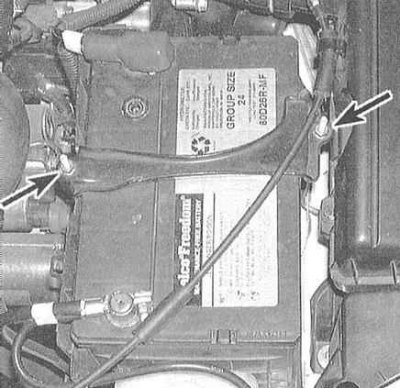
2. Release the fastener and remove the battery mounting clamp on the tray.
3. Remove the battery from the tray.
Note: Special brackets with handles are available. Using such brackets significantly simplifies the procedure of removing the battery from the engine compartment.
4. Carefully inspect the pan for signs of corrosion.
5. If necessary, loosen the fasteners and remove the pan from the engine compartment in order to remove corrosion products from it and carry out appropriate protective treatment of the metal (use zinc-based primers).
6. When replacing, make sure that the replacement battery meets the performance characteristics of your vehicle.
7. Installation is carried out in reverse order.
[Original article on the website «HondaBook»]