
Cars with manual transmission
These procedures are identical to those described in this Chapter is for the 1984-85 Accord.
Cars with automatic transmission
1. Place the vehicle in Park or Neutral, apply the parking brake, and lock the drive wheels. Start the engine and warm it up to normal operating temperature. The fan(s) should turn on at least once.
2. Disconnect the vacuum hose from the air inlet control diaphragm and clamp the end of the hose.
3. Connect the tachometer to the engine using the manufacturer's instructions.
4. Remove the air filter from the frequency solenoid valve "C" and plug the hole in the valve.
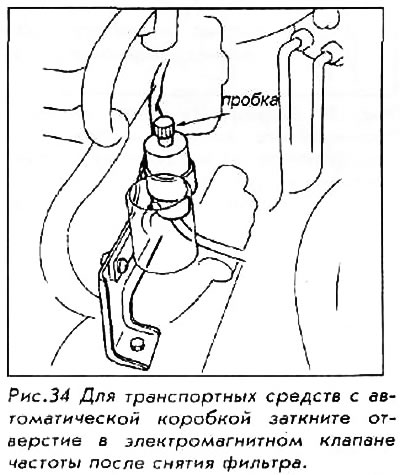
5. Without loading the engine, reduce the idle speed as much as possible by turning the throttle stop screw.
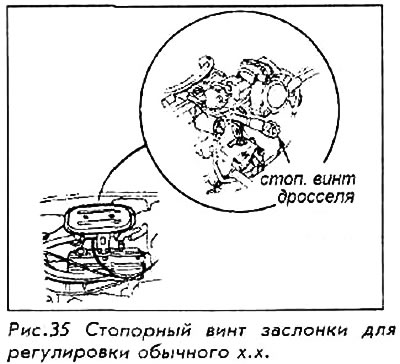
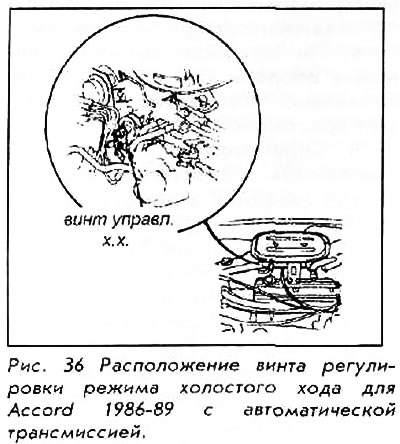
6. Adjust idle speed by turning the control screw to 600±50 rpm (630±50 on 1987-89 models).
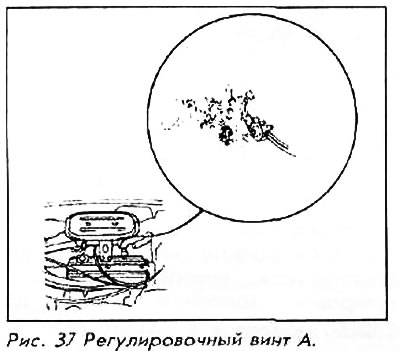
7. With the headlights on, rear defroster and heater blower at maximum, adjust idle speed by turning adjusting screw A. Idle speed should be 600±50 rpm on 1986 models and 700±50 rpm on 1987-89 models.
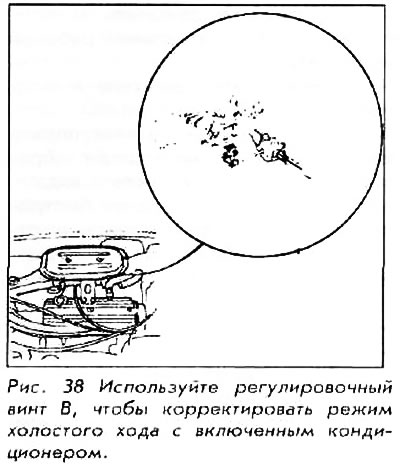
8. If the vehicle is equipped with air conditioning, adjust the idle speed by turning the adjusting screw B to 700±50 rpm with the air conditioning on.
9. Without loading the engine, disconnect the internal vacuum hose from the idle air control valve controller and plug it.
10. Adjust the idle speed by turning the idle speed adjustment screw to 700±50 rpm (650±50 rpm at high altitude).
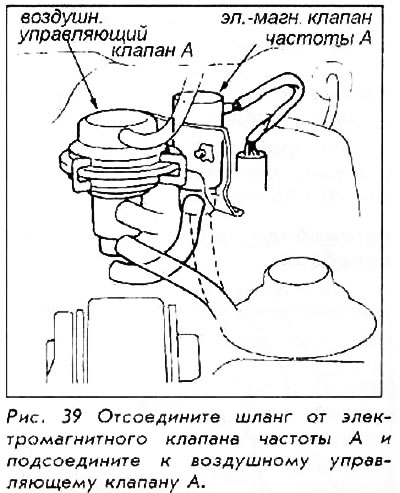
11. Disconnect the hose from the frequency solenoid valve A and connect it to the air control valve A.
12. Disconnect the air cleaner inlet pipe from the air duct on the radiator bulkhead.
13. Insert the hose from the propane kit into the inlet tube approximately 10 cm.
Propane is a highly flammable gas. Do not smoke or work near an open flame. Keep a dry powder fire extinguisher handy.
14. With the engine idling, press the button on top of the propane unit, then slowly open the propane control valve to obtain maximum engine speed. The engine speed should increase as propane is supplied.
15. Idle speed should increase to 135+35 rpm.
16. If the engine speed increase is within specification, remove the propane kit, all test equipment, and reconnect all disconnected vacuum hoses. Otherwise, continue testing with the following steps. Turn the ignition off.
17. Disconnect the quick idle release vacuum hose. Disconnect the throttle cable from the bracket.
18. Remove the carburetor nuts, washers, and bolts securing the steel vacuum manifold. Remove the carburetor from the stands, then tilt it back to gain access to the throttle adjuster hanger screws.
19. Remove the throttle adjuster hanger. Remove the mixture adjuster screw cap from the throttle adjuster hanger and then reinstall the hanger. The adjuster screw will now be accessible once the carburetor is in place.
20. Install the carburetor in place, connect the vacuum hose to the quick idle release. Install the air cleaner.
21. Start the engine and allow it to warm up to normal operating temperature.
22. Disconnect the vacuum hose from the air inlet control diaphragm and clamp the end. Reinstall the propane enrichment kit and recheck the enrichment max RPM.
23. If the speed is too low when enriched with propane, the fuel mixture is too rich. Turn the adjusting screw 1/4 turn clockwise and recheck.
24. If the speed is too high when enriched with propane, the fuel mixture is lean. Turn the adjusting screw 1/4 turn counterclockwise and recheck.
25. Close the propane control valve and recheck the idle speed. Make sure the engine runs at 2500 rpm for 10 seconds to stabilize idle conditions.
26. If the engine speed is within specification, remove the propane enrichment kit, all test equipment, and reconnect all vacuum hoses and the air cleaner inlet tube.
27. If the engine speed is not set to specification, recheck the engine speed and, if necessary, adjust by turning the idle speed adjustment screw, then repeat the adjustment steps.
28. Shut off the engine. Close the propane control valve, remove all hose plugs and reconnect all hoses.
29. Restart the engine and check the idle speed again.
30. Increase engine speed to 2500 rpm 23 times within 10 seconds, then check idle speed. Idle speed should be 700±50 rpm on 1986 models and 730±50 rpm on 1987-89 models.
31. Recheck the idle speed with the headlights, heater fan and rear window defroster on. The idle speed should be 700±50 rpm.
32. Recheck the idle speed with the automatic transmission lever in gear. The idle speed should be 700±50 rpm.
33. Recheck the idle speed with the air conditioner on and the gearshift lever in neutral or "PARK". The idle speed should be 750±50 rpm.
34. Recheck the idle speed with the air conditioner on and the transmission in gear. The idle speed should be 750±50 rpm.
35. If the idle speed does not reach the speeds specified in steps 30 through 33, inspect the idle speed control system.
(The text of the article is available on the website: HondaBook)