
WARNING: This procedure requires the use of an enriched propane kit. Do not begin this procedure if this kit is not available. Make sure the propane bottle is full before beginning.
The mixture can also be determined using an exhaust gas analyzer or emission tester, but this equipment is unlikely to be available at home. If this method is used, you must have access to the mixture adjustment screw(s).
1. Place the vehicle in PARK or neutral, apply the parking brake, and block the drive wheels. Start the engine and warm it up to normal temperature. The cooling fan(s) should run at least once.
2. Disconnect the vacuum hose from the air inlet control diaphragm and clamp the end of the hose.
3. Connect a suitable tachometer to the engine using the manufacturer's instructions.
4. Check the idle speed by turning off all unnecessary consumers. If necessary, adjust the idle speed by turning the throttle stop screw.
5. Disconnect the air cleaner inlet tube from the air duct on the radiator bulkhead.
6. Insert the hose from the propane kit into the inlet tube, approximately 10 cm.
Propane is a highly flammable gas. Do not smoke or work near an open flame. Keep a dry powder fire extinguisher handy.
7. With the engine idling, depress the button on top of the propane unit, then slowly open the control valve until the engine reaches full RPM. The engine RPM should increase as propane injection begins.
Open the control valve slowly; if you start it up too quickly, the engine may stall.
8. The engine idle speed should increase as follows:
- Accord 1984-85 with manual transmission - at 100±25 rpm;
- Accord 1984-85 with automatic transmission - at 50±20 rpm;
- 1986 Accord with manual transmission - 35±20 rpm;
- Accord 1987-89 with manual transmission - at 50±20 rpm.
9. If the RPM increases as specified, remove the propane, all test equipment, and reconnect any disconnected vacuum hoses. If the RPM does not increase as specified, proceed with the following steps: Turn the ignition off.
10. Disconnect the vacuum hose from the fast idle release. Pull the throttle cable out of the bracket.
11. Remove the carburetor nuts, washers and bolts securing the vacuum manifold. Lift the carburetor free from the frame, then tilt it back to gain access to the throttle adjuster bracket screws.
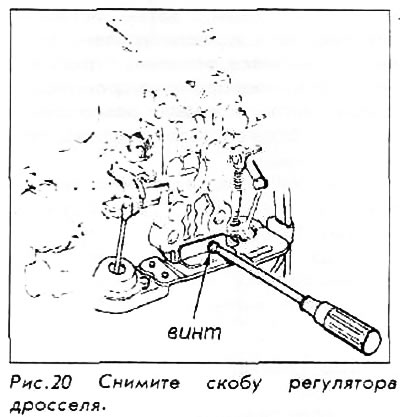
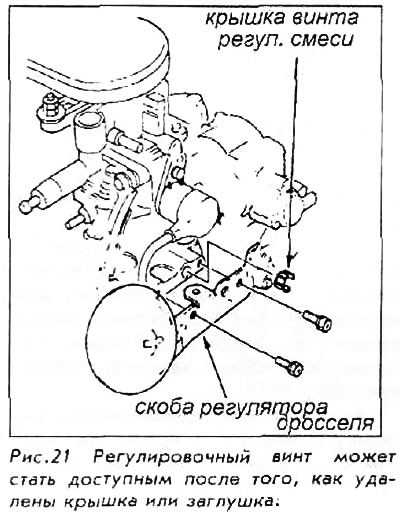
12. Remove the regulator bracket. Remove the mixture adjustment screw cap from the throttle regulator bracket and then reinstall the bracket.
13. Install the carburetor, connect the vacuum hose to the fast idle release. Install the air cleaner.
14. Start the engine and warm it up to normal temperature.
15. Remove the air inlet control diaphragm vacuum hose and clamp the end of the hose. Reinstall the rich propane kit and recheck the maximum RPM after supplying propane.
16. If the RPM is too low after enriching with propane, the fuel mixture is too rich. Turn the mixture adjustment screw 1/4 turn clockwise and repeat the check.
17. If the RPM is too high after enriching with propane, the fuel mixture is lean. Turn the mixture adjustment screw 1/4 turn counterclockwise and repeat the check.
18. Close the propane control valve and recheck the idle speed. Make sure the engine runs at 2500 rpm for 10 seconds to stabilize the idle speed.
19. After adjustment, remove the propane enrichment kit, all test equipment and reconnect all vacuum hoses and the air cleaner inlet tube.
20. If the RPM is not adjusted to specification, recheck it and adjust if necessary by turning the throttle stop screw, then repeat steps 14-19.
21.Adjust idle speed, if necessary, by turning the idle speed control screw.
22. If the vehicle is equipped with air conditioning, perform a second check with the air conditioning on. If necessary, adjust the speed by turning the adjusting screw on the idle air diaphragm.